People have always preferred stories over statistics.
But I do find it interesting that, in a world awash in data and information, narratives still seem to shape how people feel about the economy.
I understand why this is the case. Your personal economy has a far greater bearing on your feelings and financial well-being than government data and aggregate averages.
The one narrative that seems to make the most sense right now is that it’s impossible for young people to buy a house.
How could they?
Nationwide home prices are up almost 60% in the 2020s alone:
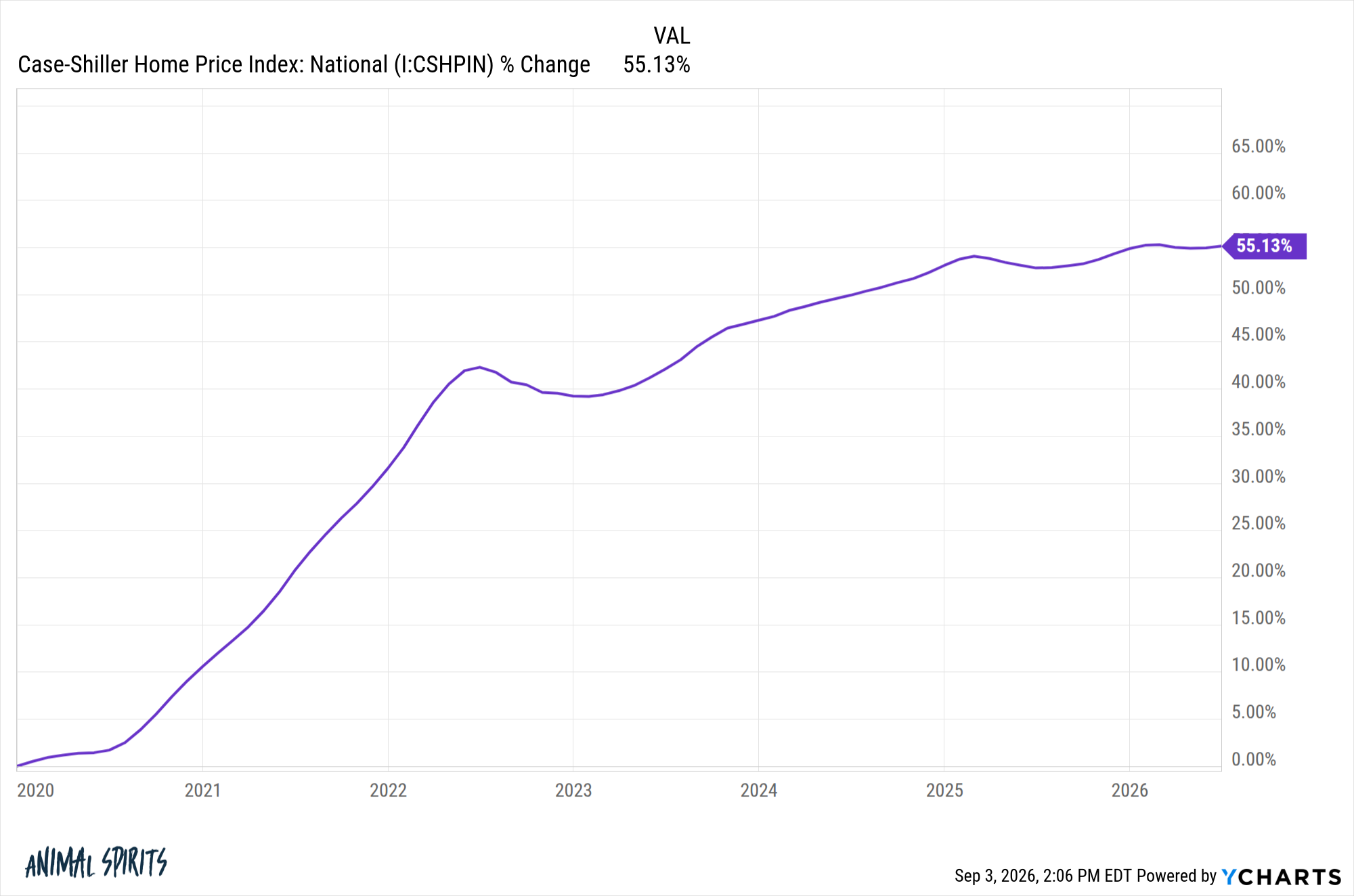
Much of that gain happened in the span of 2-3 years.
Mortgage rates went from well under 3% to 6% in the blink of an eye:
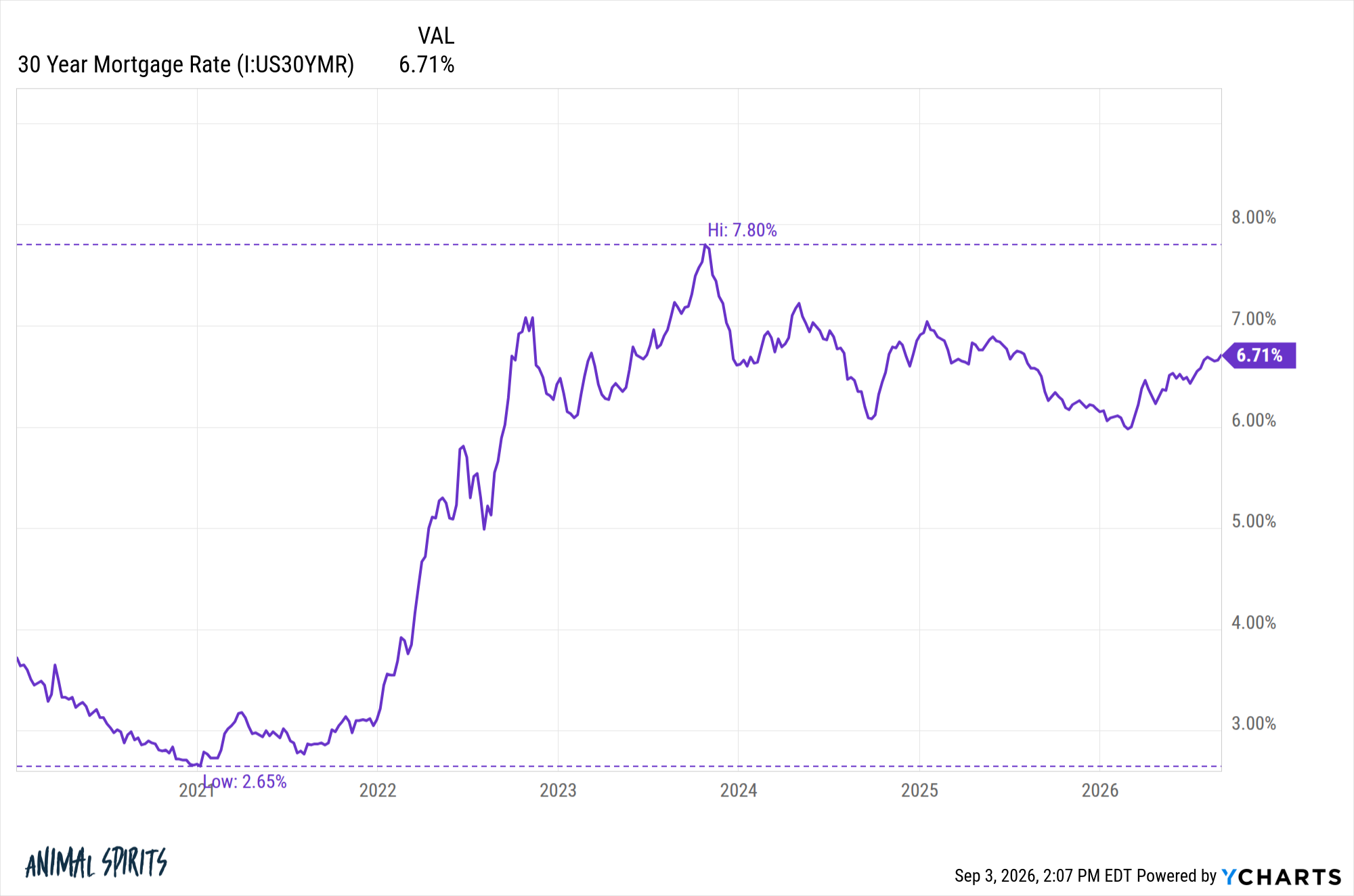
They’re still rising.
The cost of a down payment is much higher. The average monthly payment feels impossible. Insurance costs are up. It’s more costly to build a new home. Everything is more expensive.
How could young people possibly afford a home in this environment short of a monetary gift from their parents?
But is this narrative true? Are young people really not buying houses anymore because of affordability problems?
It’s not as bad as social media would have you believe.
Redfin has some good data on homeownership rates by generation over time:
Take 28-year-olds as an example: 38.3% of 28-year-old Gen Zers owned their home in 2025, compared to 42.5% of Gen Xers when they were 28 and 44.4% of baby boomers when they were 28.
Moving on to a millennial example, 57.2% of 36-year-olds owned their home in 2025, compared to 61.2% of Gen Xers and 63.7% of baby boomers when they were 36.
It’s certainly a lower homeownership rate but not nearly as bad as some people make it out to be.
Here’s a chart that visualizes it for you:
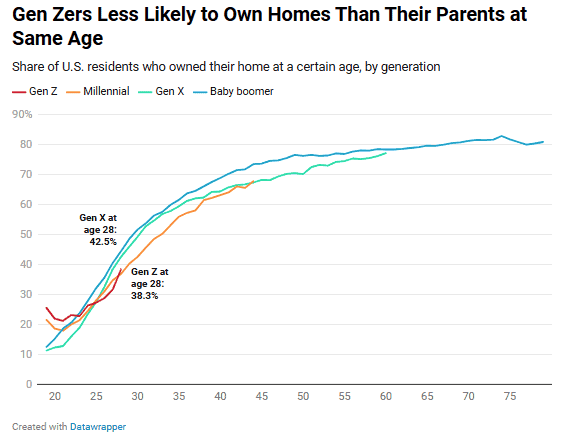
Gen Z is actually doing better off than millennials at the same age in terms of home ownership rates.
Now there are some caveats with this data. Homeownership rates only count people who live on their own, not people who are still in school or living in at home with their parents.
The Minneapolis Fed did some research to make an adjustment to the standard way the homeownership rate is calculated. They looked at the homeowners-to-population ratio by age:
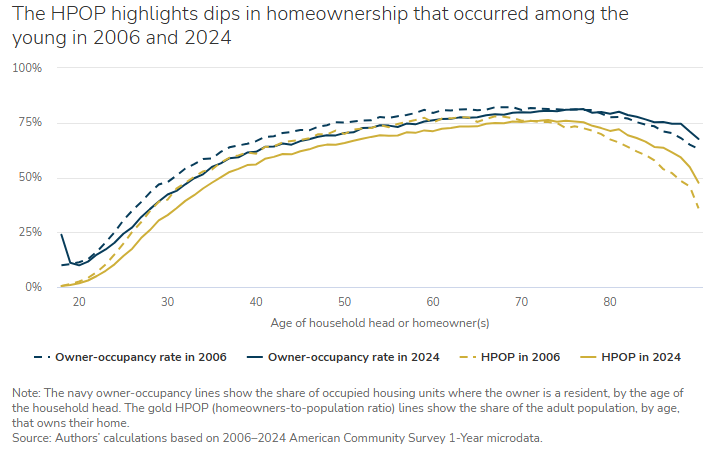
You can see the HPOP (yellow line) is lower than the homeownership rate (navy line) so making this adjustment brings it down some. But there is a difference at every age on the chart, not just young people.
To be fair, there is a slightly wider gap among the younger ages but that’s not just unemployed youngsters living in their parent’s basement. There are more young people then ever attending college and putting off adulting longer than previous generations.
Gen Z got dealt a bad hand when it comes to housing price inflation through no fault of their own. But I have faith they will figure it out.
The oldest member of the Gen Z generation is only 29. They have a lot of time to make things happen. Younger people are more financially savvy than any generation that came before them.
They are investing in stocks, saving for retirement and making more money than millennials, Gen X or baby boomers at the same age.
Most of them will end up buying a house…eventually. Just like millennials did.
I wrote the following back in 2014 when everyone was saying millennials would never buy a home:
Nearly every one of my friends from the Millennial generation put off getting married or buying a house for 5-10 years after college. Many moved to a big city or continued their education and got a graduate degree. They had fun for a few years before settling down. When that time came they all moved to the suburbs or another city with more affordable housing. Many of us are simply growing up a little later in the life cycle.
I have faith this will happen as Millennials continue to mature. It’s not if but when. It’s just going to be 5-10 years later than previous generations.
It’s easier to find like-minded people in the pessimism camp these days, but things will get better. Innovation in the coming years and decades is going to take many by surprise and the Millennials are usually the first adopters because we came up during a period of exponential technological growth.
Millennials are going to figure it out and start spending money…eventually.
It might take a few years for housing to become more affordable. Eventually mortgage rates will fall. The baby boomer generation will start dying off or selling their homes. It’s going to be much easier to buy a home in the 2030s than it is today.
Conor Sen at The Housing Frame wrote a great piece on generational home ownership trends. I like his conclusion:
The biggest risk to this view is the same risk facing all Americans over the next several years – a significant economic downturn that leads to a surge in unemployment, the kind of outcome that could happen if there’s an artificial intelligence bust. Otherwise, affordability for Gen Z will get better as they age and the supply picture improves, even if that takes a few years longer than they’d like. But in all likelihood, when people in 2040 are looking back on this period, they’ll wonder why anyone thought a generation with jobs, savings, and demographic trends on its side would never own homes.
I agree.
It might be rough for the rest of this decade but Gen Z will take that next step when the economic environment changes.
Michael and I talked about Gen Z homeownership trends and much more on this week’s Animal Spirits video:
Subscribe to The Compound so you never miss an episode.
Further Reading:
On the Inevitability of an AI Bubble
Now here’s what I’ve been reading lately:
- Do you need rich parents to get ahead? (Your Brain on Money)
- The worst job advice for graduates (Freedom Day)
- Fast time vs. slow time (History Helps)
- The high cost of being an adult (Abnormal Returns)
- Retirement is harder than it sounds (Morningstar)
- 11 other forms of currency (The Root of All)
- Why Dolly Parton never became a billionaire (Observer)
Books:
- Stories I Only Tell My Friends by Rob Lowe
- Strangers by Belle Burden
- Everybody Knows by Jordan Harper
Podcast book tour: