A reader asks:
I’ve never bought into the idea that AI is a bubble because the technology clearly has real-world value. But with companies like Uber and Amazon publicly stating their massive spend has garnered uncertain returns, more businesses like All Birds pivoting to AI, and celebrities like Tristan Thompson promoting AI-related investments, I’m starting to see some dot-com-era parallels. Could AI ultimately prove transformative and profitable, yet still experience a bubble because of excessive spending, hype, and unrealistic expectations?
I asked this question three years ago in a piece titled Is an AI Stock Market Bubble Inevitable?:
If it makes us even 50% as productive and efficient as some proponents are predicting, it seems inevitable this will lead to a bubble.
We cannot help ourselves when it comes to new and exciting technologies.
The creation of fiat currencies and new types of equity investments led to the South Sea bubble in the 1700s.
The introduction of trains led to the railway mania of the 1800s.
The explosion of new consumer and investment products led to the Roaring 20s.
The advent of the internet led to the dot-com bubble of the 1990s.
Each of these innovations ended up changing the world in many ways. But the speculation that occurred in the early stages of those innovations led to huge booms and painful busts to get there.
There are no guarantees when it comes to the financial markets but human nature is the one constant across all market environments.
Nvidia’s market cap was $755 billion the week I wrote that. How quaint.
It’s now more than $5 trillion.
There are now 11 trillion-dollar companies since Micron joined the club in recent weeks:
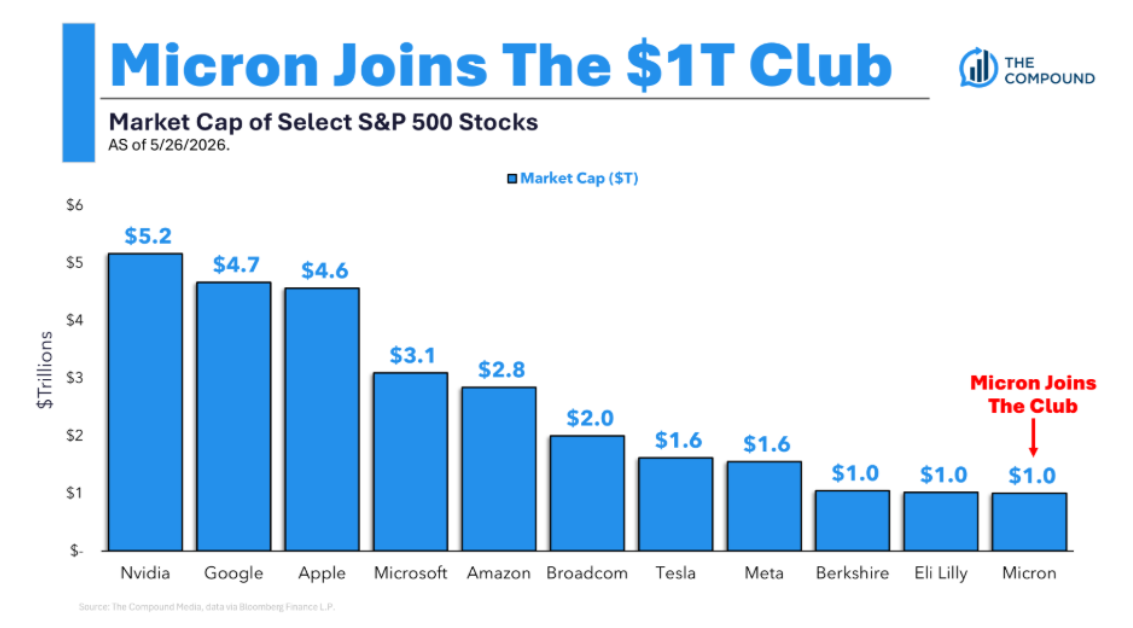
The semiconductors like Micron, Sandisk, Samsung, SK Hynix, etc. are exploding higher from the AI buildout. The money is pouring into these stocks.
Roundhill has a new thematic ETF that focuses on this segment and the growth is off the charts:
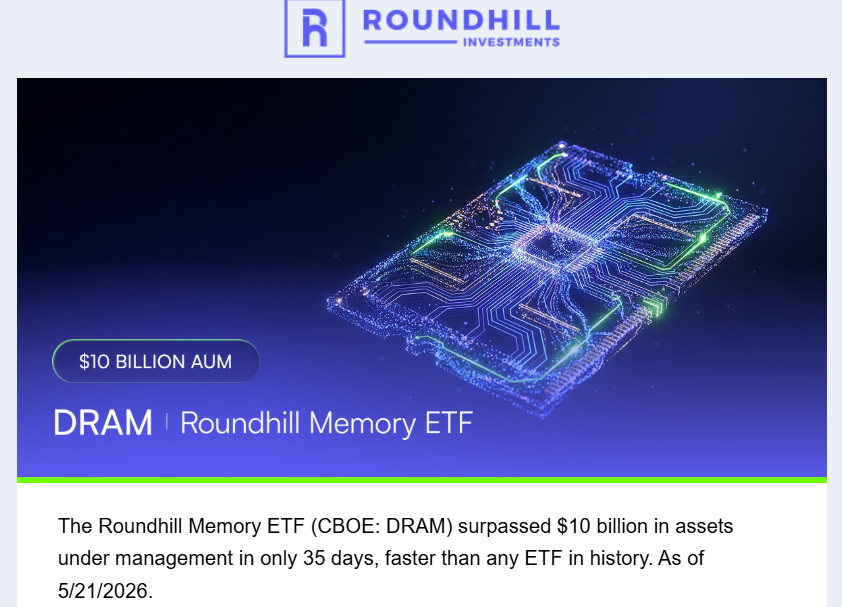
Just 35 days to reach $10 billion!
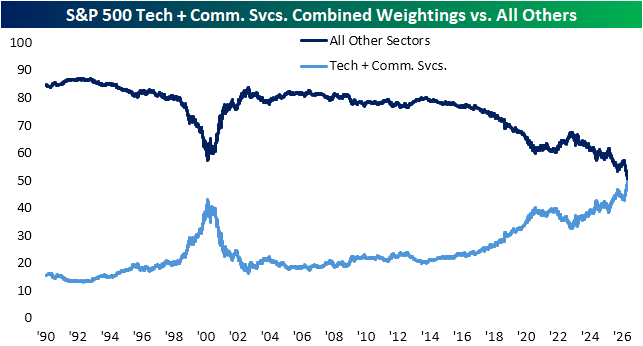
According to Bespoke Investment Research, the technology and communication services1 sectors now make up half of the S&P 500, matching the weighting of all the other 9 sectors combined:
It sure feels like AI checks all of the boxes.
It’s a capex binge. It’s a big innovation. The returns are off the charts. There’s concentration. Money is flooding in.
If it walks like a duck…
I suppose the bubble talk in tech is getting a little old at this point. It feels like we’ve been debating this for ten years now. AI has just added fuel to the fire.
There’s the old saying that those who fail to study history are doomed to repeat it. You could also make the case that those who live and die by the past are doomed to be overconfident in their forecasts about the future.
A study of market history shows that there are often surprising outcomes. I’m keeping an open mind about how this will all play out.
Cliff Asness once said, “The term bubble should indicate a price that no reasonable future outcome can justify.”
There seems to be a reasonable future outcome this AI boom could justify. Just look how fast revenues are growing for Anthropic and OpenAI:
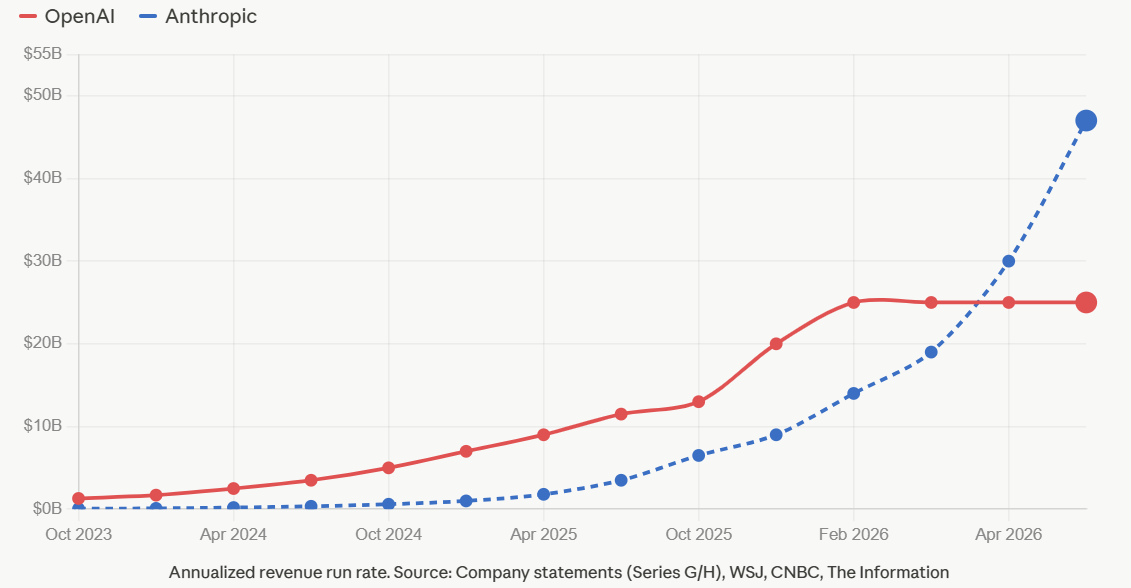
Anthropic has gone from an annual revenue run rate of $9 billion just a year ago to $47 billion and counting. The growth is unreal.
Micron is up an insane 1,000% in the past 12 months. Now look at the earnings expectations:
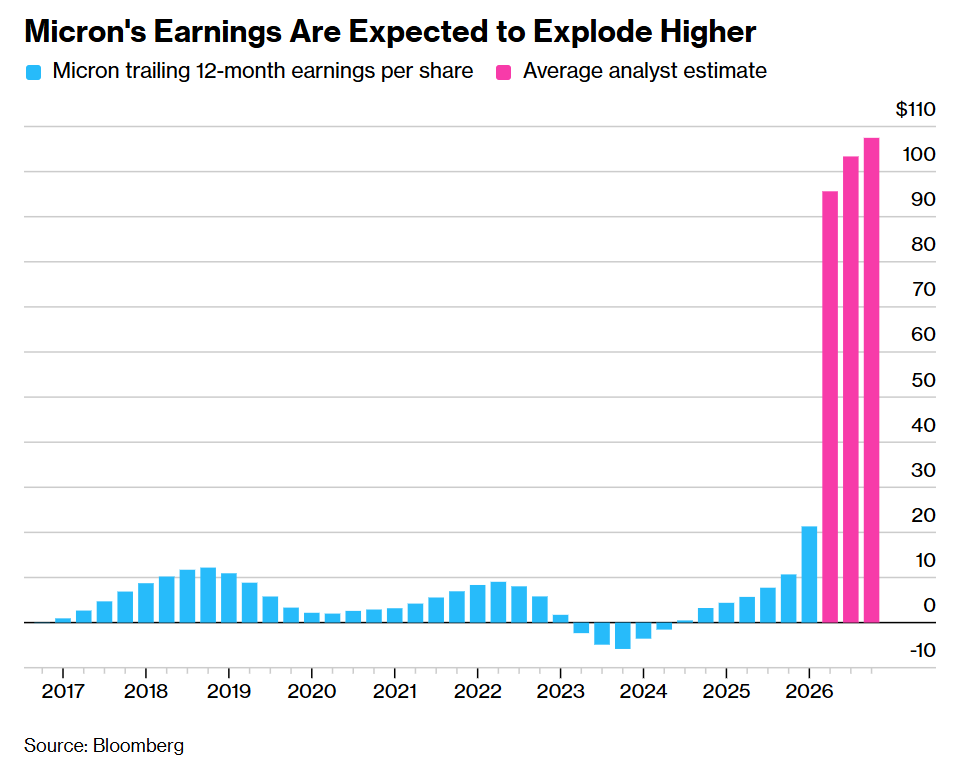
This doesn’t look real.
The S&P 500 has seen an enormous jump in earnings expectations too:
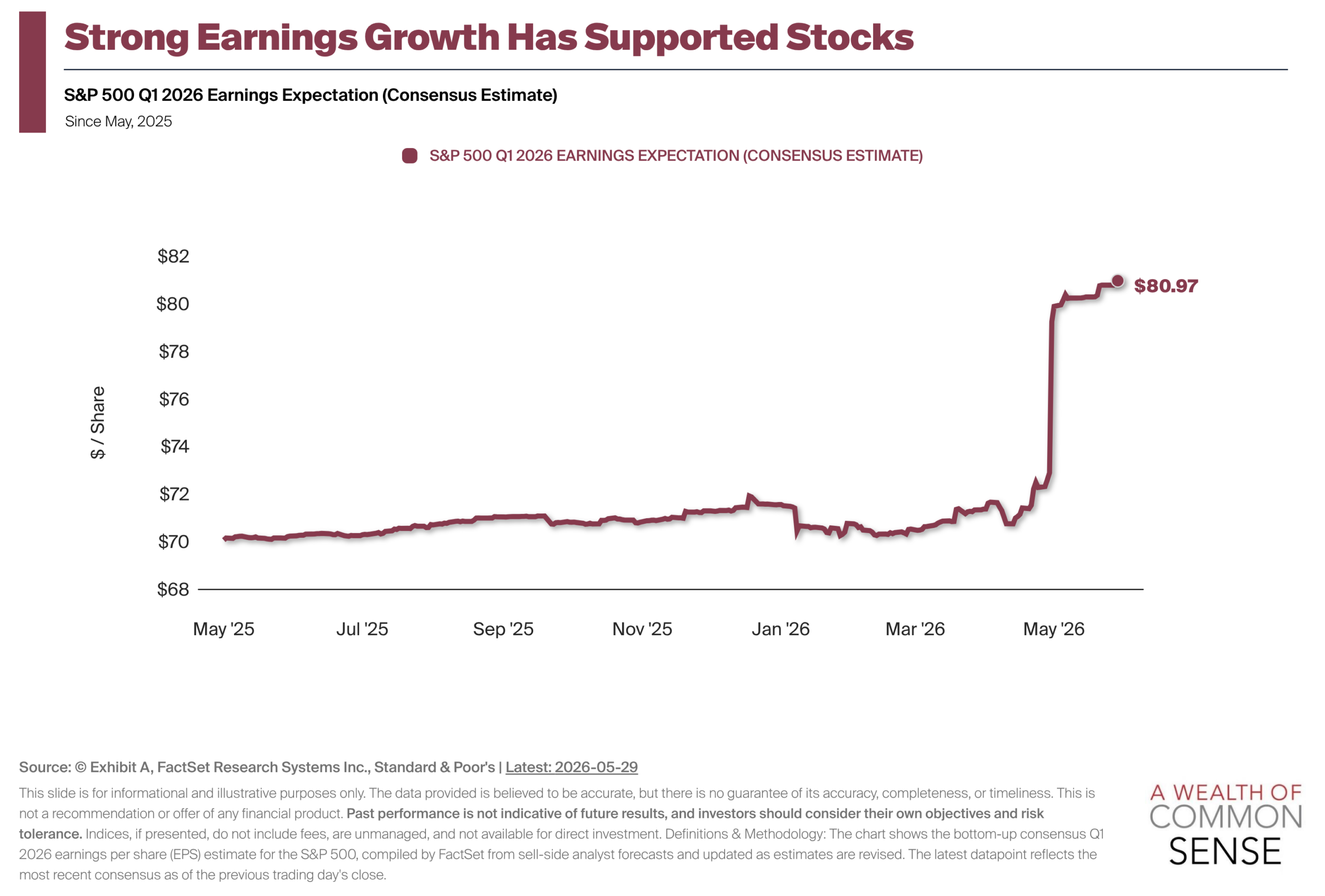
Maybe these earnings are just a byproduct of hyperscaler spending.
Maybe it’s all illusory.
Maybe this really is a bubble that’s destined to pop.
But you also have to consider the possibility that AI will be adopted at a rate that’s fast enough to keep the market gods at bay.
Neither outcome would surprise me.
People have been trying to predict a new bubble every year since the Great Financial Crisis. A lot of people are sure this is finally it.
Some humility is warranted in times like these.
I answered this question on an all new episode of Ask the Compound:
I also covered questions about the SpaceX IPO, investing in bonds during retirement, AI’s impact on the labor market, supporting your in-laws who didn’t save enough for retirement and balancing all of your financial goals in retirement.
Further Reading:
Is This a Bubble?
1Communication services is basically tech. The biggest holdings are Google and Meta.