A reader asks:
Ben has done a good job putting stock market concentration into context for me over the years. I’ve held onto my index funds despite the top 10 holdings becoming a much larger piece of the pie every year. I would be lying though if I said I’m not worried about AI being the ONE BIG TRADE. I’m not a fan of timing the market and going to cash (even with t-bills yielding 4%) so what’s the best way to hedge the concentrated AI trade? How can I diversify but still take risk?
People have been worried about stock market concentration for the better part of a decade.
I first wrote about it back in 2018.
But concentration in the S&P 500 has accelerated this decade.
Michael created this chart that shows the relative market cap of the 5 biggest stocks versus the rest of the index over time:
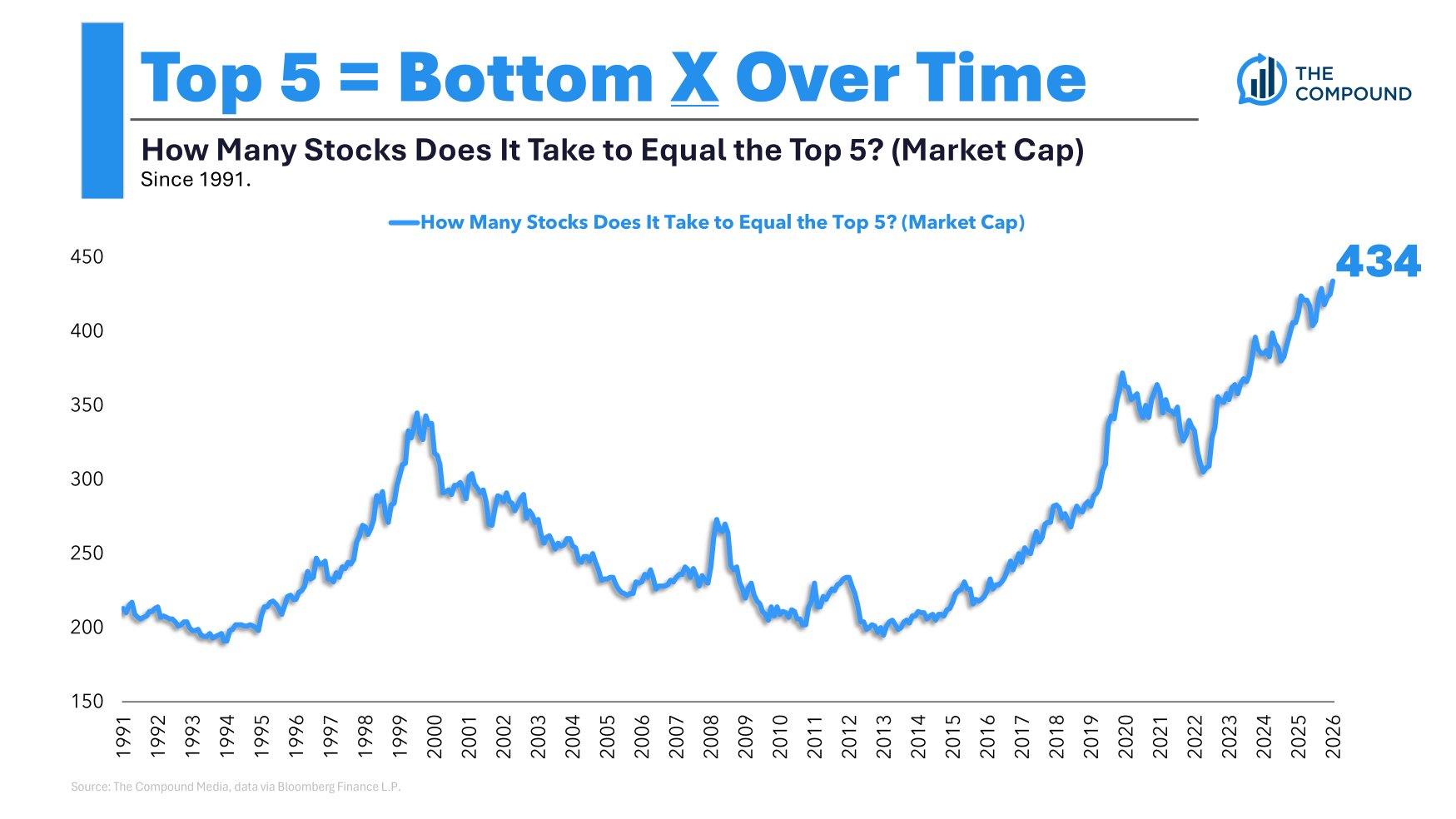
Ten years ago the 5 biggest names were worth as much as the bottom 225 stocks. Today the top 5 is worth the same as the bottom 434 stocks. The mega caps just keep getting bigger.
You can see how the share of the top 10 stocks has changed in the past 50 years or so:
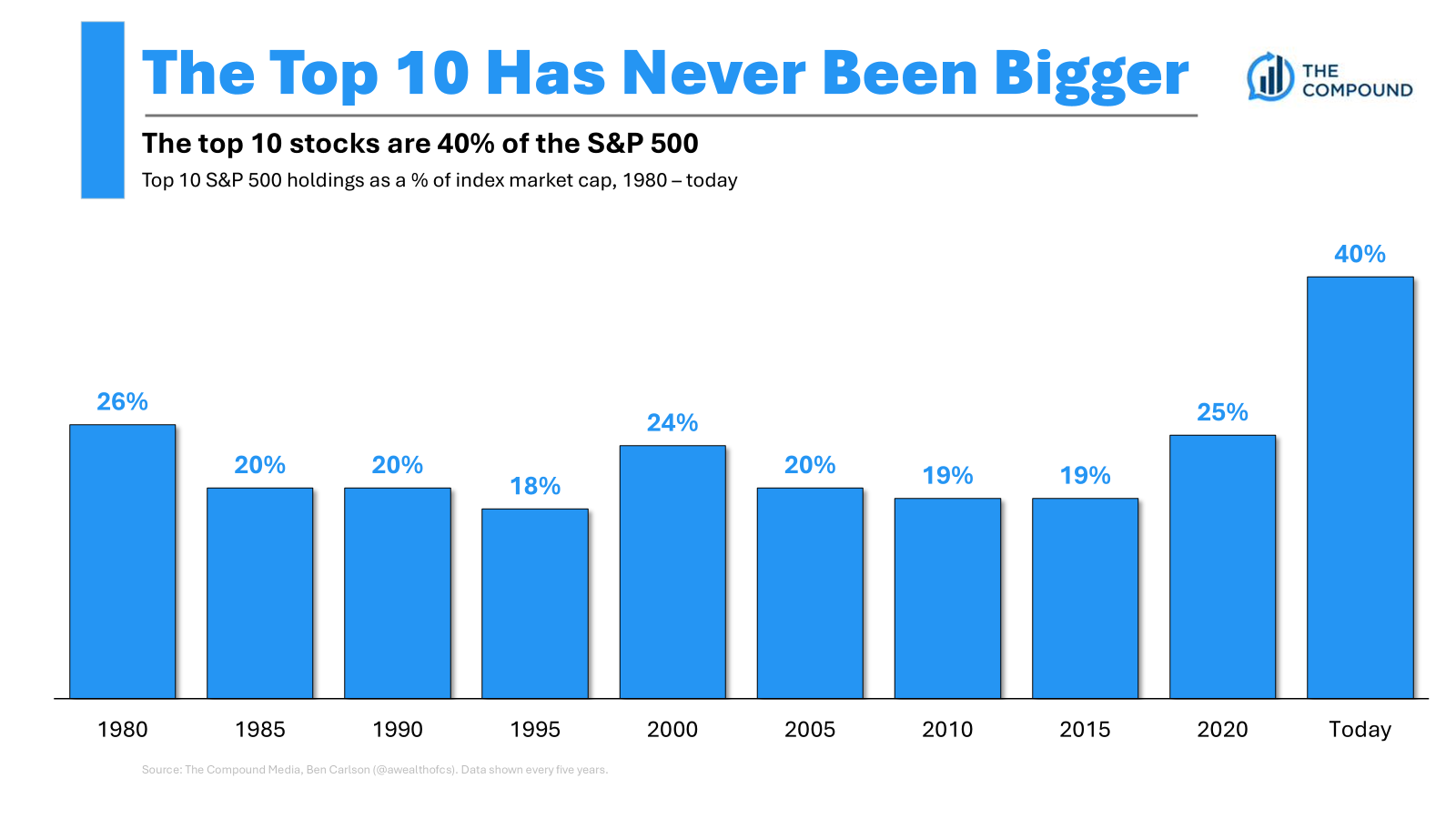
The top 10 stocks have made up somewhere in the range of 20-25% of the index since 1980. Now it’s 40%. That’s a massive jump in the 2020s.
You basically have to go back to the 1950s and 1960s for this level of concentration.
While it is true that other country stock markets are even more concentrated than the United States, those other countries don’t make up two-thirds of the global equity market capitalization.
The 10 biggest stocks in the S&P 500 are currently worth more than $28 trillion. Every single stock in the top 10 now sports a market cap with four commas.
The hard part is that you could be worried about concentration while the biggest companies just keep getting bigger. The government doesn’t show any interest in breaking up these companies. Why would they? Consumers love using their products.
It’s certainly possible that all of this AI capex will create a situation where the rich get richer and concentration is the new normal. It’s important to remember that the top 10 stocks account for 40% of market cap but 40% of profits as well.
It’s also possible we have a nasty bear market that levels the playing field.
You can see from Michael’s chart above that concentration fell sharply during the lost decade of the 2000s when the stock market crashed twice. Concentrated markets are a hallmark of bull markets. If the bull market ends, that could change things.
The good news for people who are worried about the one big AI trade is that it’s never been easier to diversify than it is today.
There are more fund options. The fees are lower. There are more tax efficient options.
I don’t know how this will all play out but allow me to take a stab at how things could look if and when the AI trade falls apart:
The S&P 500 would fall but the Nasdaq 100 would likely get hit even harder. The top 10 stocks in the Nasdaq 100 make up almost 50% of the total.
Bonds would finally earn their keep from a combination of high starting yields and falling interest rates. My guess is that rates would come down fairly quickly if all the AI capex spending slows. That’s good news for bonds and other interest rate sensitive strategies.
I also think foreign developed stock markets will do relatively well, especially places like Europe because those markets have a much smaller allocation to tech stocks. Plus basically all of the AI spending is coming from the U.S. The dollar would probably fall if they pull back on AI capex which would be great for foreign stocks from the perspective of a U.S. investor.
Most strategies that break from a market cap weighting will likely help you diversify as well.
Let’s look at some examples to see why this could be the case from a sector perspective.
This is the current sector breakdown for the Vanguard Europe ETF versus the S&P 500:
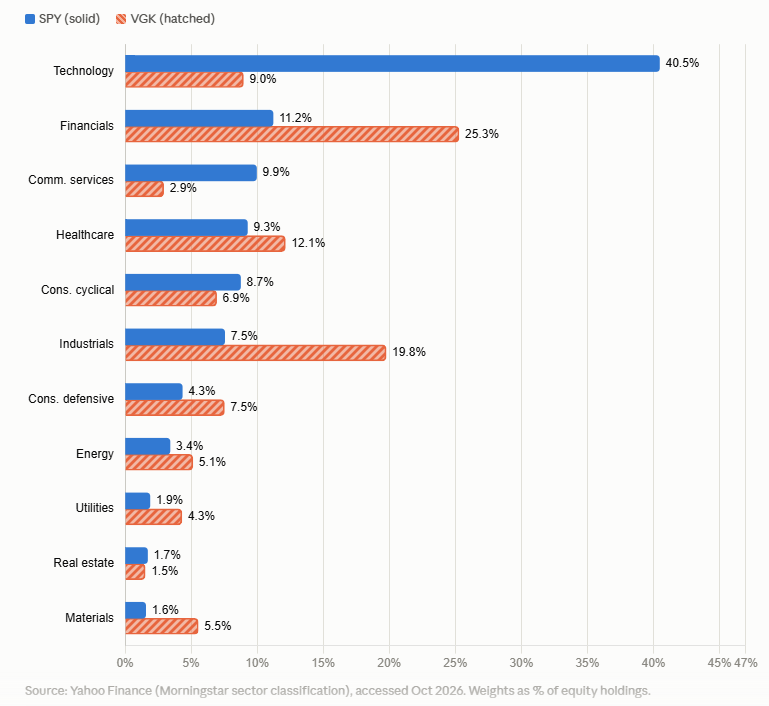
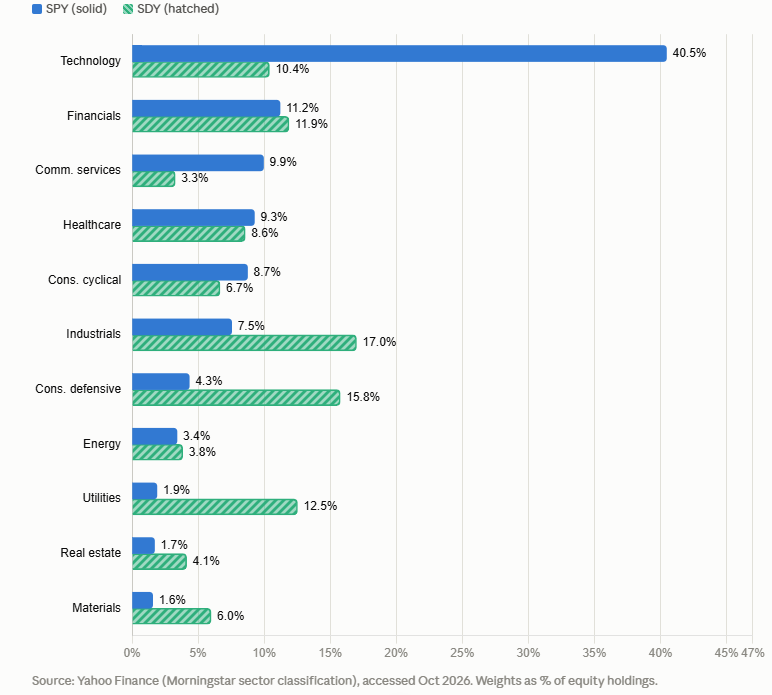
Now look at S&P 500 sector weightings versus the S&P Dividend ETF:
And the Vanguard Value ETF:
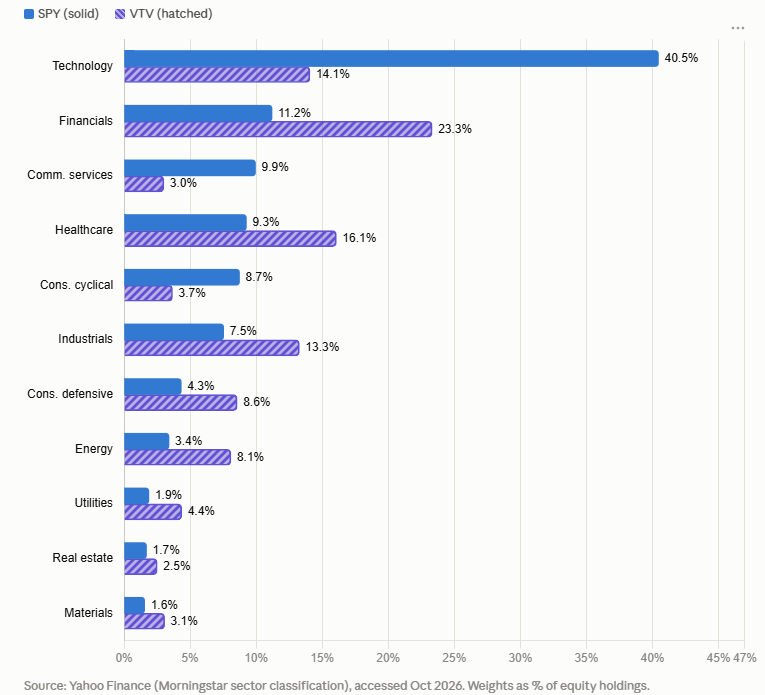
The one thing these funds all have in common is they’re more diversified by sector and have far less exposure to tech stocks.
Here’s a look at the top 10 stocks by weight in each of these funds:
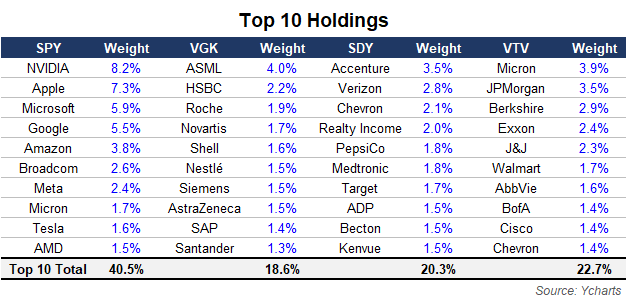
There is far less concentration in these other strategies.
I’m not saying you have to invest in these funds specifically. There are many different diversifiers that would probably work if AI goes belly up — dividend stocks, value stocks, quality stocks, low vol stocks, bonds, REITs, etc.
If the AI trade goes wrong and it leads to a stock market crash I’m not sure how more diversified, fundamentally-driven strategies would hold up. But I do think the last lost decade is probably instructive in terms of asset classes that were left behind coming back into vogue.
Diversification is the only rational solution for worries about stock market concentration.
Alternatively, you could just stay in index funds and continue letting the market pick the winners for you.
Another reader asks:
For over half the year the ‘impressive 493’ led the S&P higher while the Lag 7 underperformed. Everyone celebrated breadth. Now the Mag 7 has once again taken the lead and everyone is ringing alarm bells about concentration risk again. Doesn’t this market YTD show the value of owning the index rather than the problems of owning it?
This is a fair point too.
Look at the performance this year of the S&P 500 vs. the Mag 7 and the S&P 493 (which is ex-Mag 7):
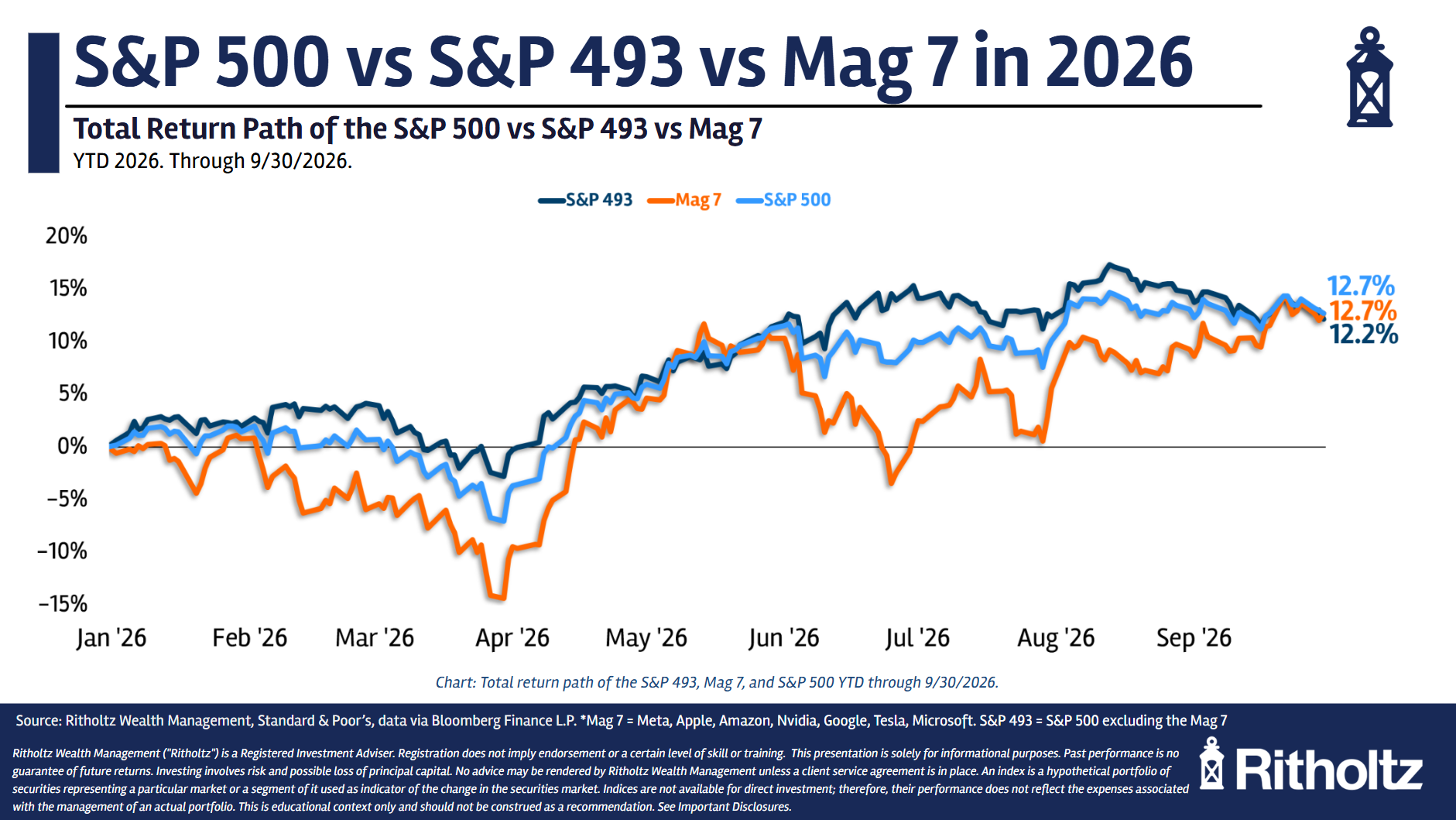
They all basically ended up in the same place through the end of September. You just had a much bumpier ride in the Mag 7.
If you’re worried about concentration risk the answer is to diversify your holdings. But completely moving away from the gigantic tech companies is also a big bet.
You could be right by going all in on AI stocks or you could be right to avoid AI stocks completely.
I don’t like the idea of going to either extreme because it opens you up to the possibility of big-time regret.
I discussed both of these questions on an all-new episode of Ask the Compound:
Bill Sweet joined us this week to chop it up with questions about Roth IRA conversions, how to buy bonds, asset location for Roth IRAs, the 10 year rule and how depreciation works for rental properties.
Further Reading:
The New Normal of Stock Market Concentration