A reader asks:
I know you guys are fielding many questions about bonds. Does it not always come down to time horizon? At any rate of yield, a long term investor is better off staying or adding to stocks? I get in the short term the yields are great, but if you’re invested for 10 years isn’t the opportunity cost of bonds worse? More bond buyers means fewer stock buyers, creating more opportunity for the long term investors? Or is a 5% gain (in bonds) important regardless of the timeline?
Another reader asks:
I’m starting to build out at what yield do I put all my 401k future contributions to bonds. My entire asset allocation is built on an assumed 6.5% return. What happens if I can just get that yield on fixed income?
One person wants to keep their entire portfolio in stocks. The other person wants to keep their entire portfolio in bonds.
This is what makes a market.
Time horizon is a huge component here but there are other considerations for both of these extreme takes.
It’s true that returns for stocks are much higher in the long run. Here’s some Ibbotson data on stocks versus bonds over the past 100 years or so:
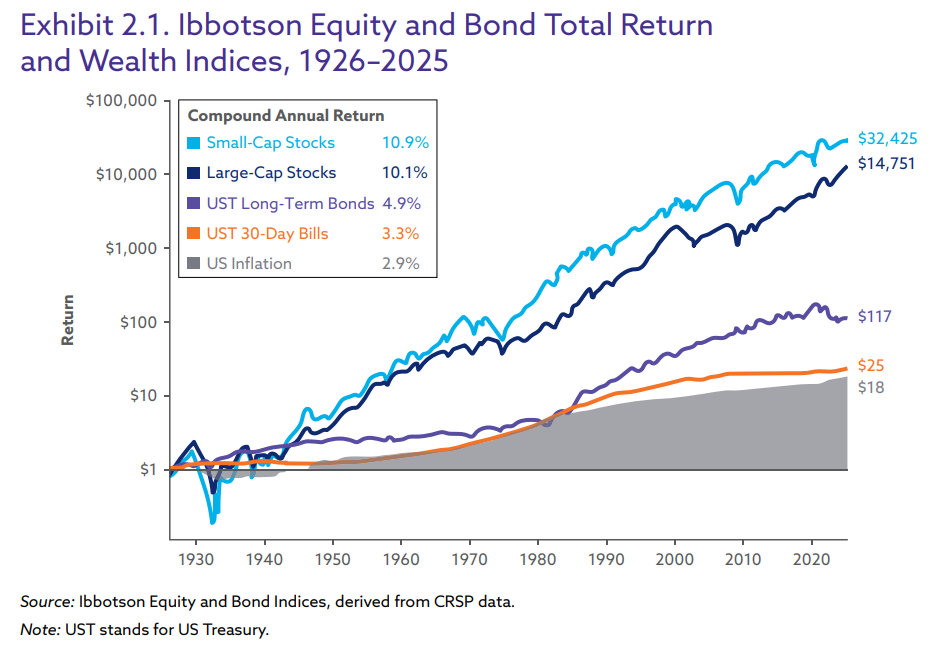
There is certainly an opportunity cost to keeping some of your portfolio in fixed income or cash in the long run.
The stock market doesn’t have a perfect track record against bonds over a 10 year time frame but the win rate is still pretty impressive.
I looked at the rolling 10 year total returns for the S&P 500 and 5 year U.S. Treasuries starting in the late-1920s: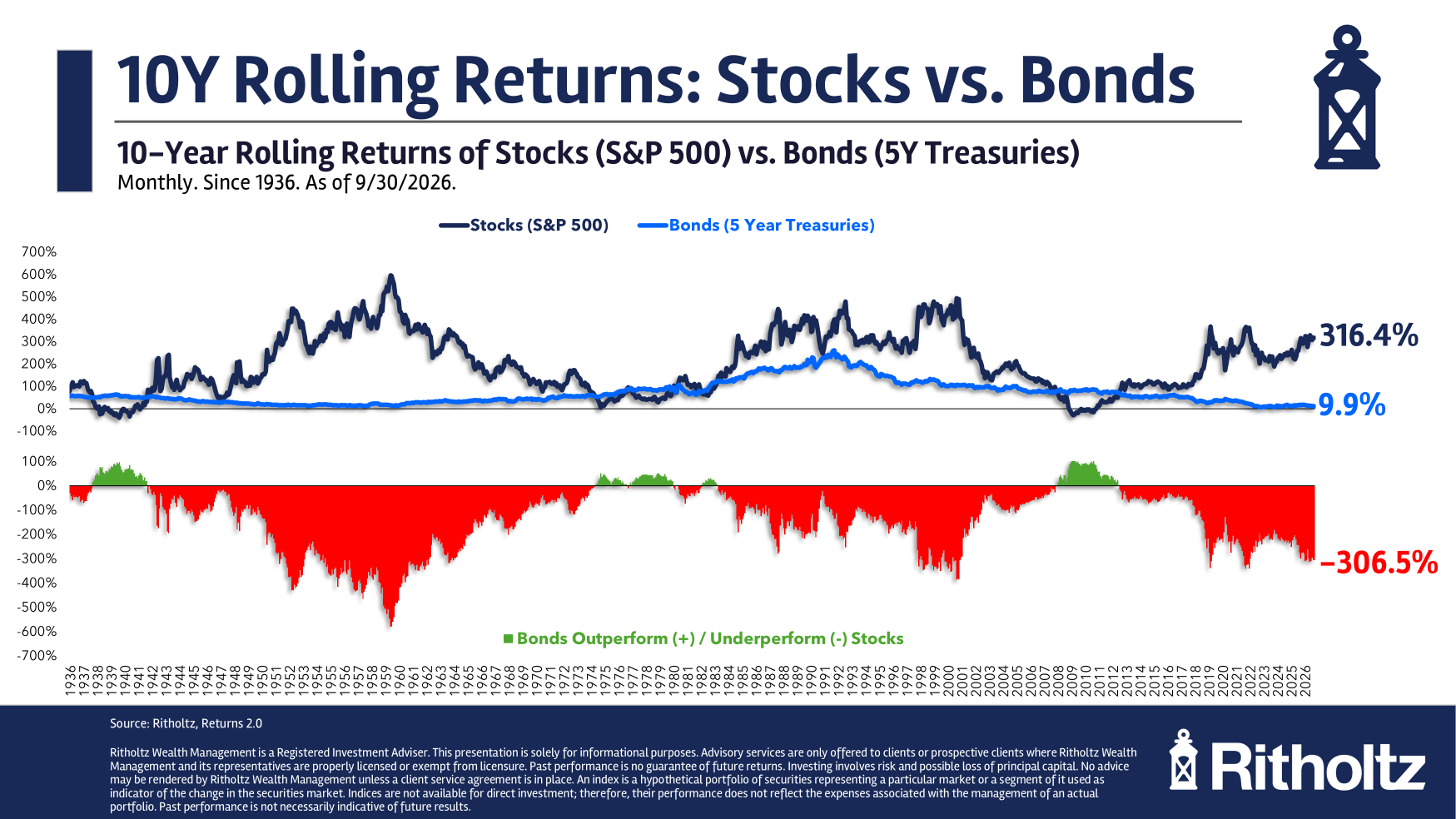
Stocks beat bonds over 83% of all 10 year periods in this time.
But you can see that there were times when bonds outperformed stocks — in the 1930s, 1970s and 2000s, which were coincidentally the lost decades for stocks.
Of course there are short periods when bonds earn their keep.
These are all of the down years for the U.S. stock market along with the corresponding bond returns in those same years: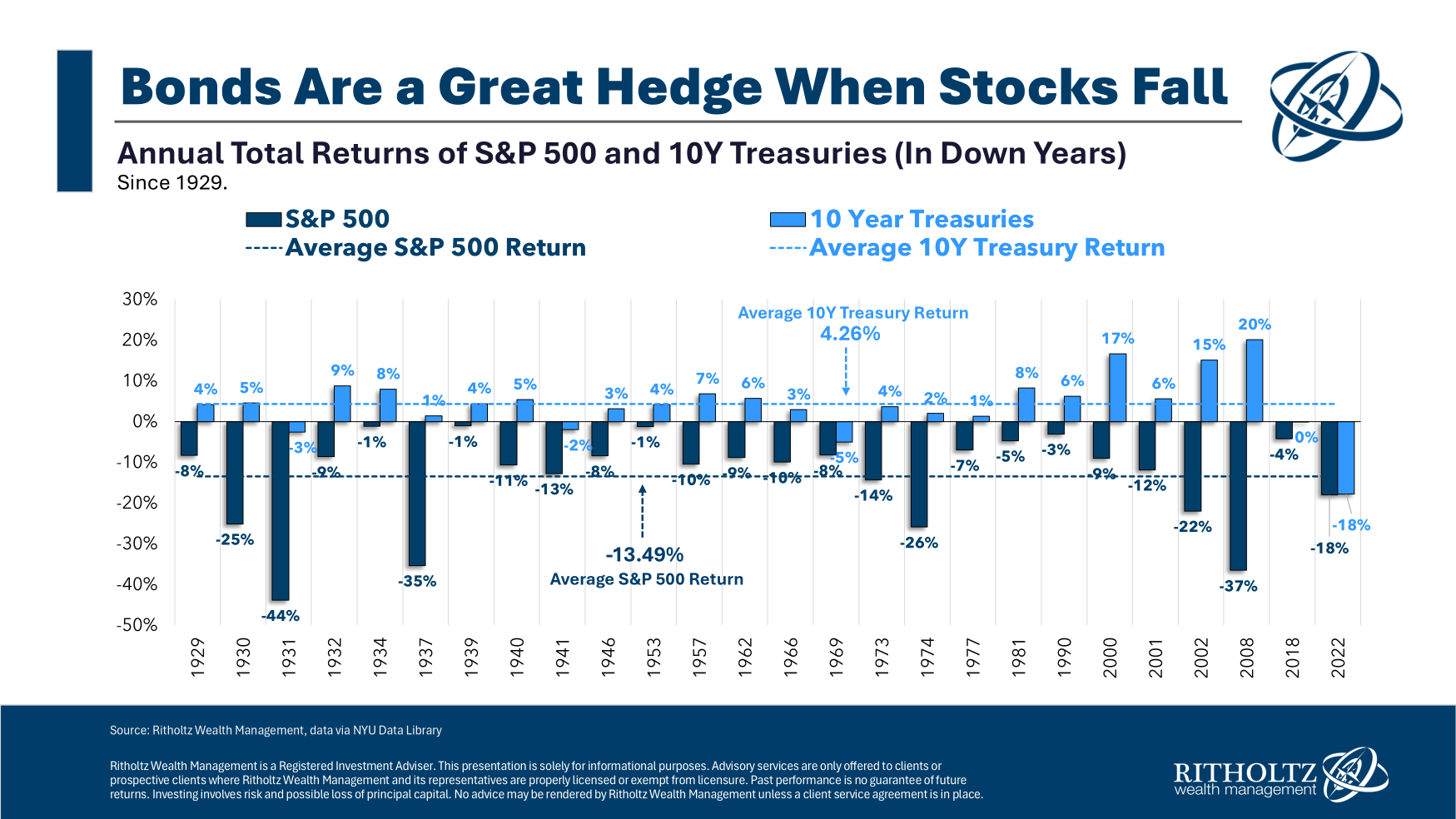
In the 26 down years for the stock market the average return was -13.5%. In those same years bonds averaged a gain of 4.3%, thus outperforming by nearly 18%.
Of course, there was the dreadful 2022 period that saw both stocks and bonds get crushed but that was an outlier. Most of the time bonds are a wonderful stock market hedge.
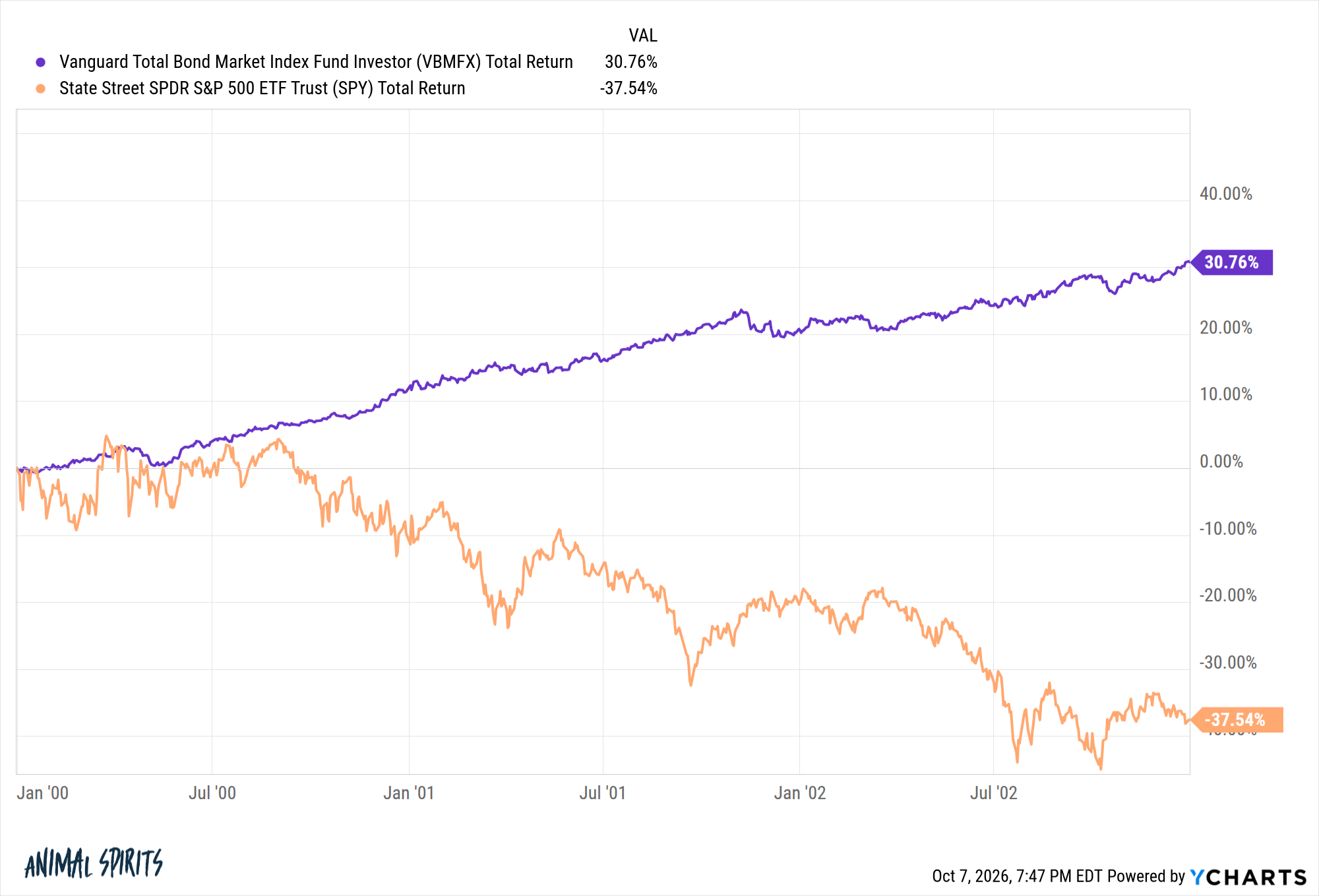
This is even more apparent during a stock market crash.
Look at the returns for a Vanguard Total Bond Market Index versus the S&P 500 following the bursting of the dot-com bubble from 2000 to 2002:
Now here are the results during the Great financial crisis from late-2007 through early-2009:
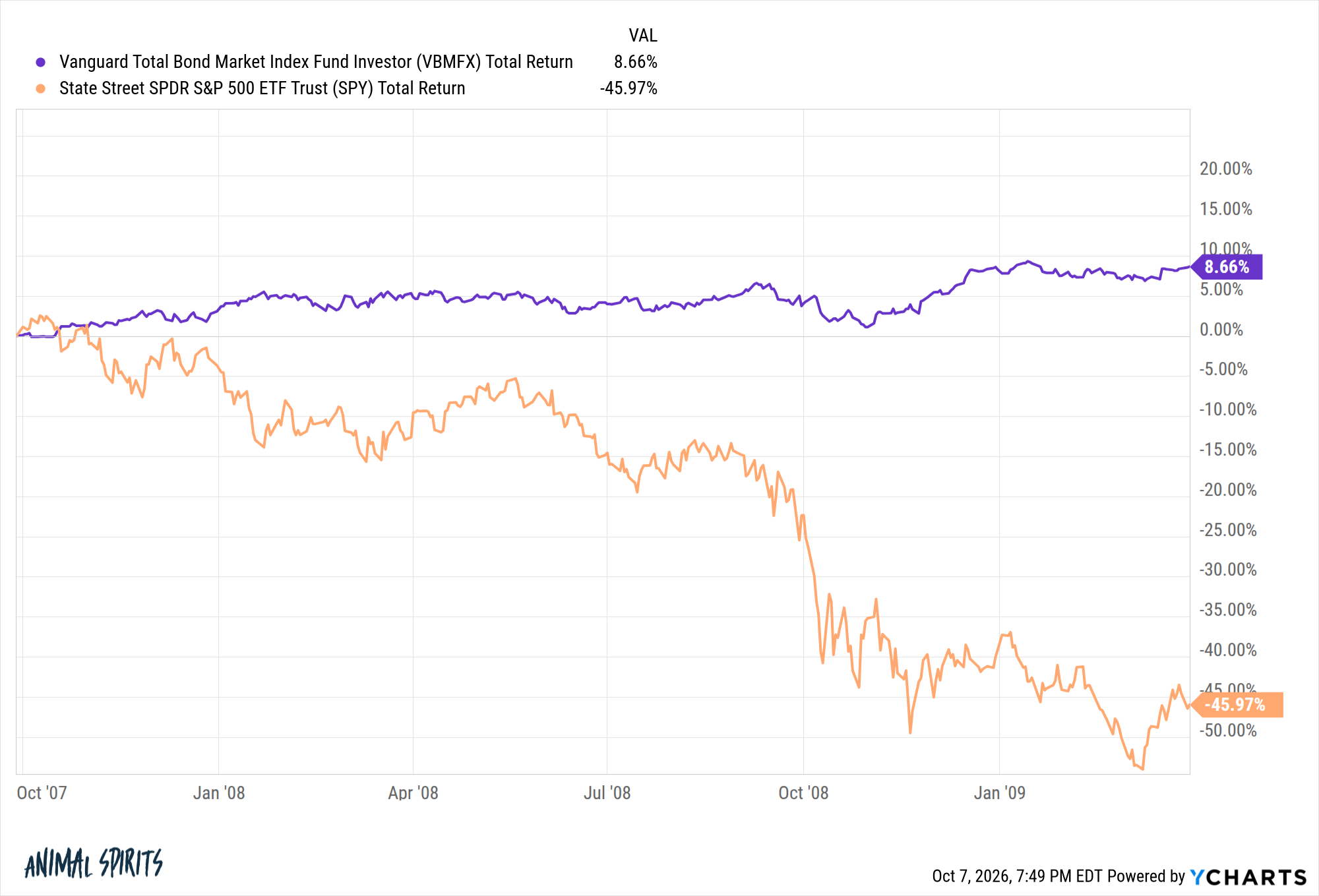
Bonds can be an effective hedge during a financial crisis when there is a flight to safety. The next time this happens many investors will wish they had an allocation to fixed income.
Do you need to own fixed income if you have a time horizon of 10 years or more? No but some investors require an emotional hedge, behavioral release valve, regular income or source of dry powder when stocks go down.
Despite terrible performance this decade, bonds can still provide that, especially at current yield levels.
I’ve gotten plenty of questions over the years about investing 100% of your portfolio in stocks. This is the first time I’ve ever received a question about having all of your money in bonds.
This is mainly because bond yields have been very low for almost 20 years now. This is the first time in a long time bonds actually have appetizing yields.
I understand the thinking here.
Why continue playing the game when you’ve already won? Why accept more volatility in your portfolio if you don’t need it?
Even if you can earn your return target in high quality bonds, you should probably still have a small allocation to stocks.
Bonds can be a good hedge for stocks but stocks can also be a good hedge for bonds.
Bond yields are nominal. Inflation is your biggest risk in fixed income because you get paid back in nominal terms. If inflation goes up a lot, your standard of living could fall if all your money is invested in bonds.
Plus, inflation and interest rates can and will change. What will you do if interest rates fall substantially and you can no longer hit your return target?
Sure, you can lock in bond yields by purchasing individual bonds but you still have reinvestment risk and interest rate risk if you need to sell for a large spending item.
Income in the stock market tends to grow above the rate of inflation. Same with earnings.
I’m a fan of diversification even when if feels like there’s an easy button in the way of higher yields. I like the flexibility you can get from holding different types of assets in your portfolio.
The beauty of diversification is you can often improve your return or volatility profile without sacrificing too much.
Take a look at the historical returns and volatility numbers for stocks, bonds and a 20/80 portfolio:
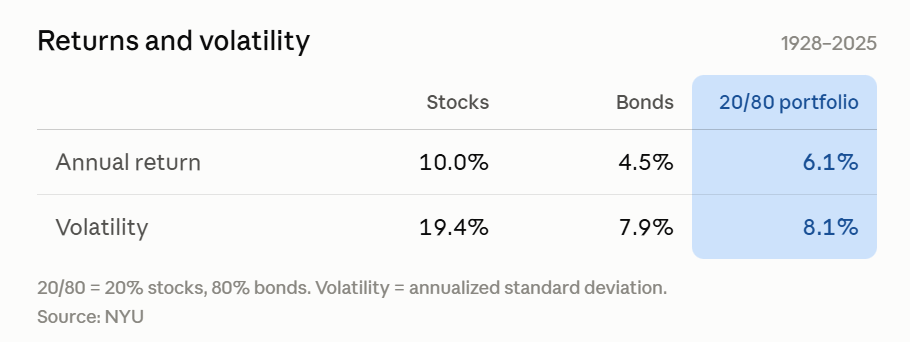
Adding 20% in stocks to a portfolio of bonds gives you a much better return profile without a commensurate increase in volatility.
You could make the case that it’s probably riskier to have all of your money in bonds than it is to have a small allocation to stock as an offset.
Concentration has been the clear winner for the past 10-15 years. Diversification hasn’t helped very much because bond yields were so low and U.S. large cap stocks have been one of the only games in town.
With bond yields where they are there’s a good case to be made that diversification is going to have a comeback when you need it the most.
I don’t know when that will be but investors finally have some more options when it comes to portfolio diversification.
I answered this question on an all-new episode of Ask the Compound:
We also covered questions about how to spend money that improves your well-being, what to ask your parent’s financial advisor, safe withdrawal rates in retirement and looming debt risks for the hyperscalers.
Further Reading:
5% Bond Yields