A reader asks:
I don’t totally understand bonds. Is the yield on the Agg the equivalent of a near guaranteed 5.2% annual return?
Here are the portfolio characteristics for the iShares Core U.S. Aggregate Bond ETF (AGG):
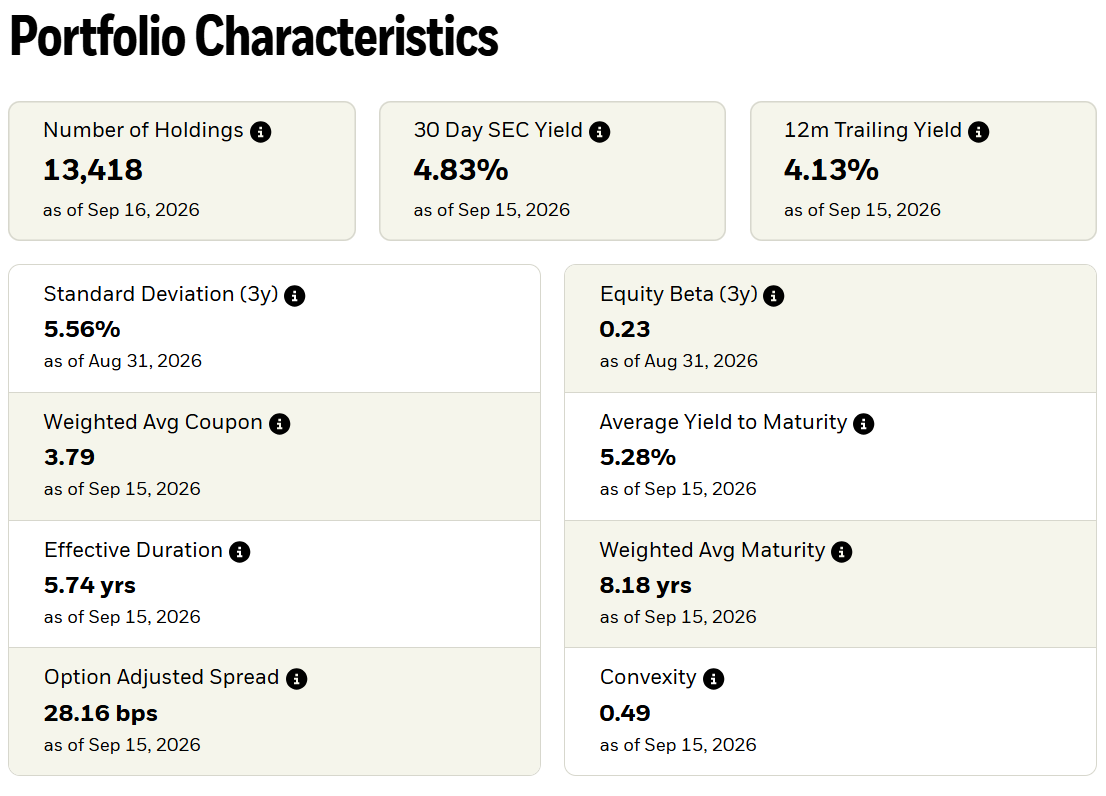
The number you want to pay attention to here is the average yield to maturity which is now around 5.3%.
This should be welcome news to fixed income investors. The yield on the Agg was below 3% for much of the 2010s. Covid saw bond yields plunge even further with interest rates on the Agg at less than 2% for a decent chunk of the early-2020s.
Now you can earn more than 5% on a high quality bond index fund. The 10 year Treasury is yielding 5% after falling below 0.5% earlier this decade.
Of course going from ultra low interest rates to the current levels has been painful for bondholders. As interest rates rose, the Agg fell nearly 20%. Ten year Treasuries were down more than 20%.
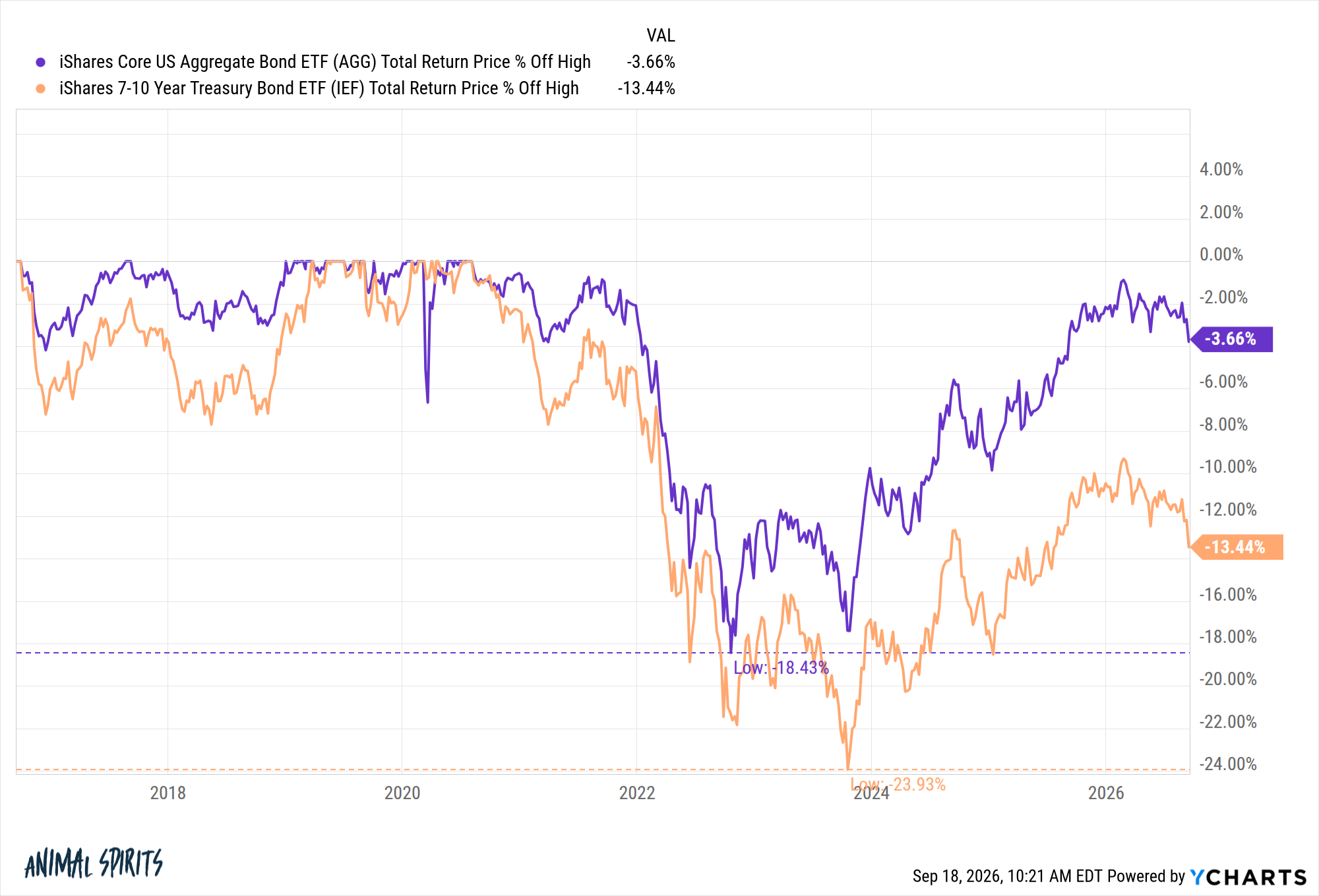
And these are total return numbers, meaning they include income reinvested. This was the worst bond bear market in history.1
So what do current yield levels mean for the future?
Forward returns in the stock market are driven by two main components: fundamentals (earnings and dividends) and emotions (valuations). You can have a reasonable approximation of what future earnings and dividends will be based on past growth rates and current yields.
But the complete unknown is the emotional component — what investors are willing to pay for the fundamentals. Valuations are really a gauge of investor sentiment which is nearly impossible to forecast.
So estimated returns in the stock market are very hard to quantify.
Bonds, on the other hand, are driven more by math than emotions when it comes to forward returns.
The starting yield plays a huge role in your forward returns, especially for short-to-intermediate-term bonds. For long-term bonds, interest rate movements and changes to inflation are a much bigger risk. But the starting yield for bonds is a pretty good indication of what the future returns are going to be.
Here’s a good chart from Exhibit A that compares starting yield with forward returns for the 10 year Treasury bond since 1999:
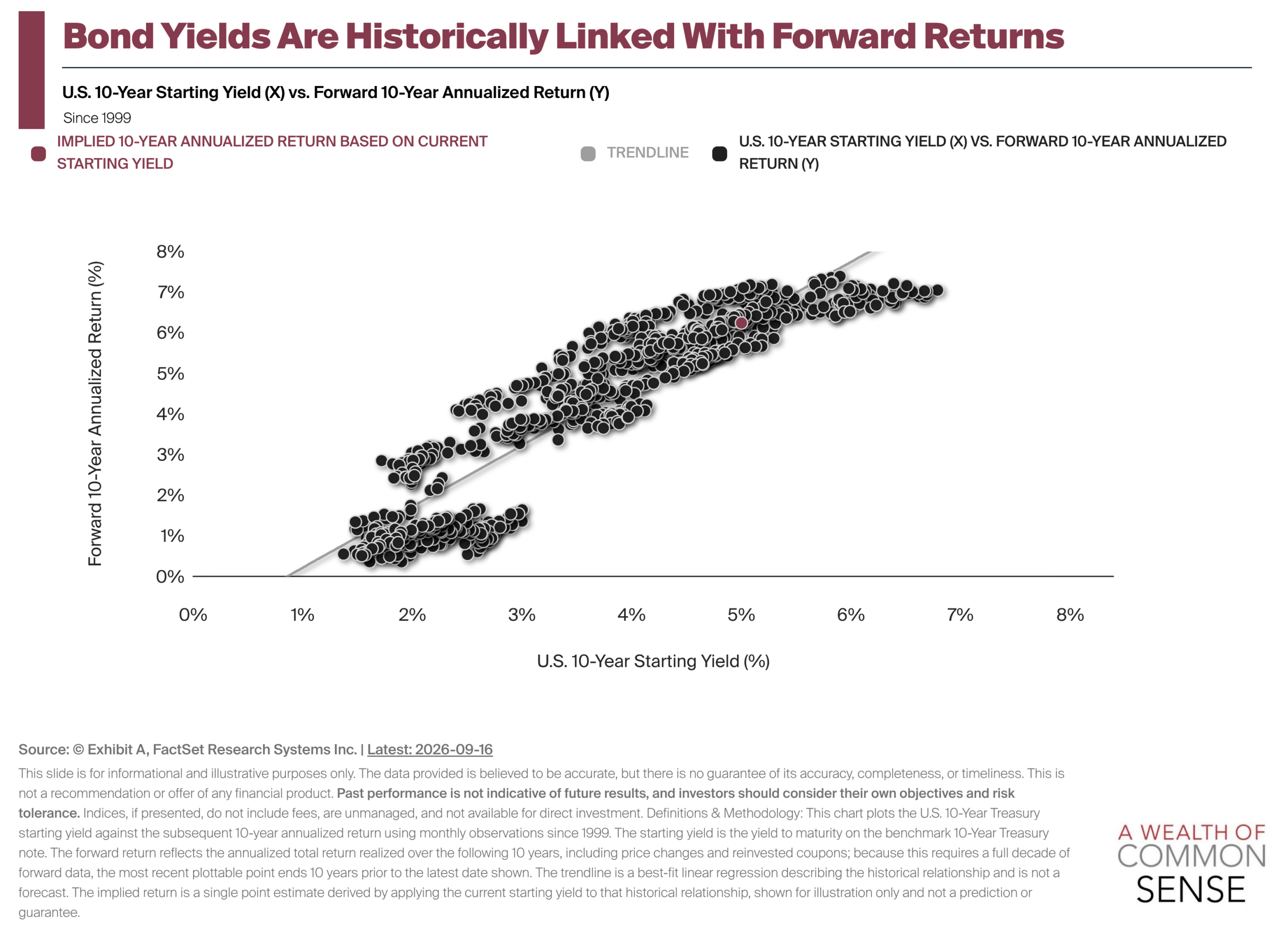
This is not a perfect one-to-one relationship but there is a very strong correlation between the current yield and returns over the next 10 years. This relationship is even stronger for bonds with lower maturities and duration.
Why are there deviations on the chart?
Bond prices and interest rates are inversely related. When yields fall, prices rise and and vice versa. In a falling rate environment, that gives you a short-term boost in returns. In a rising rate environment, that’s a short-term headwind.
But eventually, the bond yield wins out.
For instance, the 10 year Treasury rate has gone from around 4.2% at the start of the year to 5%. That’s a 20% increase in yields. But a 10 year U.S. government bond is only down 3% or so on the year. The reason it’s not down more is because you would have earned the income on the bond, which softened the blow from higher rates.
And now starting yields are even higher.
So the 5.2% yield on the Agg is not guaranteed. Interest rates could keep rising if inflation expectations remain high. That would ding bond prices in the short-term.
But in the long-run, a 5% starting yield in bonds means your returns in intermediate bonds over the next 5-7 years should be in the vicinity of roughly 5% per year.
That’s a pretty good yield relative to what fixed income investors have been dealing with since the Great Financial Crisis.
Alex Morris from F/m Investments joined us on Ask the Compound this week to discuss this question:
We were recording from Future Proof so Barry Ritholtz and Bill Sweet both hopped on to chop it about on questions about luxury watches, baby boomer wealth, stock picking, asset location and how to find the right financial advisor.
Further Reading:
The Most Hated Asset Class in the World
1Long-term Treasuries (TLT) are still in the midst of a 40% drawdown from the peak.