The phrase ‘mid-life crisis’ is still relatively new.
It was coined by Canadian Elliot Jacques in an article called Death and the Mid-life Crisis back in 1965. This is the gist of it:
The individual has stopped growing up, and has begun to grow old. A new set of external circumstances has to be met. The first phase of adult life has been lived. Family and occupation have become established; parents have grown old, and children are at the threshold of adulthood.
Jacques was in his 40s when he wrote the piece so he understood these feelings.
Jonathan Rauch provides extensive research on the dreaded mid-life crisis in his book The Happiness Curve:
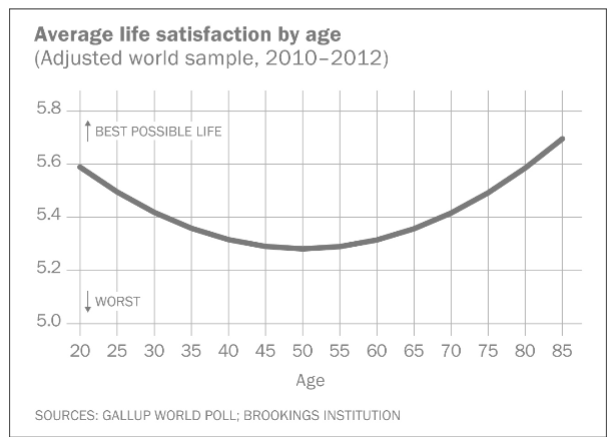
Happiness starts out higher when you’re young, dips in middle age and then goes back up in your older years.
The thing about the happiness curve is you overestimate your future life satisfaction when you’re young and underestimate your future happiness when you’re in middle age.
Both feelings are probably wrong but impossible to ignore.
A mid-life crisis doesn’t necessarily mean there’s anything wrong with you. It’s almost a natural state of affairs to go through this.
This happiness smile makes sense if you have regrets about life or don’t have the success you wished for in your younger days. But these results hold even for people who have done well at work, have a happy marriage, or make a lot of money.
It’s not necessarily circumstances that cause this situation but expectations.
If you’re not as successful as you once desired that’s a huge disappointment. But even successful people can feel unfulfilled. Reaching your goals can often be a letdown because even getting everything you thought you wanted doesn’t always make you feel any better.
At 45, I’m a prime candidate for a mid-life crisis.
In your 40s you can still recall your younger days but you’re getting closer and closer to retirement.
Watching my kids get older is proof that I’m aging. My parents are getting older. I have friends who are currently taking care of their parents with health issues while also raising kids.
Being in the sandwich generation can be a bizarre experience.
You could also make the case that it’s never been harder to avoid the feelings of a mid-life crisis.
It’s never been easier to compare yourself to people who are more successful than you. Social media is constantly showing you how rich people are, the fabulous trips they take, the toys they spend money on, the outsized returns they earn on their investments, etc.
Money was a taboo subject when I was growing up. In the 1990s, selling out was the worst thing you could do.
Today, selling out is seen as the obvious choice. People love bragging about their successes, whether real or imagined.
If comparison is the thief of joy, robberies are at an all-time high in today’s society.
I get these feels too.
Why is that person wealthier than I am?
Why is their house nicer than mine?
They sold their company for how much?
How do they afford that car?
Wait they have more followers than me? A bigger audience? More book sales? Nicer clothes? A bigger portfolio?
This is the human condition.
My brother passing away in his mid-40s has also made my mid-life crisis feelings more acute. Watching his life get cut short in his 40s has altered my perspective on mortality in many ways.
I don’t have it figured out yet but here’s what I’ve been doing to deal with it:
Expect less and appreciate more.
The advice I try to give my kids in things like school and sports is to do your best and let the chips fall where they may. Sometimes you can’t control the outcome or it’s bad timing or bad luck or just not your day.
I try really hard to avoid the trap of high expectations. When you set your expectations too high the failure and disappointment can cause you to give up.
You can be ambitious without letting the results of your ambition dictate your happiness. Keeping score isn’t always worth it because the goalposts never stop moving.
Appreciation is the friend of joy so I’m trying my best to be grateful for what I have.
In 2015 I started my new job with Ritholtz Wealth.
One of the first talks I ever gave was just a month after I joined the firm. A bank in Italy flew me out to give a presentation to their advisors.
First, I spoke to a few thousand advisors in Milan. Then we took a train to Rome and did another event just steps away from the Vatican.
The events were bigger than I expected, and I had to work with a translator to go from English to Italian.
The whole trip was kind of a whirlwind.
After my final talk in Rome, I walked back to my hotel, which overlooked the back of St. Peter’s Basilica.
It’s one of the most beautiful hotels I’ve ever stayed in. I sat down by the pool and grabbed a beer to catch my breath.
At that moment I had this great sense of appreciation.
New job. New opportunities. New stage in life. So I took a picture to remember that feeling:
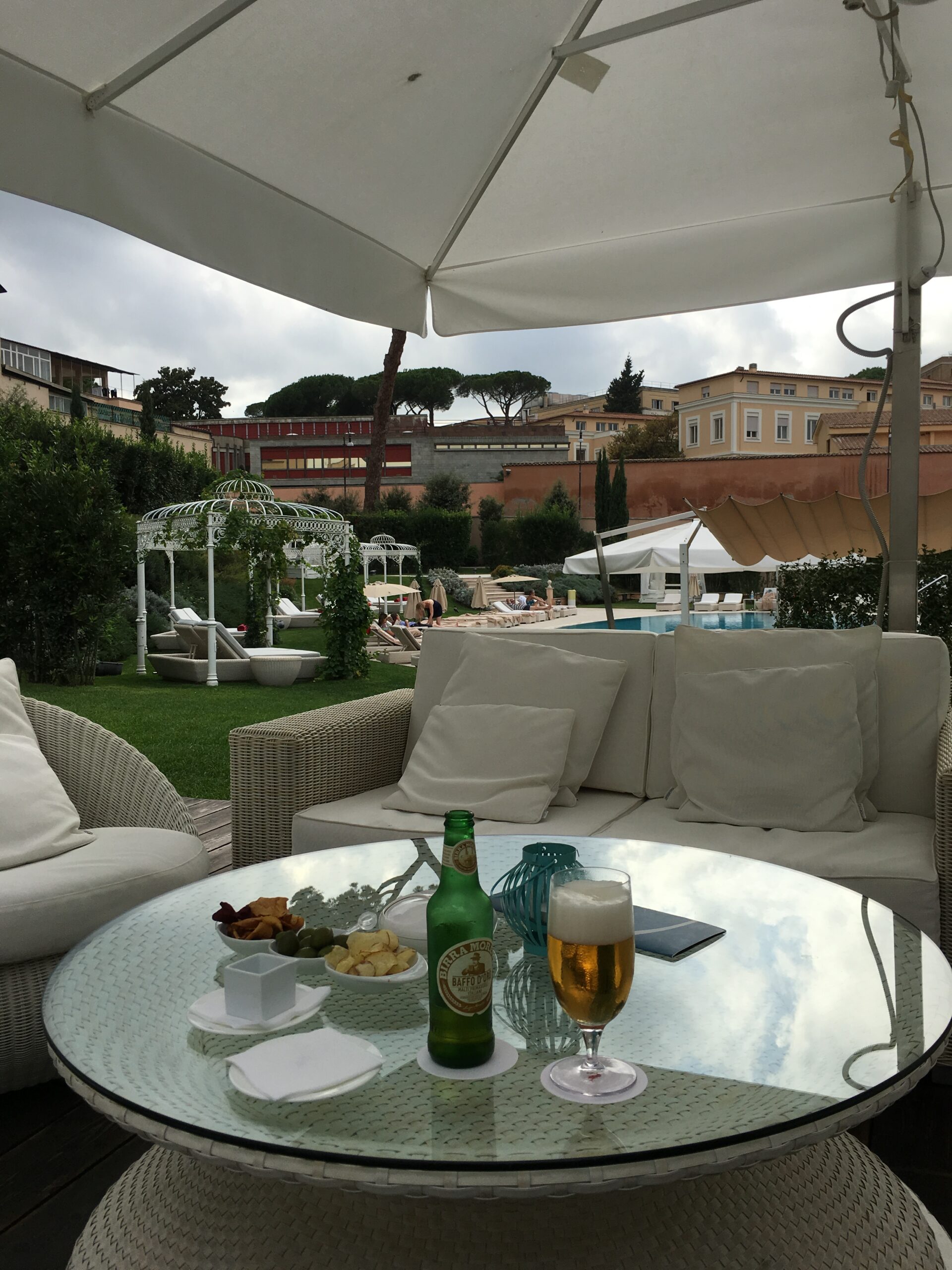
This picture has been the background wallpaper on my phone ever since as a reminder to be grateful for what I have instead of worrying about what I don’t.
Is that always easy?
Of course not.
But a combination of expecting less and appreciating more is something I’m constantly striving for.
*******
I was in Italy again this past week for the release of the Italian version of Risk & Reward.
Here are some pictures from the event, which included a live podcast and a Q&A:
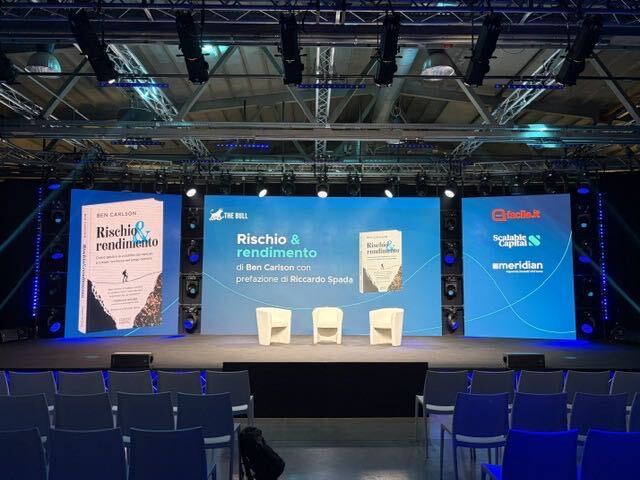




Italy is such a beautiful place filled with wonderful people.
I had a great time.
Further Reading:
Trying Not to Get Lost in Translation