The economy is a weird thing because no matter what happens to GDP growth, inflation or interest rates there are bound to be pros and cons, winners and losers.
There’s no such thing as equilibrium in the economy.
Inflation was low in the 2010s which consumers liked. But economic growth was slower and wage growth stalled out. People didn’t like that.
Economic and wage growth have been better this decade but that’s come with much higher inflation. People like the wage growth but hate the inflation.
Interest rates are on the rise again which freaks out a lot of economic pundits but it’s not all bad.
Let’s look at the winners and the losers of rising interest rates starting with the winners:
Cash earns something. You can earn more than 4% in T-bills right now. The yields for savings accounts, CDs, money market funds and the like should be similar.
Fixed income investors. High quality bond yields are well over 5% now. Other segments of the bond market are yielding 6-7%. Fixed income actually provides income again.
Retirees. Retirees couldn’t have timed things any better. They got a massive stock market pump this decade along with one of the biggest increases in house prices in history.
Now that they need to downshift their portfolios there are yields on fixed income for the first time in forever. Annuity rates are much higher. The less volatile assets are actually paying something.
The boomers win again.
Cash rich companies. If you hold a lot of cash on your balance sheet you can make a return on it without taking a lot of risk.
People who locked in lower rate debt. If you locked in a 3% mortgage rate or 5% auto loan a few years back you effectively hedged interest rates by paying much lower monthly payments than the market is currently offering.
A 3% mortgage was the best inflation hedge in history.
Now for the losers:
Homebuyers. Seven percent mortgage rates aren’t bad by historical standards. It happened in the 70s, 80s and 90s. But 7% mortgage rates with housing prices that came from 3% mortgage rates are really bad.
Monthly mortgage payments now versus pre-2022 days aren’t pretty.
Housing market activity. The buying and selling of houses in America has already been subdued for some time now:
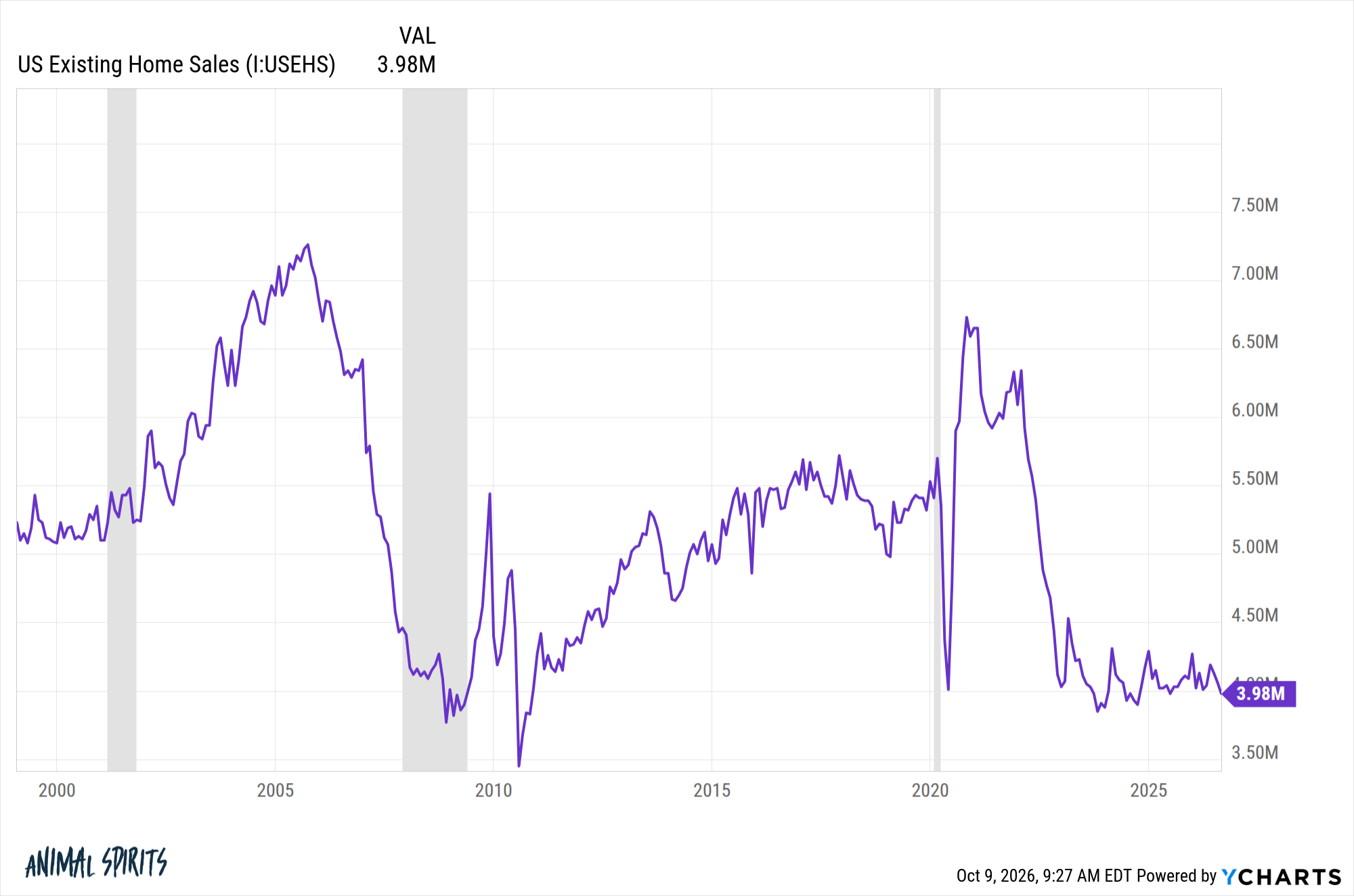
With mortgage rates at 7.5% it’s not likely to get any better.
Consider the fact that there were more than 5 million homes trading hands in a given year at the turn of the century with a population of 280 million people.
Today there are less than 4 million existing home sales with nearly 65 million more people in the country.
What an awful time to be a homebuyer.
Auto loan rates. The national average for auto loans is also now more than 7%. With the cost of new and used vehicles up almost 30% this decade, that can make for a painful monthly payment at higher borrowing costs.
The average new car payment was already approaching $800 even with a quarter of new loans extending to 84 months. More than 20% of new car loans for are monthly payments of $1,000 or more.
Not great.
Higher interest expenses on government debt. One of the reasons I didn’t think the government would allow interest rates to go much higher coming out of the pandemic is because of the trillions of dollars of debt we took on.
I assumed the debt burden would be bad enough even with low rates.
Boy was I wrong.
It’s hard to see a scenario where this line goes down anytime in the near future:
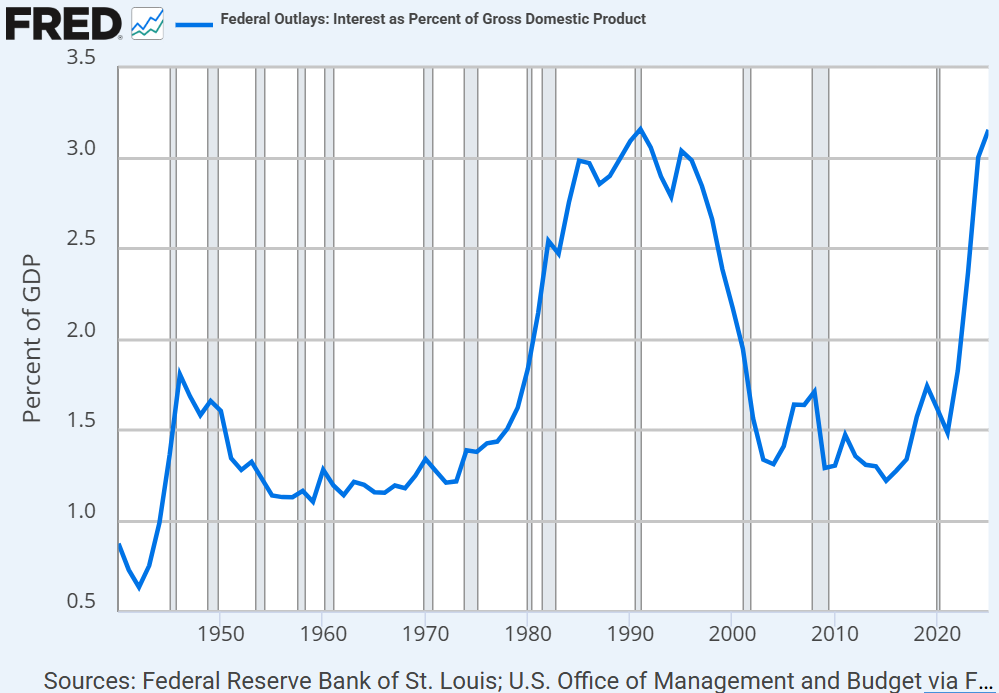
Government debt is going to be a political issue for a very long time in this country.
Smaller businesses. Check out this chart from Michael Cembalest that shows net interest costs as a percentage of profits for corporations:
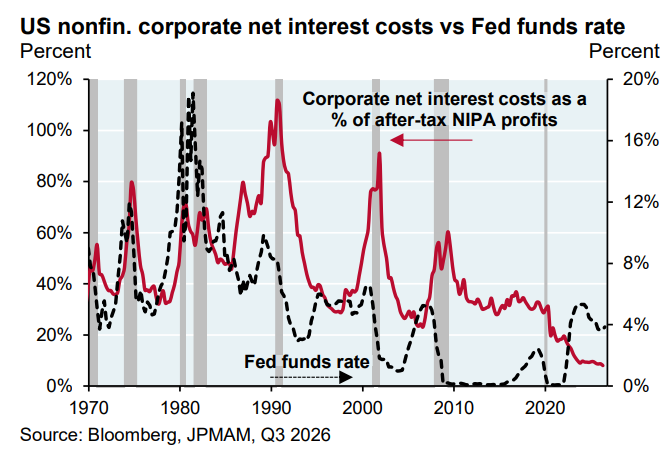
Interest rates have gone up but corporate interest costs have not because they were able to lock in such low rates, much like a homeowner with a 3% mortgage.
But that’s mostly the gigantic companies.
Many small cap corporations and small businesses are forced to borrow floating rate debt, meaning it becomes more onerous to fund operations when rates rise.
Riskier yield products. When rates were super low there were a ton of yield products created to fill the void. Some were halfway decent. Most were pieces of garbage that took way too much risk for a fixed income substitute.
It’s a good thing many of these products now have actual competition from high quality bond yields. It makes certain decisions easier for investors.
Renters. Higher inflation is one of the causes of higher interest rates. Ironically, higher interest rates now could be the cause of higher inflation in the future.
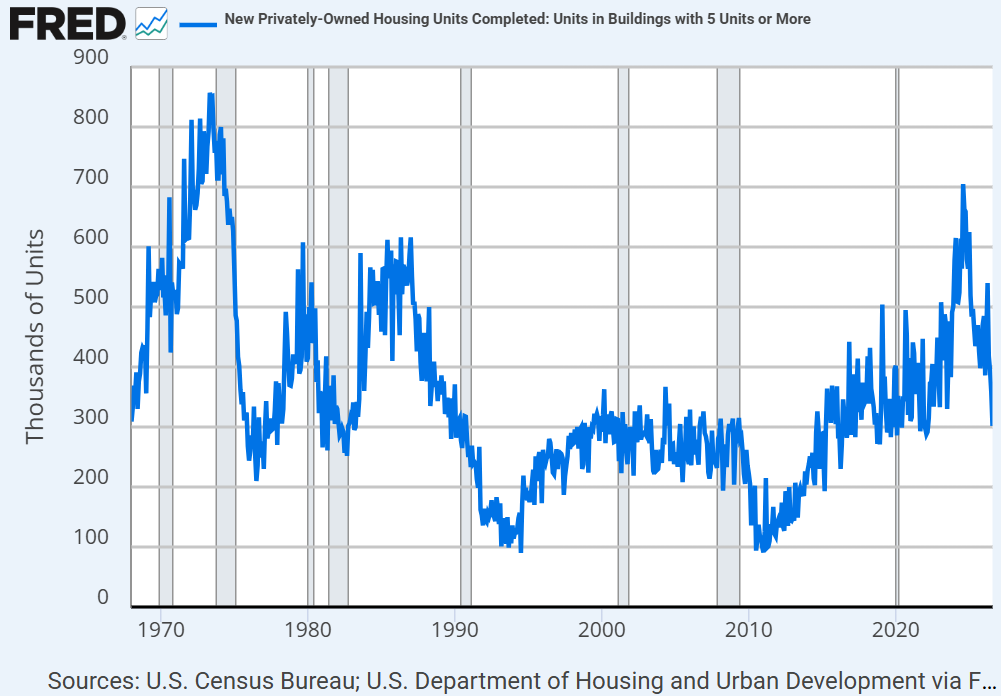
While there hasn’t been a boom in new homes built this decade, multifamily housing did see a big uptick when mortgage rates were lower.
So while rents shot up in the early part of this decade, the new apartments caused rents to stagnate for a number of years:
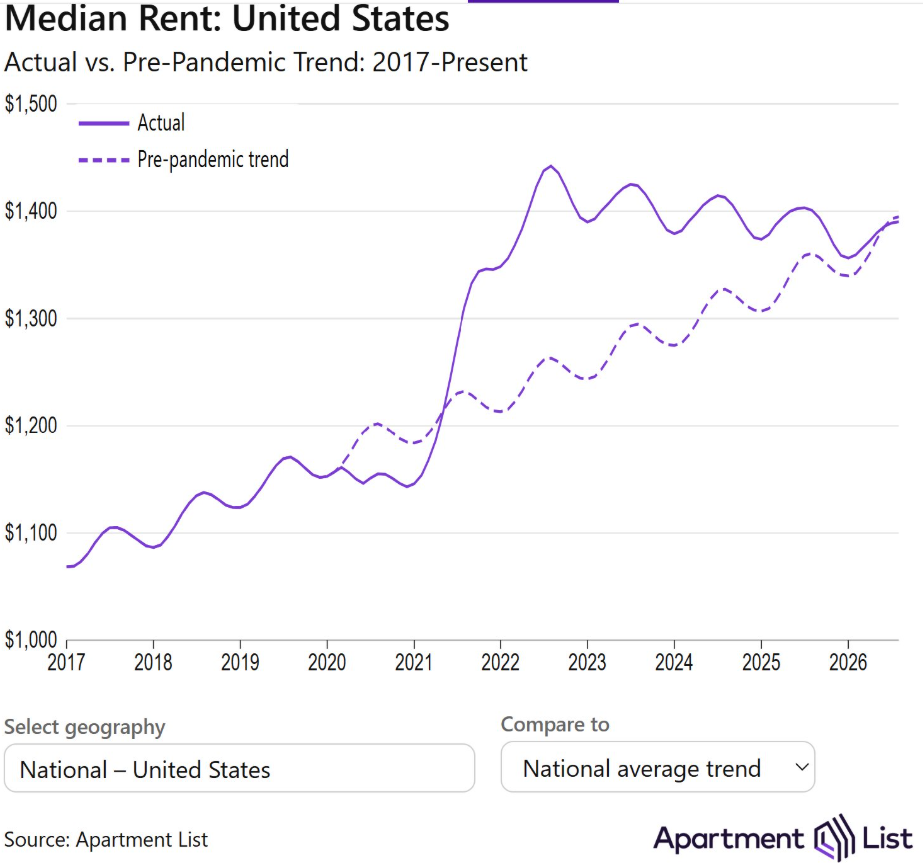
This is great news…and it won’t last.
Torsten Slok explains:
When rates are high, builders build less, and when fewer homes and apartments get built, rents go up, which pushes inflation higher and keeps rates high.
Call this the “higher rates, higher rent doom loop.”
With owners’ equivalent rent alone making up roughly a quarter of the CPI basket, this re-acceleration in rents is a problem for the Fed because it puts upward pressure on inflation driven by higher rates.
The number of apartments being built has already fallen off a cliff following a big upswing when mortgage rates were lower:
I know there were a lot of people who were worried about what the ZIRP period would mean for the economy. I’m not saying we should go back to 0% rates by any means.
But any reasonable judge would look at the tale of the tape here and recognize higher interest rates are causing far more damage than good right now.
Interest rates haven’t stopped the economy like many people expected for a number of reasons.
But today’s interest rates are going to have implications for years to come and not in a good way.
Michael and I talked about the impact of higher rates and much more on this week’s Animal Spirits video:
Subscribe to The Compound so you never miss an episode.
Further Reading:
Strange Times
Now here’s what I’ve been reading lately:
- The best selling product of all-time (Asymco)
- Warren Buffett is one of a kind (Jason Zweig)
- How to think about bonds and diversification (Behavioural Investment)
- There’s always a good reason to hate bonds (Belle Curve)
- Wealthy retirees have a hard time spending money (Barron’s)
- Your brain is not a computer (Aeon)
- A spectacular rise in global wealth (Washington Post)
Books: