This is one of my favorite statistics about human nature:
Each year, Americans spend more money on the lottery than on sporting events, books, video games, movie tickets and music combined.
Some people are just bad at understanding probabilities.
But this is more about buying daydreams and spending a small amount of money to purchase some hope. People love betting on longshots.
This phenomenon helps explain the rise in prediction markets and sports gambling.
Sure, some people who use these services have a system in place and try to make high probability bets. But most people make wagers that could provide a large payout but with a very low probability of ever materializing.
Bloomberg has some good data on how most betters use prediction markets for longshots:
Since the start of 2025, around half of all trading volume on Kalshi, the largest prediction market platform, has involved one side chasing potential returns of at least 1,000% betting against mostly sophisticated traders and market-making firms on the other side, a Bloomberg News analysis of over a billion transactions shows. In recent weeks, that percentage has climbed even higher, up to more than 65%, as bettors piled into sports combination wagers, known as parlays, in pursuit of big scores.
Look at the extremes here:
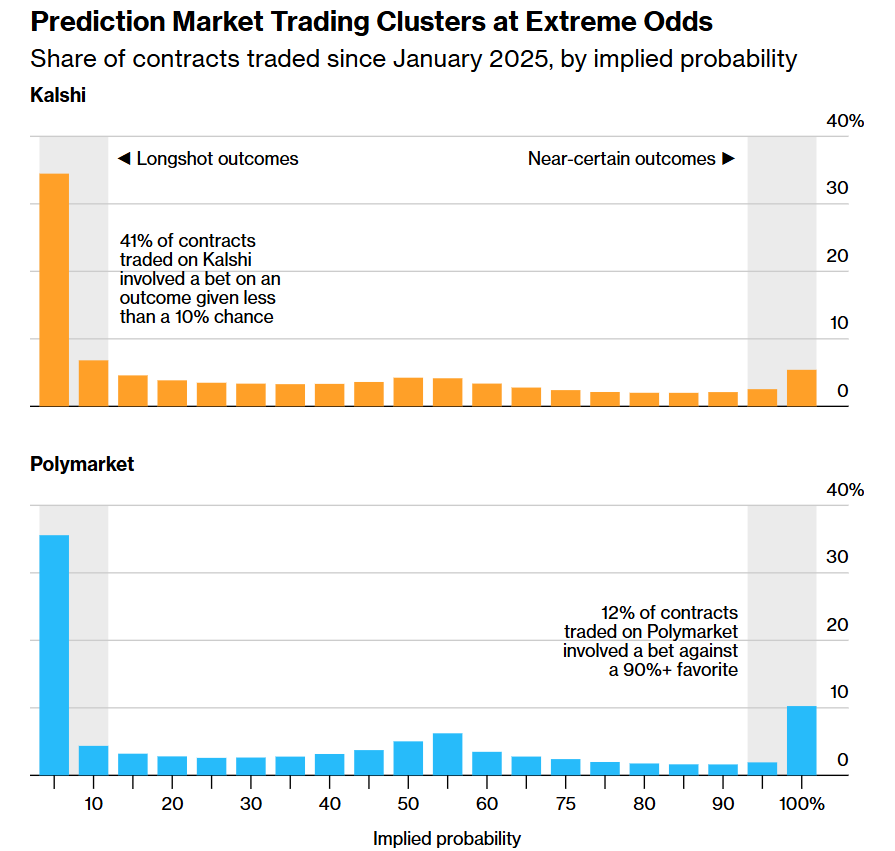
Betting on extremes and betting against the favorites.
Parlays are big business for the sports betting sites too.
Another study looked at millions of bets made on the NFL. Nearly three-quarters of all bets were parlays. The number of bets placed on parlays more than doubled in the last five years between 2018 and 2023.
It’s hard enough being right once when betting against the sharps, market-makers and professional gamblers on the other side of the bet.
But a parlay means you have to be right not just once but multiple times on the same bet.
Parlays are all about buying hope just like lottery tickets. Creating a multi-leg parlay is world-building in many ways. You see a game or games playing out in a certain way.
Look, we don’t need the lottery. We don’t need casinos or prediction markets or sports gambling apps on our phones.
But people seem to like these things.
People like buying dreams of a new future.
Is it rational?
Of course not.
But we humans are not always rational.
We’re all irrational in our own way.
For many people, that includes gambling on low probability outcomes in hope of striking it rich.
Betting on hope springs eternal.
Further Reading:
Smart Investors vs. Dumb Investors