A reader asks:
On various shows the idea of the current economy being recession-proof or Teflon has come up. In the age of information availability and the ability to act on it instantaneously, maybe a full blown stock market crash is not possible short of massive black swan event like full nuclear war. What if going forward there will only be sector pullbacks? With the ability to rotate immediately and keep money in the market instead of just selling into cash keeps the overall market heading up and to the right. This is only enhanced by the transition from an older generation (hide cash under the mattress) to the younger generation (FOMO/desire to get rich quick). Thoughts?
I wrote about this recently.
To be clear — I never said the U.S. economy is recession-proof. We will have a recession again at some point.
Recessions are simply fewer and far between compared to the past:
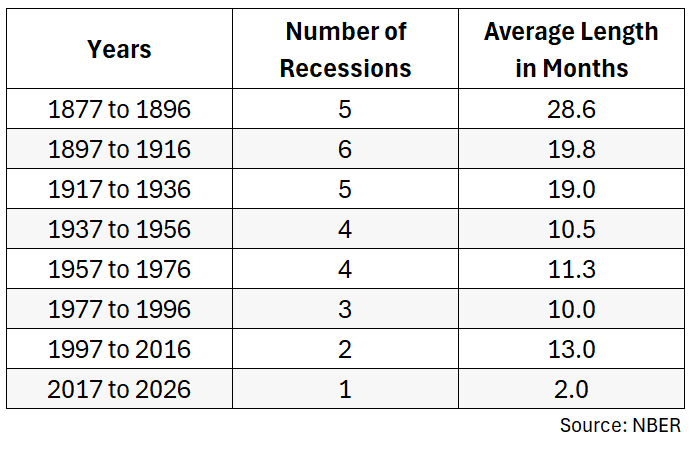
Here’s what I wrote about this last month:
The U.S. economy is far bigger, more mature and diversified than it was in the past. The fact that technology plays a bigger role and more workers are in the service sector helps as well.
Corporations are better run and more efficient. Plus policy makers are quicker to respond when disruptions do occur.
Interestingly enough, less frequent recessions hasn’t taken risk out of financial markets. There have still been bear markets. They’ve just been relatively short-lived.
Now let’s add in the number of bear markets and the average peak-to-trough drawdown of those bear markets:
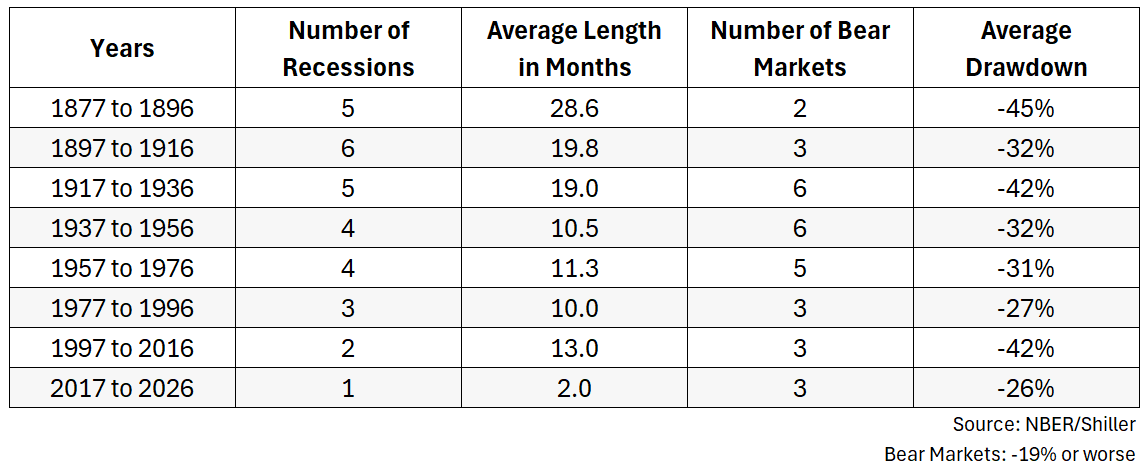
The number of recessions has been falling for the past 150 years. They are less severe in both magnitude and length. But this hasn’t really impacted bear markets.
Sure, there were more bear markets in the 1930s and 1940s but that’s because there was the Great Depression and World War II.
We haven’t had a real recession since 2009. These are the biggest drawdowns for the S&P 500 in that time:
- 2010: -16%
- 2011 -19%
- 2018: -20%
- 2020: -34%
- 2022: -25%
- 2025: -19%
This has all happened during one of the great bull markets of all-time. We haven’t had a real recession. No credit cycle. No financial crisis. Sure, there was a pandemic but we threw so much money at it that it never truly became a financial problem.
There will be an economic downturn again at some point. Maybe AI will be the cause or maybe it will be an exogenous shock no one is predicting right now.
When that happens revenues will slow, earnings will fall and investors will overreact. That will likely cause a bear market or even a crash.
There will be a financial crisis again at some point too. That will likely cause a stock market crash because the economic pain from a financial crisis tends to be severe.
Recessions and financial crises don’t happen very often anymore but when they do you can be sure there will be an overreaction on the part of investors.
How can I be so sure?
It’s human nature.
The stock market is far more emotional than the economy because people are emotional.
When things are going really well in the markets, recency bias causes you to assume things will always be this good. Investors become complacent. You start taking more and more risk, like a drug addict who needs a bigger hit to keep the same high.
When things do finally turn bad many investors are caught off guard. Witnessing a chunk of your money disappear causes panic.
But it’s more than that.
In some ways the stock market has to crash on occasion.
The whole reason stocks earn a risk premium to bonds and cash is because they are risky.
If you were promised 10% year in and year out with no volatility or risk of crash everyone would simply put their money into the stock market.
Crashes are a reminder that risk exists.
Investors over-extrapolate. Expectations get too high. Greed and FOMO take over. The pendulum swings too far. Then something bad happens. Investors are reminded that stocks don’t always go up. Fear and panic return. The pendulum swings now swings too far in the other direction.
Stock market crashes are not a penalty for investors. They are an occasional subscription fee you pay to earn higher long-term returns than other asset classes.
And they’re not going away.
I covered this question on an all-new episode of Ask the Compound:
We also answered questions straight from our Compound audience about setting up a financial plan for your elderly parents, the pros and cons of investing in real estate, how to have difficult financial conversations and how inflation impacts portfolio withdrawal strategies.
Further Reading:
4 Big Questions About the Economy