Four big questions about the economy I’ve been pondering:
Why don’t we have recessions anymore? The National Bureau of Economic Research has historical data on U.S. expansions and contractions going back to the 1850s:
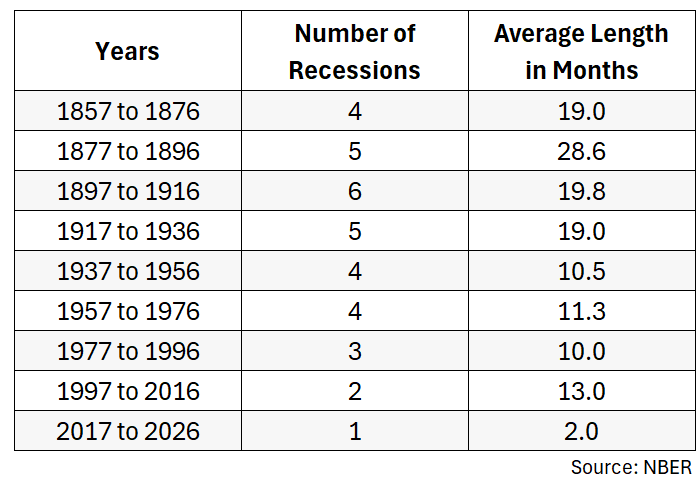
Is 19th century data as reliable as today’s? Probably not but it’s obvious that recessions are fewer and far between than they used to be.1
It feels strange that we’ve had just one recession in the past 17 years that lasted just 2 months and didn’t involve a credit cycle.
The U.S. economy is far bigger, more mature and diversified than it was in the past. The fact that technology plays a bigger role and more workers are in the service sector helps as well.
Corporations are better run and more efficient. Plus policy makers are quicker to respond when disruptions do occur.
Interestingly enough, less frequent recessions hasn’t taken risk out of financial markets. There have still been bear markets. They’ve just been relatively short-lived.
I do wonder if there will now be bigger reactions from investors when the next economic contraction finally hits because we’re not used to them anymore.
Why hasn’t the housing market led to a recession? There is an idea from some economists that housing is the economy.
Research shows housing activity — making up nearly 20% of GDP — has been the main driver of U.S. economic cycles since WWII.
So why isn’t it having a bigger impact now?
Existing home sales have crashed because mortgage rates have been stuck above 6% for 3+ years and housing affordability is about as bad as it’s ever been.
It probably helps that housing prices never crashed, a lot of people locked in 3% mortgage rates and the unemployment rate has been below 5% for almost 5 years.
Enough people have low mortgage rates and housing wealth to offset the lack of housing activity.
But how long can this last?
That I don’t know.
Why aren’t rates higher? Inflation is still much higher than it was last decade. Government debts are astronomically high. Fiscal deficits don’t appear to be going anywhere for the foreseeable future.
Government debt to GDP is as high as it’s ever been outside of WWII.
Nothing stops this train.
And yet…
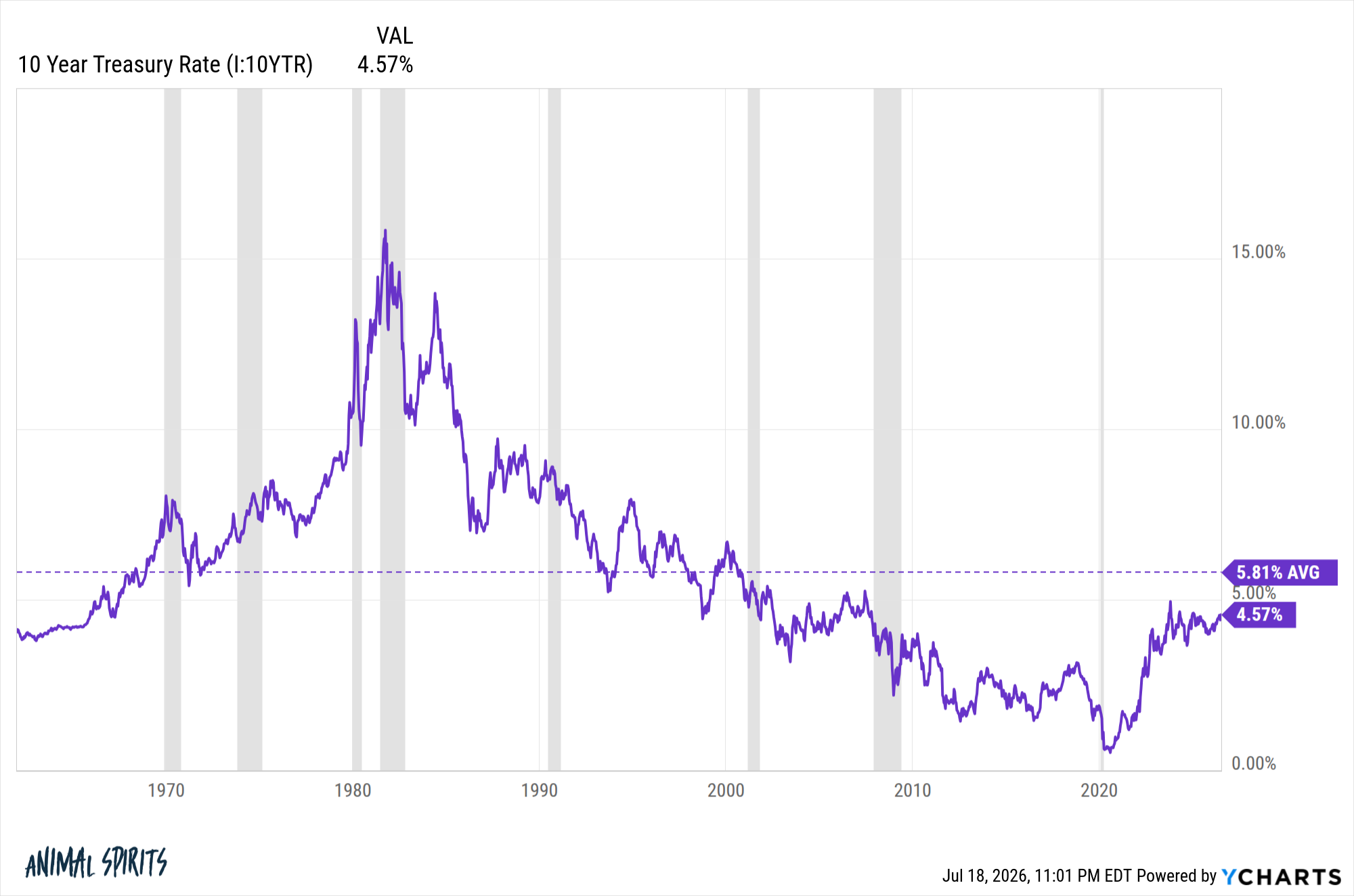
…10 year Treasury yields are well below the average of the past 65 years or so.
Some people think rates are high today because they anchor to the post-GFC world of 0% interest rates.
But today’s government bond yields are what I would consider normal (if there is such a thing in markets.
Bond yields don’t line up with the idea that government debt is a crisis.
All of the people predicting a government debt crisis should probably have an answer for this one.
Is this a normal economy finally? Consider the fact that:
- The U.S. economy is growing in the 2-3% range.
- Inflation sits at 3.5% (right on the 100 year average).
- The 10 year is yielding just below 5%.
- And the U.S. stock market was up 10% in the first half of the year.2
In the 2020s the economy has weathered a pandemic, supply chain shocks, a hot labor market, 9% inflation, a rate hiking cycle, tariffs, energy shocks and multiple wars.
We’ve been in a constant state of flux.
What if the current situation is one of normalization?
I could go for that.
It probably won’t last.
Further Reading:
A Government Debt Crisis?
1The average length in months here is peak-to-trough.
2OK, 10% for the year would feel more “normal” in terms of long-run averages. However, the average gain in an up year is 21% so we’re right on track.