Here’s a brief history of the 401k plan:
The Revenue Act of 1978 included an obscure provision called Section 401k which offered employees the option to defer taxes on certain types of compensation.
It was never meant to be the foundation for the nation’s retirement savings.
Ted Benna, a benefits consultant, realized the rule could allow employees to contribute part of their salaries in a tax-deferred savings vehicle while employers could make matching contributions.
In 1981, the IRS created rules that helped clear the way for employees to contribute directly from their income to a 401 k plan.
Forty-five years later, most workers are now on their own when it comes to saving for retirement.
Bloomberg profiled Benna to get his thoughts on the 401k plan all these years later:
In Benna’s view, the retirement savings plans he helped create have grown too complex and costly, beyond the reach of workers who most need financial security — those stretching their paychecks to afford groceries, much less save money in a 401(k). More than two-thirds of private-sector workers have access to 401(k)-type plans, according to the US Bureau of Labor Statistics, but just half of those eligible participate in them.
He makes some valid points but I actually disagree with Benna here. Take a bow, sir. The 401k has been a success.
Is it perfect? No but the system in place before defined contribution plans wasn’t perfect either. Here’s some more data from Bloomberg:
Benna was co-owner of a small benefits consulting company in the late 1970s when he first hatched the idea that would become the modern 401(k). At the time, 38% of US private-sector workers — many of them in unionized industries — had pensions that promised income for life.
Would life be easier for workers if everyone had access to a pension plan? Of course. Lifetime income makes retirement planning much easier.
But it’s a myth that everyone had a pension in the past. Pension plans for private sector workers were a one-time anomaly. Fewer than 40% of workers had a pension when the 401k was concoted.
Most of those who had pensions were in unions. Unions now cover a much smaller piece of the labor force, around 6% of total private sector workers.
So the pensions were going away regardless of the existence of the 401k plan because workers lost bargaining power.
I would argue the 401k plan came on board at the perfect time. In the early-1980s the baby boomer generation were hitting their 30s. The fact that many of them now had access to a tax-deferred retirement account is one of the big reasons stock market ownership skyrocketed in the 1980s and 1990s:
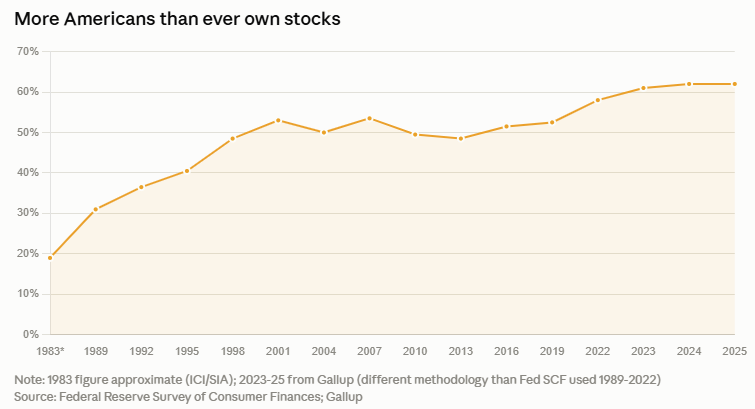
Assets in defined contribution plans broke the $1 trillion mark for the first time in the mid-1990s. There is now something like $12 trillion in defined contribution retirement plans.
And these plans are only getting better features.
There are now defaults in most of these plans that put workers into diversified targetdate funds. Some plans allow participants to automatically rebalance their portfolios and auto-increase the amount saved each year. Plus these contributions come out of your paycheck before you ever see it hit your bank account.
From a behavioral perspective, it would be hard to beat a 401k in terms of incentivizing better long-term behavior.
Could the current situation be improved?
Absolutely.
There are still far too many workers who don’t have access to a 401k plan. More than 30% of workers have no retirement plan option through their employer.
Here’s what I would do to improve the U.S. retirement system:
Give anyone who earns a paycheck access to a retirement plan run by the government. The Thrift Savings Plan, where federal workers save, is one of the best retirement plans ever created.
There are just 5 funds in the plan. All of them are index funds. The cost for each fund is five basis points or less.1 There are also targetdate fund options that utilize a mix of these low cost funds. Anyone who wants access to this retirement plan should have it.
And if your employer doesn’t have a retirement plan, you should be automatically enrolled in the TSP. If you don’t want to save, you can opt out. Don’t like your employer’s plan? You can access the TSP too.
This gets more people investing for the long run in a tax-deferred vehicle and more people invested in the stock market.
The 401k is pretty good. We should try to get as many people as possible saving in these plans.
Michael and I talked about 401k plans and much more on this week’s Animal Spirits video:
Subscribe to The Compound so you never miss an episode.
Further Reading:
My Stock Market Abundance Plan
Now here’s what I’ve been reading lately:
- How to remain calm (Safal Niveshak)
- Cash is an allocation (Big Picture)
- No one has it all figured out (Darius Foroux)
- Lessons from getting laid off and becoming a father (Esquire)
- Where do your childhood memories go? (Aeon)
- Your brain doesn’t see reality (Big Think)
- An oral history of The Town (The Ringer)
Books:
1That’s 0.05% or less for the non-finance people.