There are certain financial scripts ingrained in our culture when it comes to real estate.
A house is your biggest investment.
Renting is throwing away your money to pay someone else’s mortgage.
Housing prices always go up.
When you retire it’s time to downsize and move to the beach or golf course.
Rules of thumb are meant to be broken.
Here’s a recent story from The Wall Street Journal:
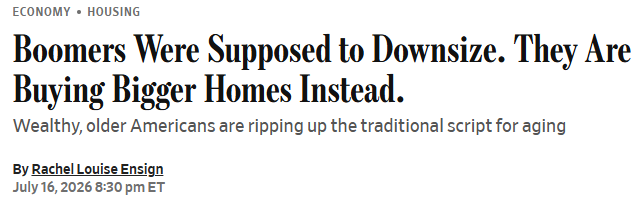
These are some quotes from the article:
The practice is even more common among affluent people. This generation’s considerable wealth is making upsizing possible. Baby boomers and those who are older hold around $110 trillion in total wealth, far more than younger Americans. Many bought homes and stocks decades ago and have benefited from the appreciation of those assets.
This year, eight of the clients of Merrill Lynch financial adviser April Tardiff retired. Every single one of them upsized. Only one client has downsized in the past five years.
“The historic retirement play of sell your home and buy a smaller one just isn’t happening,” said Tardiff.
“We’ll downsize when they plant me 6 feet into the ground,” said Victor, 64.
Baby boomers are the wealthiest generation in history. Many have paid off their homes and can afford to buy in cash. This is why 42% of homebuyers right now are boomers.
They don’t want to downsize? They don’t have to!
It’s their choice.
This is, however, making it tricky for young people with families who want to put down roots.
Kyla Scanlon wrote about this for The New York Times:
Since 2010, Americans 55 and older added roughly $20 trillion in real estate wealth. Americans under 40 added $3.5 trillion. Of the housing wealth America added since then, two of every three dollars now sit with Americans 55 and older. Empty nesters own about 28 percent of large homes in the U.S. Millennials with children own about 16 percent.
So older people are living longer in their big houses and buying up more houses in retirement. And housing has become unaffordable for many young people.
This could begin to challenge some of the long-held beliefs about housing in this country.
Pew Research has a study that shows just one-quarter of adults aged 18-39 think housing is a very good investment:
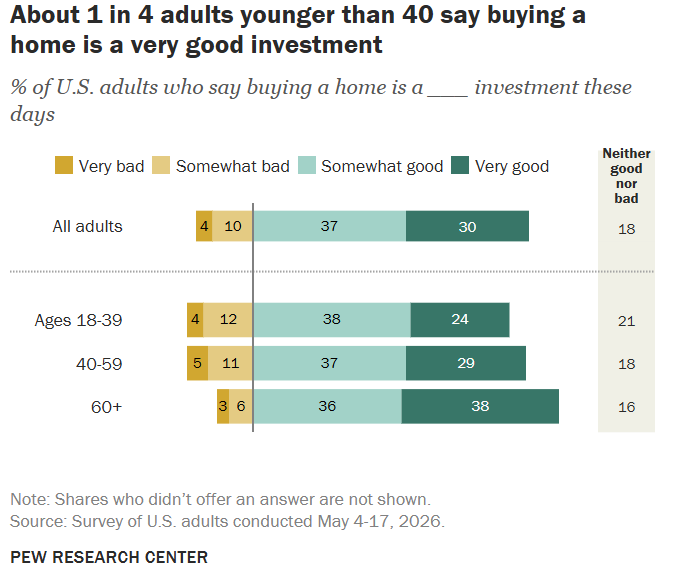
That’s much less than people in the 60+ age group.
One of the reason equity holdings for people under 40 have soared in the 2020s is because housing is unattainable to so many young households.
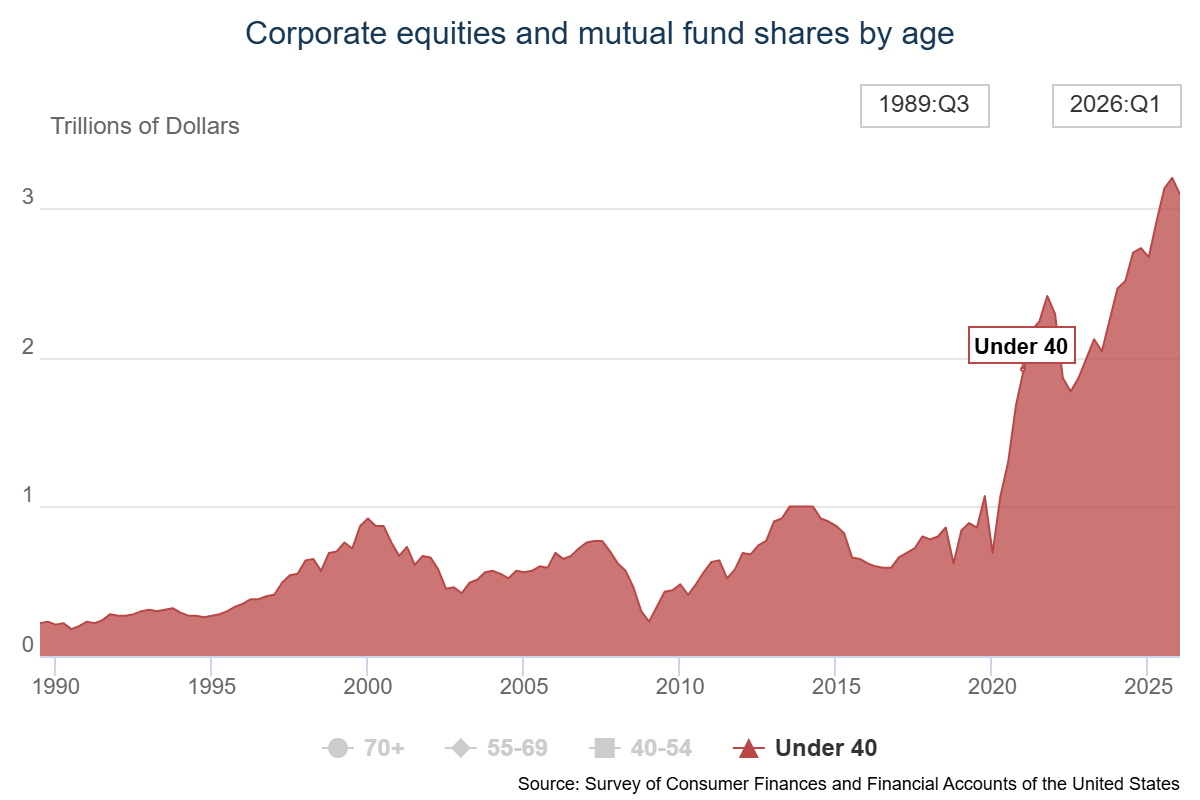
There’s no mystery about why this is the case:
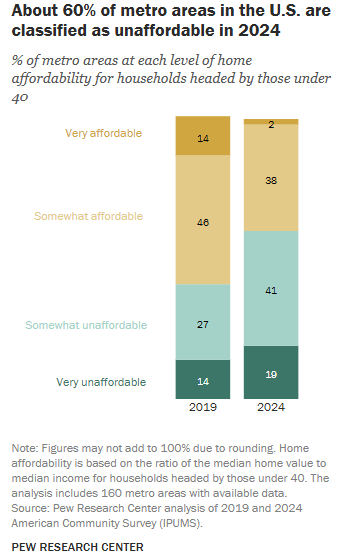
It would be wonderful if we decided to build more houses in this country. It would solve a lot of our problems, especially for younger people.
For whatever reason, this is not a priority for our policymakers.
There is a high likelihood that millions of young people who would have otherwise purchased a home will not do so because it doesn’t make sense for their finances.
Alison Schrager wrote a piece for Bloomberg about the housing market versus the stock market from an investing perspective:
The median house price in Nantucket, Massachusetts, is nearly $4 million. It was just $500,000 in 1995. This sounds like a stunning increase in one of the hottest and least accessible real estate markets in the country. What’s even more stunning is the stock market: If you invested $500,000 in the S&P 500 Index in 1995, you’d have more than $8.2 million today, even more if you reinvested the dividends you earned.
As a homeowner who has shelled out money for a new washer and dryer, a mole problem, a new garage door, an exterior power wash and interior vent cleaning in just the past month alone, I can attest to the fact that the housing returns are likely even lower than most people assume when all costs are included.
Obviously, there is a psychic income component to owning a home. It gives you an emotional return your stock portfolio never will.
However, I don’t think we have thought about the downstream effects of this.
What does it mean for the stock market?
Will young people end up wealthier because expensive housing forces them into the loving arms of the stock market?
Will they remain unhappy even with more money?
I think we’re going to test many strongly held beliefs about home ownership in the years ahead.
Further Reading:
Rich Old People