America is the wealthiest country the world has ever seen.
Of course, that wealth is not evenly distributed (and never has been).
It’s concentrated.
The top 10% control nearly 70% of the wealth in this country. The top 1% has the same amount of wealth as the bottom 90% (each is 32% of the total).
The top 1% owns more than 50% of the stocks, while the bottom 50% owns 1% of the stocks.
And it’s not just the top 10% or even the top 1% that have experienced the biggest relative gains in wealth. The top 0.1% have seen the most growth since 1989 by a wide margin:
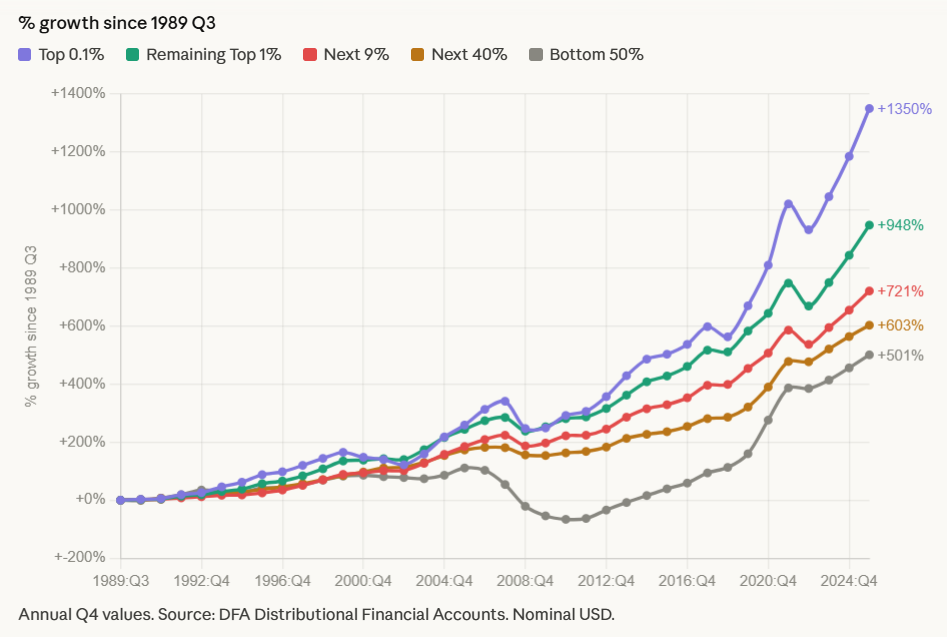
In 1989, the top 0.1% controlled 9% of the wealth in America. Today this group owns 15% of the money pie.
The Wall Street Journal has some pretty eye-opening numbers about the super rich class in America:
There are about 430,000 U.S. households worth $30 million or more, according to an analysis of Federal Reserve data by Zidar. Within that, there are about 74,000 worth $100 million or more. Over the past few decades, the growth in the number of very rich households has surpassed general population growth.
Here’s the accompanying chart:
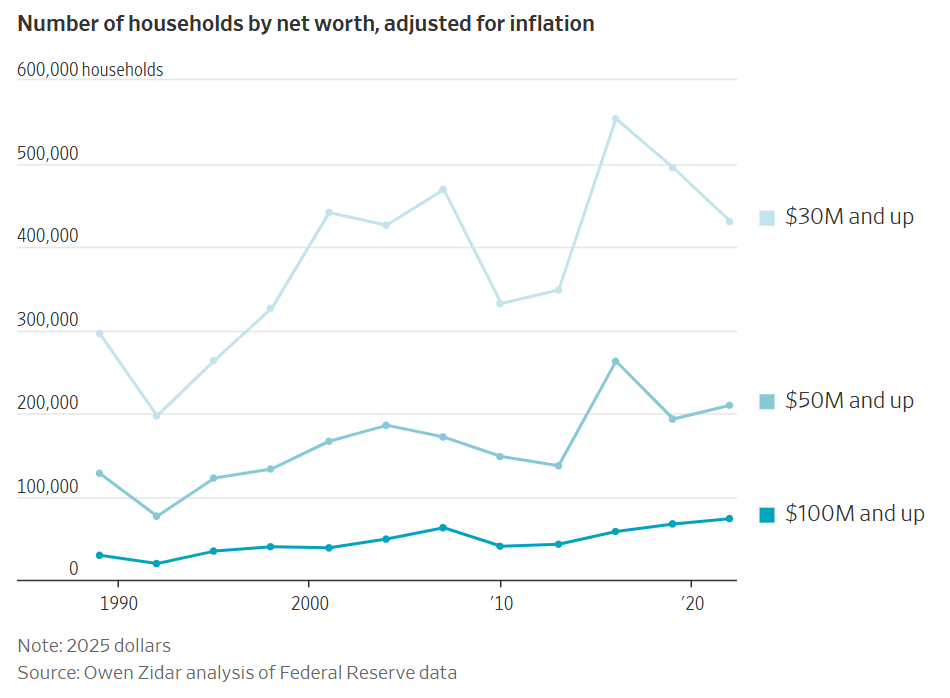
To be clear, these numbers are adjusted for inflation. The $50- and $ 100-million clubs seem to be letting more and more people in.
According to the Journal, the wealth of the top 0.1% has grown more than 13-fold in the past 50 years, and that’s even after adjusting for inflation.
Some people would claim this is a good thing because that much money is a source of motivation.
Some people would claim this is a bad thing because so much money is concentrated in the hands of so few.
Others would say it’s a somewhat natural outcome of the system we operate in.
Regardless of your feelings about how much wealth the top 0.1% controls, what are some potential outcomes from the increasing wealth concentration at the top?
Here are some thoughts, questions and observations:
This is one of the reasons we have so many rich people who don’t feel rich. Sure I make good money, own a beautiful home and have a portfolio that would make 95% of the population blush…but I don’t have a vacation home!
Sure I have a vacation home…but I don’t fly private!
Sure I fly private…but I don’t own a yacht!
Sure I own a yacht…but I don’t own an NBA franchise!
More super rich people means the regular old rich people don’t feel nearly as special. This is how you get rich people who consider themselves middle class.
Will AI make inequality worse? The AI outcomes are still up in the air but it’s a good possibility it will make the owners of the companies better off at the expense of workers.
Productivity gains. More efficiency. Fewer workers needed for certain tasks.
The equity in many companies could become even more concentrated.
How many people are going to despise AI in this scenario? What is the political blowback if that happens?
Speaking of politics…
Wealth inequality means more extreme election outcomes. How do you get Donald Trump elected as president again at the same time as Zohran Mamdani being elected mayor of New York City?
Inequality means rich people have more power when it comes to spending on elections but more politicians will focus on the financial fears of the bottom 90%.
Right or wrong, that means voters will be willing to give new voices and ideas a shot.
Can anything stop this train? The idea of a wealth tax on the super-rich is gaining steam with more politicians and countries, but implementation is much harder than it sounds.
Rich people are very good at shielding their wealth from taxes.
Anything is possible but short of some drastic measures it doesn’t seem like wealth inequality will be improving anytime soon.
Further Reading:
The Top 1%