The New York Times wrote a story in 1929 that’s fascinating to read with the benefit of hindsight:
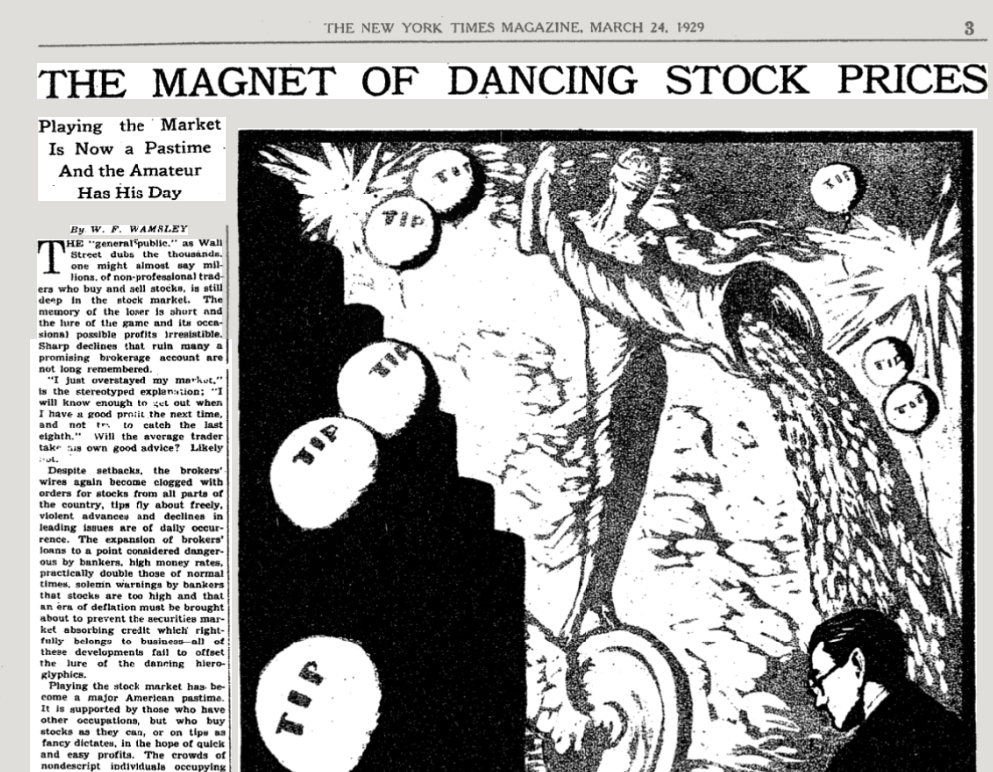
Some highlights as the Roaring 20s kicked into overdrive:
Despite setbacks, the brokers’ wires again become clogged with orders for stocks from all parts of the country, tips fly about freely, violent advances and declines in leading issues are of daily occurrence.
It is quite true that the people who know least about the stock market have made the most money out of it in the last few months.
Jesse L. Livermore, one of the shrewdest stock market operators of this generation, once declared that “stocks could be beat, but that no one could beat the stock market.” By that he meant that profits could be amassed on particular issues at special times, but that staying with the general market would financially defeat even the shrewdest market players in the long run. One cannot be ruled off for trying to beat the stocks, however, and members of the Stock Exchange will testify that thousands of amateurs are doing that very thing–and in a large way.
There’s a lot of stuff in here that sounds eerily similar to today’s environment.
It was the tail end of a glorious bull market.
Retail investors were beating the pros.
Investors were all in on the stock market.
It felt like nothing could stop the runaway bull market train.
Look at this chart from the Financial Times on how the most heavily shorted stocks have performed this decade:
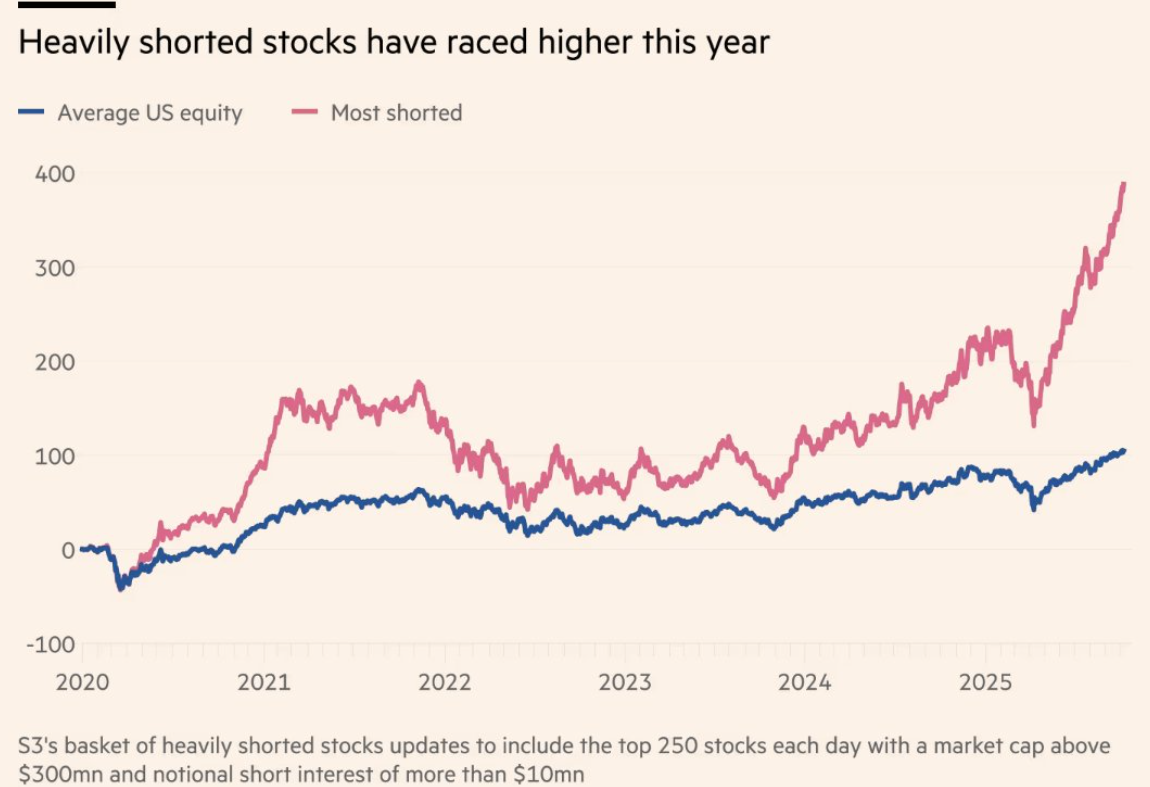
There are two different ways you could interpret this trend:
1. Speculation is out of control. Retail investors have gone all-in on speculative junky stocks.
2. Professional investors are getting worse at shorting stocks. I thought the hedge funds would have learned their lesson from the short squeeze in Gamestop and other meme stocks a few years ago.
It could be a little of both.
In his new book, 1929, Andrew Ross Sorkin talks about how Jesse Livermore used the excessive retail euphoria as a sign that the great bull market was coming to an end.
Livermore shorted the market to score an estimated profit of $100 million.1
The other famous contrarian indicator from The Great Crash was a shoeshine boy offering stock tips to Joseph Kennedy in 1929. He also profited by betting against the market before the peak.
That hard part about trying to use contrarian indicators in the information age is that you can find them everywhere you look.
There are so many more platforms for people to share opinions and analysis that there will always be fodder for any market stance you can want.
For example, I saw this story on The Today Show last weekend:

Almost everyone thinks we’re in an AI bubble right now. Everyone also thought there was a 100% chance we were heading for a recession in 2022.
That didn’t happen.
What if a bubble is yet another consensus opinion that turns out to be wrong?
This is what makes handicapping the stock market so difficult. There are usually plausible arguments on both the bull and bear side of the equation.
Livermore once said, “Another lesson I learned early is that there is nothing new in Wall Street. There can’t be because speculation is as old as the hills. Whatever happens in the stock market today has happened before and will happen again.”
That’s the human nature component that never changes.
People get excited, dejected, too high, too low and all of the other feelings.
The difference between now and previous market environments is that there are millions and millions of people sharing those feelings with the world every single day.
You can try to pick tops and bottoms if you wish.
Good luck trying because it’s getting harder by the day.
Michael and I talked about Jesse Livermore, retail investors, sentiment, the AI boom and much more on this week’s Animal Spirits video:
Subscribe to The Compound so you never miss an episode.
Further Reading:
Timeless Advice From Jesse Livermore
Now here’s what I’ve been reading lately:
- How to sell a winner (Belle Curve)
- Credit cockroaches (Optimisticallie)
- The writer’s room (Seth Godin)
- 9 things to know about investment returns (White Coat Investor)
- You can go your own way (Irrelevant Investor)
Books:
Also, check out my discussion with Nick Downer from Opto Investments about how AI is helping financial advisors with private investments:
Subscribe to our Talking Wealth newsletter here.
1Livermore used sentiment indicators as signals on numerous occasions to bet against the market — both to the upside and the downside. But it should be noted that while he made a fortune in the Panic of 1907 and the Great Depression, Livermore went broke multiple times because he couldn’t always outsmart the market, declared bankruptcy and eventually took his own life following a bout of financial troubles.