This Jensen Huang situation is one of the craziest market stories I’ve ever seen.
The most important CEO of the most important company in the most important technological innovation this century just resigned during the middle of an AI boom.
Huang is quite possibly the most central figure in orchestrating the AI buildout. I don’t think we’ve even begun to figure out what all the ripple effects will be from the fallout of this scandal.
There is so much going on here.
I don’t want to get into the affairs, potential spy operation, importance of chip technology in the race for global AI world domination with China, etc.
I want to look at this from a stock market perspective.
The stock was down almost 14% last week alone.
Nvidia is down more than 30% from the highs and it happened in a hurry.
The market cap was $5.8 trillion a month ago. It’s shed nearly $2 trillion since then.
In October Nvidia was almost 8% of the S&P 500. Even after the crash it still makes up more than 6% of the total and remains the second largest position in the index (for now).
Now look at the difference in drawdowns between NVDA and the S&P 500 (via Exhibit A):
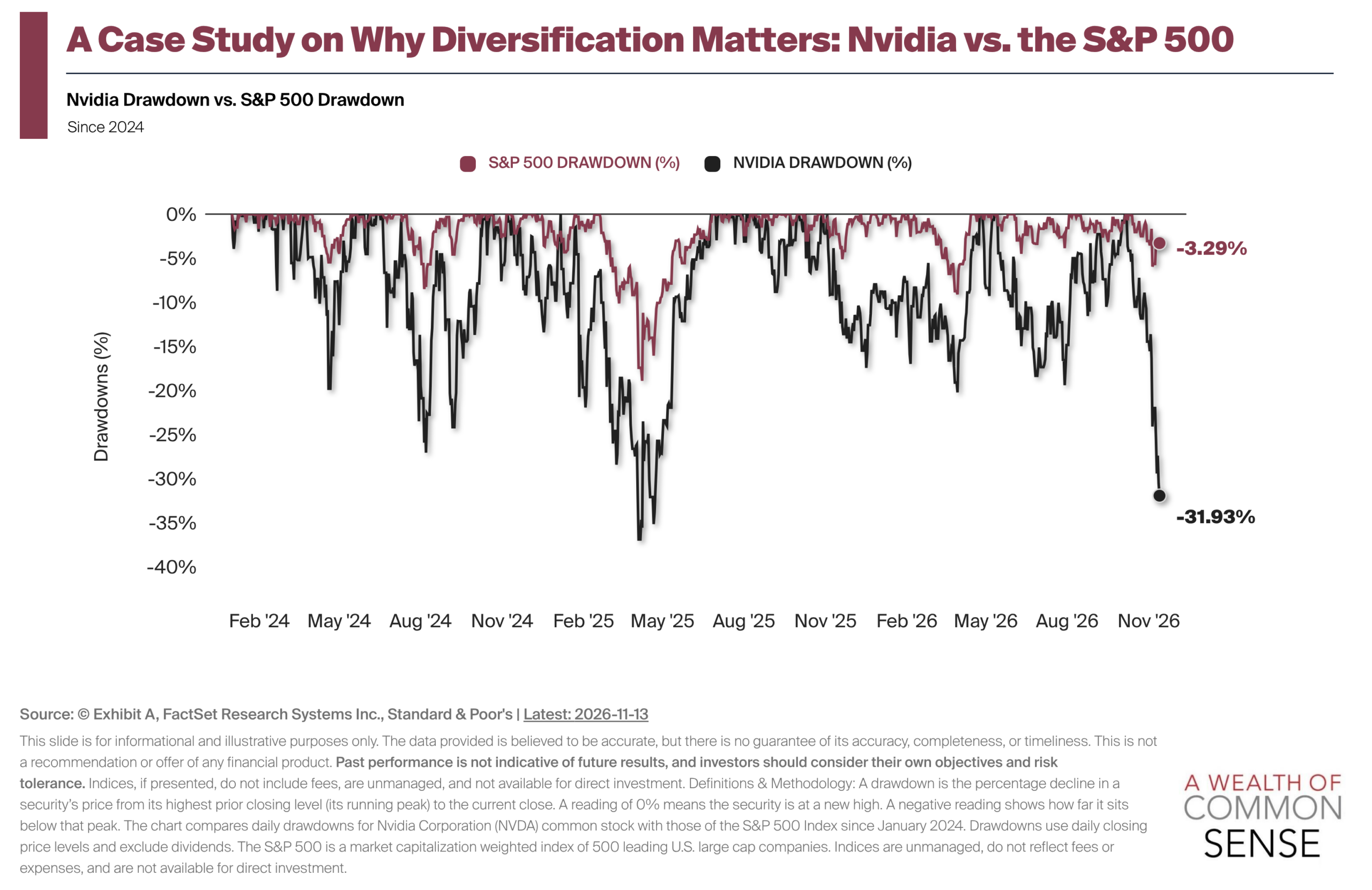
One of the biggest, most influential stocks in the S&P 500 got marked down by one-third in five weeks and the market barely budged.
This market is incredible.
Nvidia’s stock price isn’t the only thing crashing at the moment for the company. The valuation has been in a freefall for some time now:
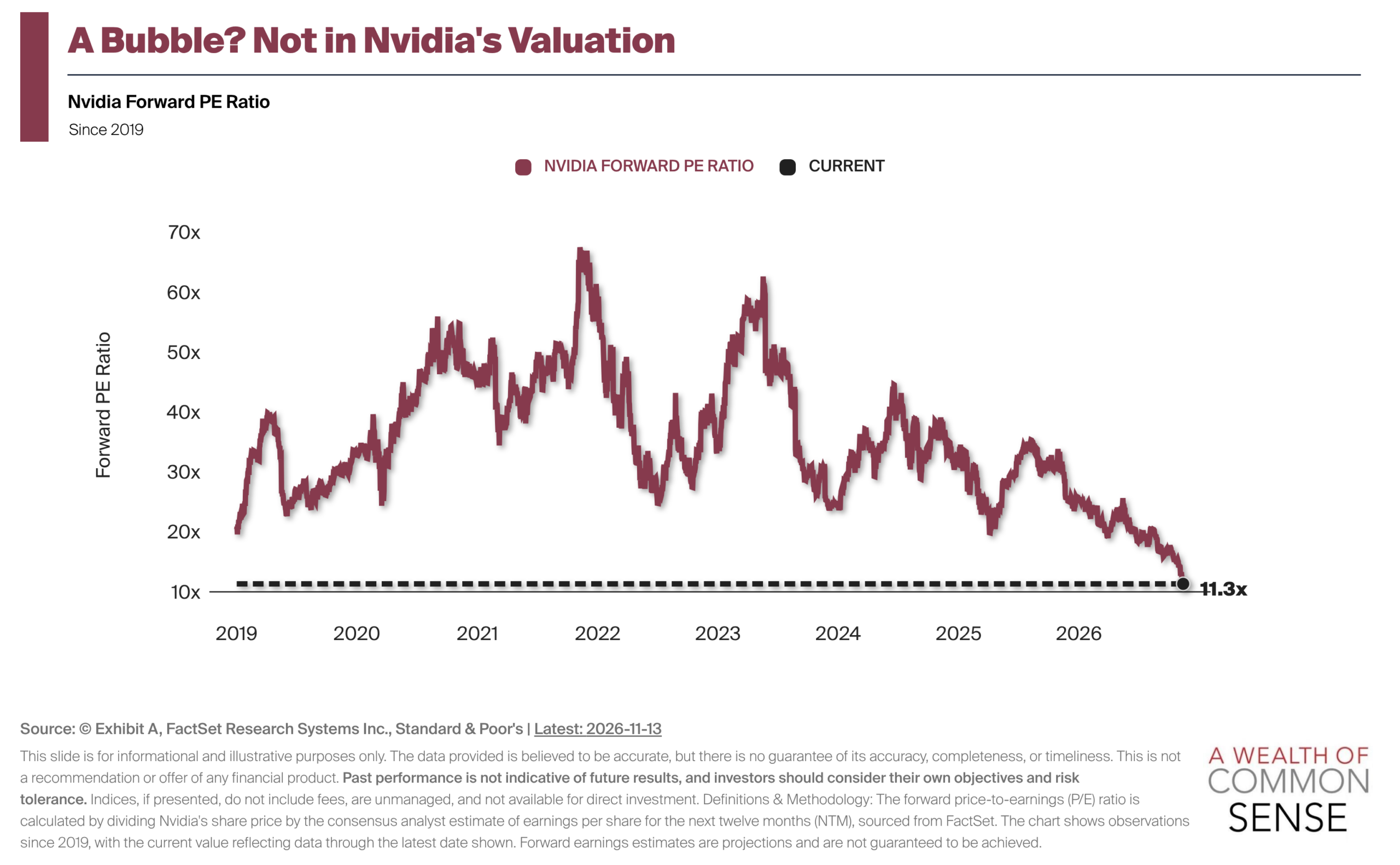
For context, the S&P 500 currently trades at a little more than 18x its forward earnings estimates. That means Nvidia is trading at nearly a 40% discount to the market.
The fundamentals are still there. Earnings are growing like crazy. Will they continue to grow in the future?
I don’t know.
A similar dynamic is playing out in semiconductor stocks. The sector is down almost 30%:
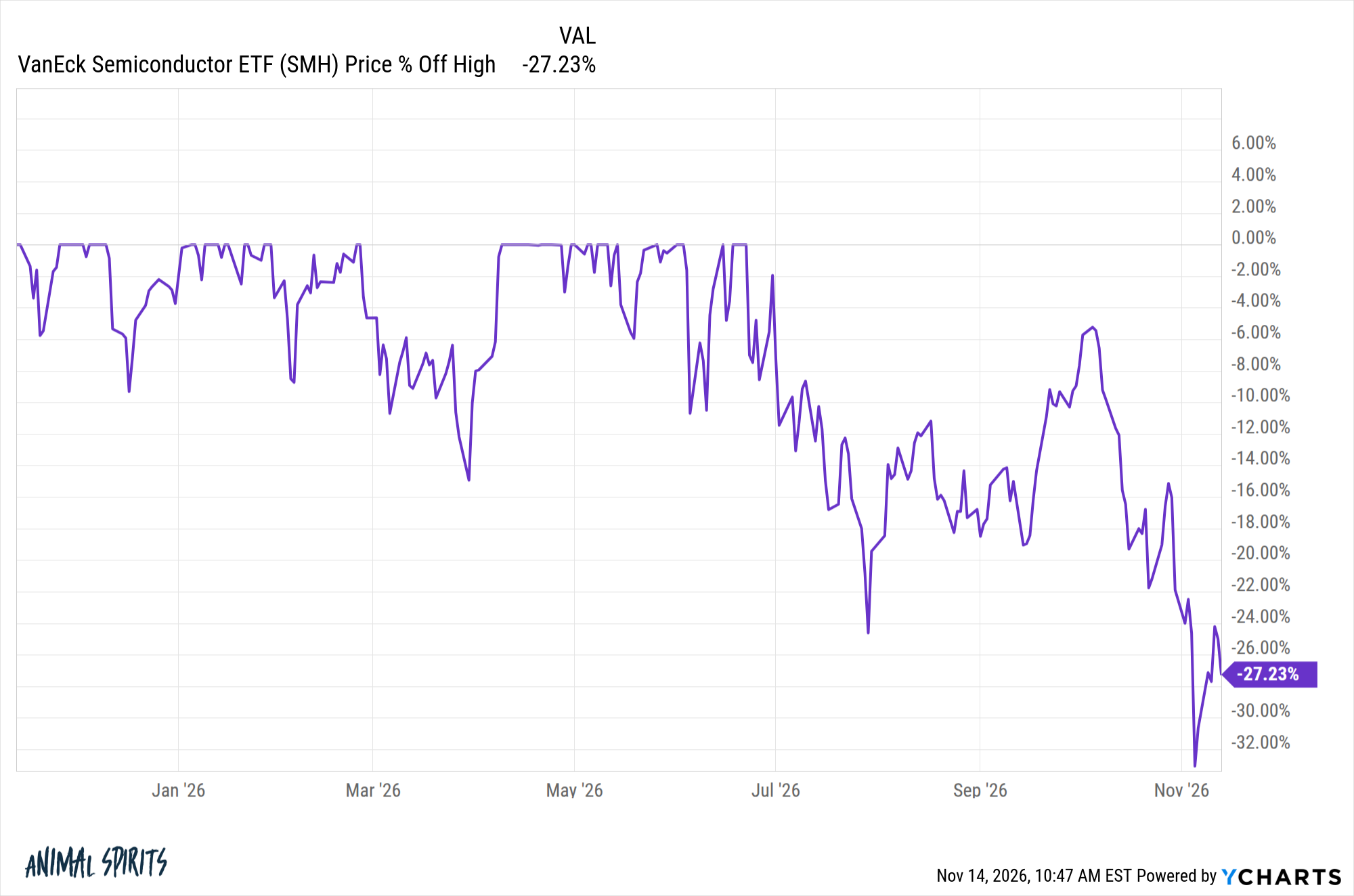
This makes sense when you consider Nvidia is the biggest holding in this fund.
However, a lot of other semiconductor stocks are getting creamed right now too:
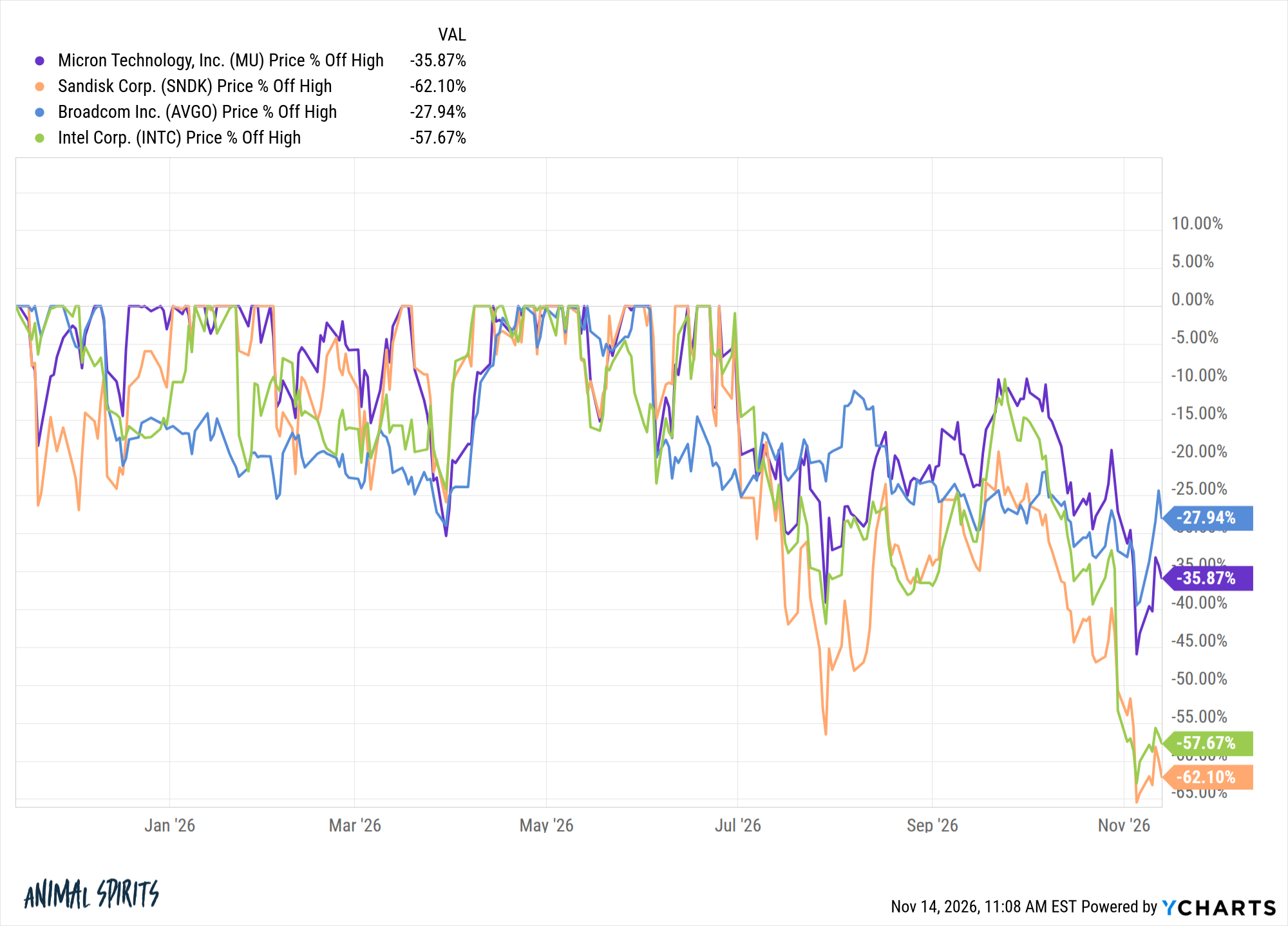
These companies had some massive gains earlier this year so it makes sense they would be volatile.1
Similar to Nvidia, the fundamentals are still there but the prices don’t care at the moment.
Look at how the the relationship between estimated earnings and stock prices has broken down of late:
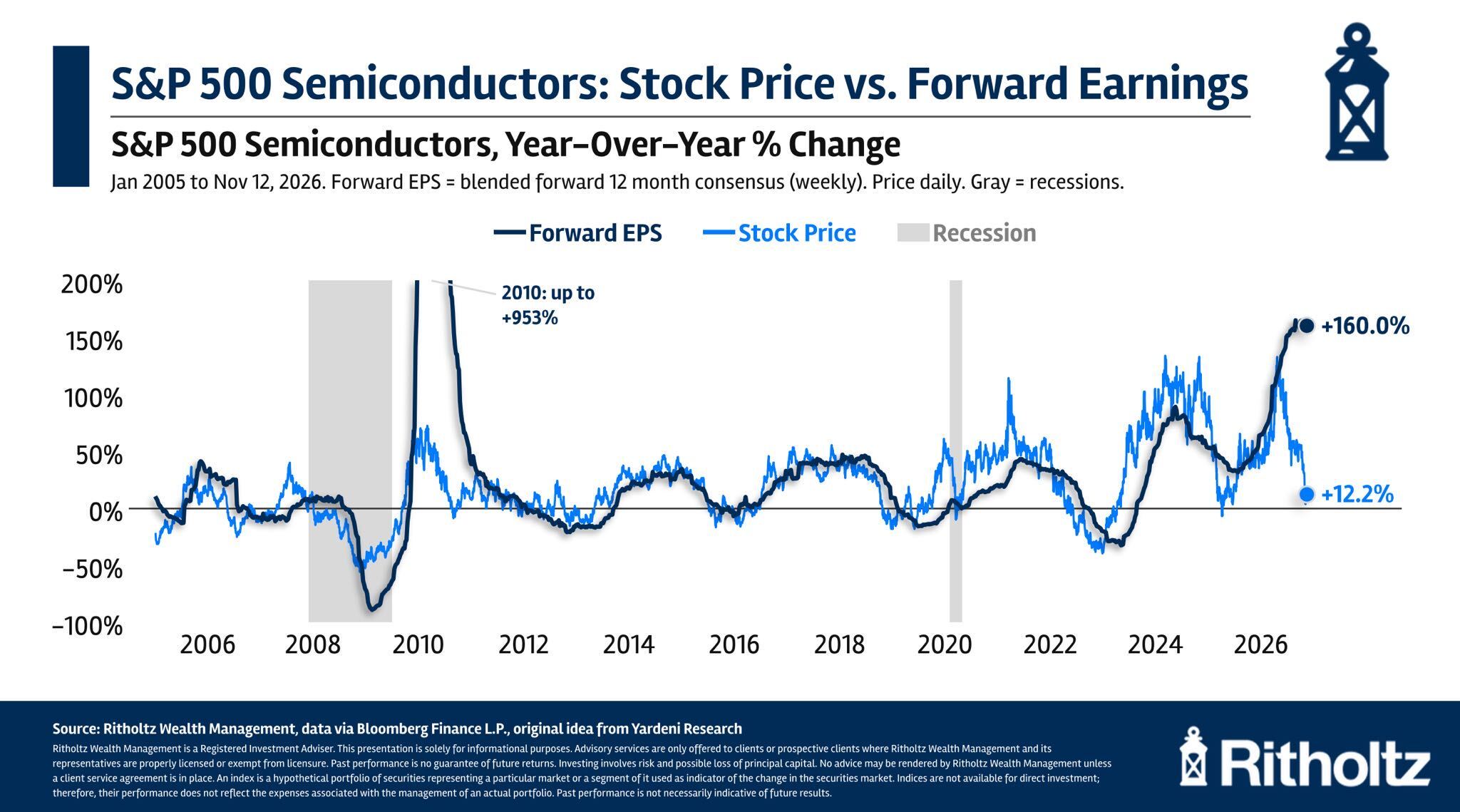
It’s a huge divergence.
Earnings estimated keep getting ratcheted up but prices are falling.
Of course, semiconductors are known for extremely cyclical earnings growth. You can see it in the chart.
There are a few interesting observations to be made about this divergence between prices and fundamentals going on in AI stocks right now:
Maybe investors don’t want a bubble. Tech valuations keep falling even as the stock market keeps rising. It’s quite possible investors have learned their lesson and don’t want to take multiples to nosebleed levels during a boom.
This could be a sign of sobriety in the market.
The market is usually right. The market doesn’t seem to believe the high level of earnings will continue into the future.
The market is not always right but it’s right most of the time. What if it’s wrong this time and earnings aren’t as cyclical as they were in the past?
It can pay big time to be a contrarian when the market is wrong. You can also get run over since contrarians are wrong most of the time (by definition).
That’s what makes this game so interesting in times like these.
Picking AI winners and losers is nearly impossible. Who could have possibly predicted a few weeks ago the Nvidia would be crashing because their CEO got caught up in a scandal like this?
Maybe the company will come back even stronger.
Maybe the shareholders will get their way and Jensen will come back as CEO.
Maybe there will be new winners that pick up the slack.
Maybe this really is the end of the AI boom for now.
Maybe this is all impossible to predict at any given time and being certain about anything will surely make you look foolish in a matter of days or weeks.
Here are some questions to ponder when thinking about AI forecasts:
What edge do you have that will allow you to understand who the winners and losers will be in this arms race?
What are your guidelines for when to sell?
When will you admit you were wrong?
What is your position sizing if you are trying to pick the winners or avoid the losers?
Do you need to pick the winners in order to achieve your financial goals?
Every new AI story leads me to believe that the only certainty here is uncertainty.
Trying to forecast when this boom will end, how it will end, who will win and who will lose is a game I don’t want to play.
There’s no shame in admitting that most of the time the market is too hard to predict.
Further Reading:
This is Why You Need a Plan
1SMH is in a 28% drawdown but still up 35% on the year.