Ten years ago Nvidia was a $50 billion company.
Heading into the 2020s, the market cap was $150 billion and video game GPUs were its main business line.
By October of this year, Nvidia was arguably the world’s most powerful AI company and worth almost $6 trillion. Heading into this decade the company made up roughly 0.5% of the S&P 500. That was up to more than 8% last month.
It’s been a meteoric rise.
That is until Jensen’s scandal and resignation brought the meteor back to Earth:
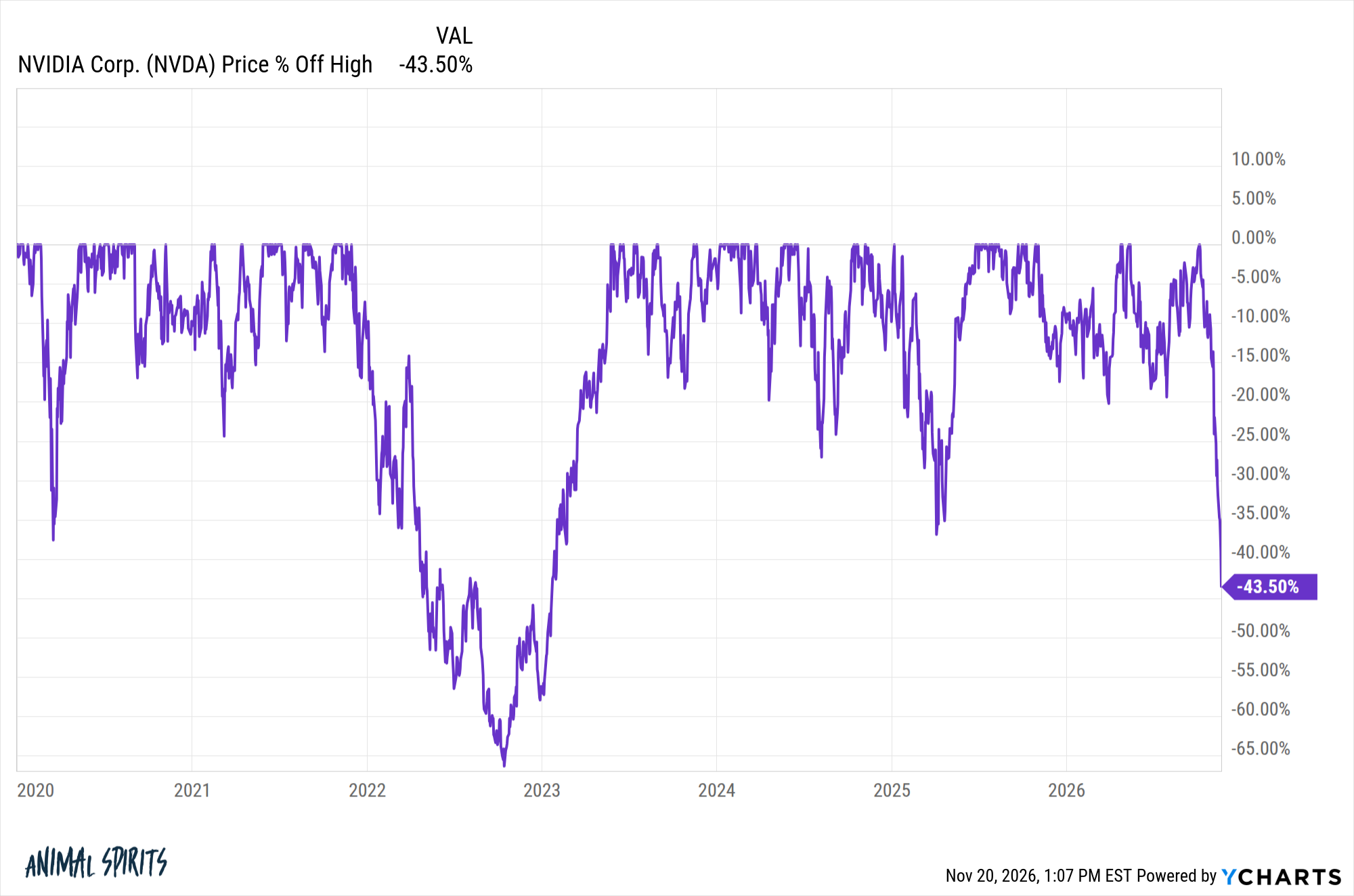
Nvidia is now down more than 40% in since early-October.
However, you can see from the chart that Nvidia has a history of large drawdowns, even this decade when the company’s stock price took off like a rocket ship.
It dropped more than 35% during the Covid crash. In the 2022 bear market, the stock price crashed by almost 70%. In the Liberation Day sell-off it was down close to 40%. That’s three times this decade getting clobbered more than 30% along with eight other double-digit corrections.
If you bought the dip in those previous corrections, you were handsomely rewarded.
On the day Jensen resigned, the stock was down 9% (and was down even more than that throughout the day). So what did investors do?
They bought the dip. Here’s the data from Vanda Research:
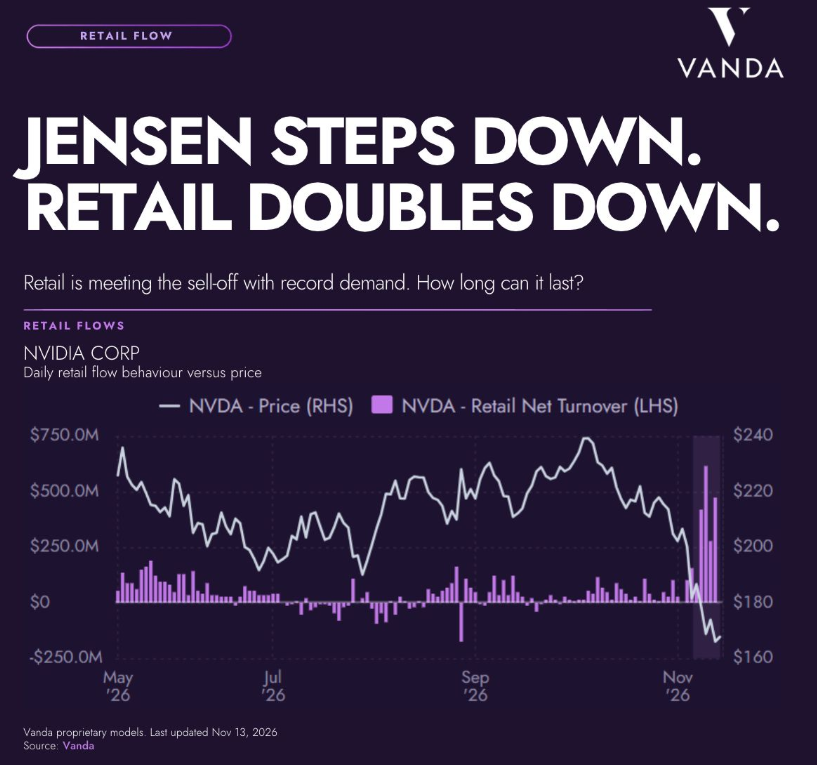
There was an insane amount of retail buying in the stock.
Here’s one more chart from Sherwood for good measure:
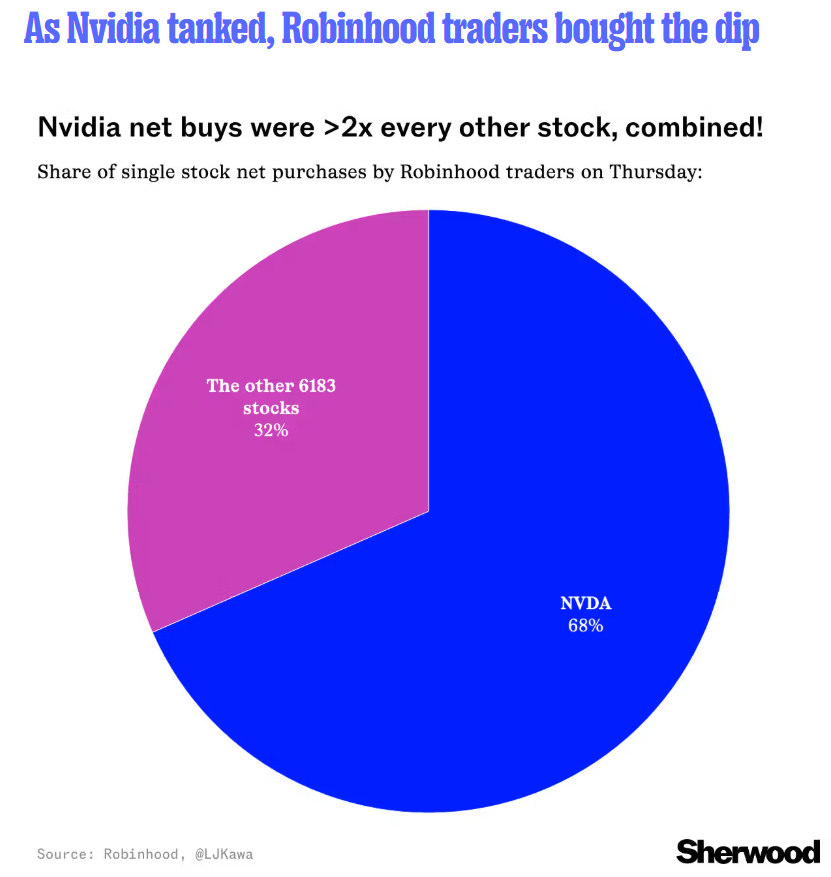
There’s the old adage that the stock market is the only store where the products go on sale and people run for the exits instead of buying. Well, that’s not the case anymore.
When tech stocks crash, investors have become conditioned to step in and buy the dip.
Every other drawdown in NVDA shares has worked out spectacularly for investors.
Will it work out this time?
I don’t know.
Maybe this is an Apple situation where the successor keeps the stock moving higher. Or maybe this is one of those times where a huge company stumbles and never recovers it’s previous perch on the mountain top.
JP Morgan’s Michael Cembalest shows there is a history of mega cap companies that get knocked from their perch but never regain top billing:
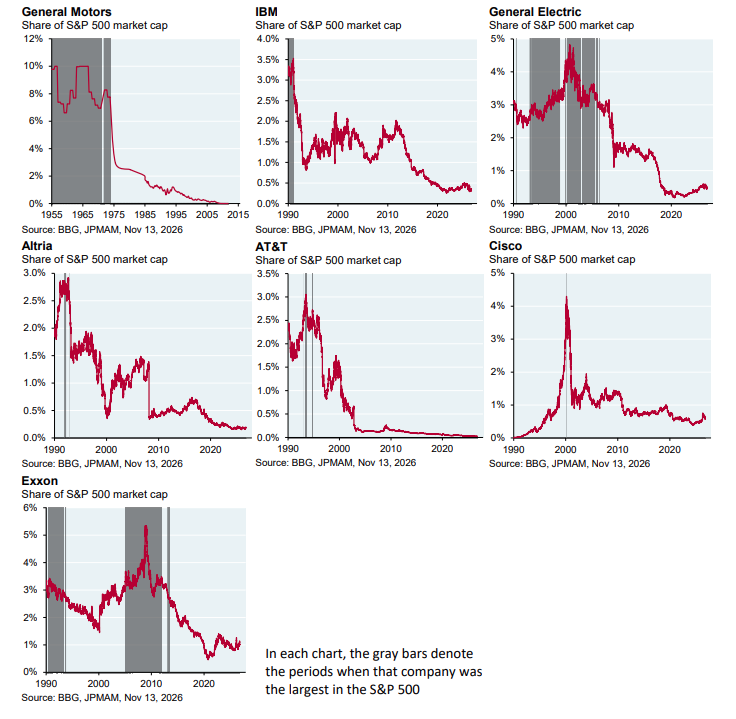
This is the agony and ecstasy of the stock market. No one knows if Nvidia will lose market share or come charging back for the throne.
Beyond any one stock, it is interesting to consider this buy the dip behavior of investors.
Most stock market corrections don’t turn into gigantic bear markets. But those things do happen on occasion. What will buy the dip retail investors do if we get a long drawn out bear market?
Eventually you run out of cash to keep buying the dip. Then what? Do you tap out? Sell? Hold on for dear life?
The dot-com bubble is a great test case for this scenario since there are a lot of similarities to the current market cycle.
Just like the 2020s in the late-1990s there was:
- An explosion in retail investor participation.
- Concentrated bets being made on a new and exciting technology.
- A widespread belief that the good times would last forever.
- More households than ever investing in the stock market for the first time.
In fact, more than half of all equity shareholders in 2002 had made their first purchase after 1990. One-third of households came into the stock market after 1995, which is when the dot-com bubble really kicked in.
Did they sell.
Not really.
Maggie Mahar documented the 1980s and 1990s bull market along with the bursting of the dot-com bubble in her book Bull: A History of the Boom and Bust:
So, even after it became clear to the vast majority of investors that the Great Bull Market of 1982-99 had ended, mutual fund investors stood firm. The mass redemptions from equity funds that many had predicted never took place. As late as March 2003, Gail Dudack observed: “Net redemptions since the beginning of 2002 have been tiny compared with total stock fund assets. The net cash outflow in the 12 months ending March 30, 2003, amounted to 3.6 percent of the sector’s assets.
“Everything I own has gone down too much–I can’t sell now,” confided one 401(k) investor. “The market is coming back–this is a buying opportunity,” said another.
That’s surprising right?
The S&P 500 crashed 50%. The Nasdaq 100 got demolished, down more than 80% from the bubble highs.
If you look at household equity ownership, it stayed relatively stable throughout the bursting of the dot-com bubble from 2000-2002 and the initial years after the crash:
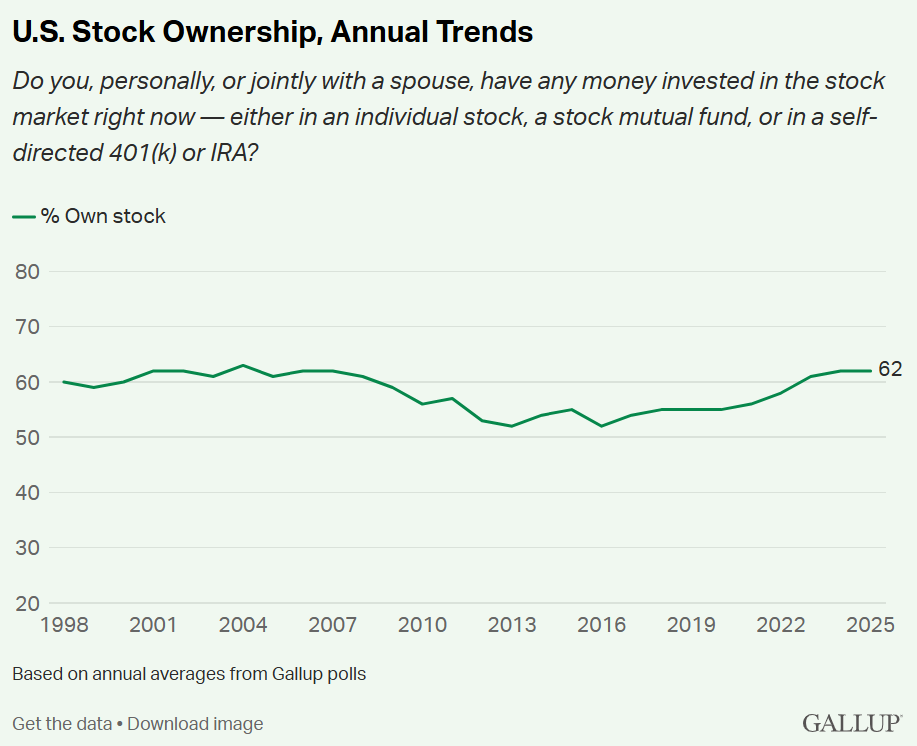
It wasn’t until the Great Financial Crisis in 2008 that equity ownership rates began falling. After topping out at 63% in the mid-2000s, household ownership of stocks fell to 52% by 2013.
Why didn’t people give up from the dot-com crash but they did following the GFC?
I think a big part of it is the economy.
There was a recession in 2001 but it was shallow and mild. The economic contraction lasted only 8 months with GDP falling just 0.3%. The unemployment rate increased from just under 4% to 6.3% at the highs.
There was far more pain in the stock market than the economy coming out of the late-1990s euphoria.
The Great Financial Crisis was much worse on the economy. The recession lasted a year-and-a-half. GDP fell by more than 5%. The unemployment rate rose to more than 10% when all was said and done.
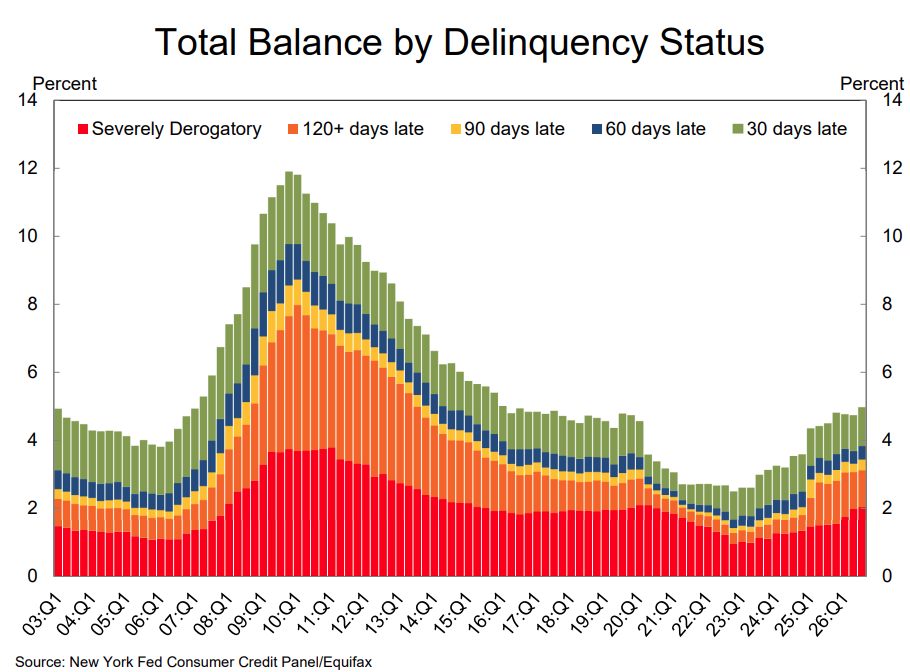
Plus you also had one of the biggest housing market crashes in history. People were getting foreclosed on their homes. There were far more late payments on debt:
It didn’t help that the stock market got cut in half twice in the same decade.
But it really took an economic calamity to get people to bail out of the stock market.
My best guess is the economic environment during the next downturn will have a big say in how retail investors react to a crash.
It’s much easier to step in and buy with the unemployment rate at 4%.
Once you lose your job it’s much harder to worry about the stock market. But it’s not just people being unemployed. Your tolerance for risk can change just by seeing peers, co-workers, friends or neighbors lose their job.
A buy the dip mentality might survive a relatively minor recession. That’s a much harder strategy during a financial crisis.
There’s the old saying that during bear markets, stocks return to their rightful owners.
Those rightful owners aren’t always the people with the most discipline. Sometimes it’s simply the people who can survive the downturns with their job and savings in tact.
Michael and I talked about the Jensen-Nvidia saga, retail investors buying the dip and much more on this week’s Animal Spirits video:
Subscribe to The Compound so you never miss an episode.
Further Reading:
Do We Need a Long Bear Market?
Now here’s what I’ve been reading lately:
- How to be a better writer (Jason Zweig)
- How much should you have saved for retirement? (Of Dollars & Data)
- Best finance books of the year (Idea Farm)
- Do you need to invest in rental properties? (The Purpose Code)
- Bumbition (Noah Smith)
- How the eggheads cracked (New York Times)
Books: