Nvidia’s stock price was down more than 30% heading into last week.
Then Jensen Huang resigned and all hell broke loose.
The stock was down nearly 23% last week alone. That left NVDA almost 50% off its highs which were reached in the first week of October.
That’s an enormous crash for one of the biggest, most important companies in the world.
Last week’s stock market swoon is likely the biggest reason the board reinstated Huang as CEO Monday morning.
The shareholders, employees and President of the United States thought Huang was so important to the company, they did everything in their power to bring him back:

There are a few lessons here that are worth considering.
The stock market usually gets what it wants. In the fall of 2008, the House voted down the TARP bailout package for the banks. The stock market threw a tantrum and fell close to 10% that day. The bailout passed a couple of days later.
In March of 2020, the stock market crashed 35% in a matter of weeks when Covid changed the world. The market falling apart is one of the big reasons the Fed and government acted so swiftly with fiscal and monetary policy to shore up the economy.
In the spring of last year following the Liberation Day tariff announcements, the stock market dropped 5% and 6% on back-to-back days. The S&P 500 was down 19% in the blink of an eye. This caused the President to put a 90-day pause on the tariffs.
I think you could make the case that everyone acted so quickly to bring Jensen back to Nvidia because the stock market sold off so hard last week. Nvidia getting cut in half forced everyone’s hand.
The stock market got what it wanted…again.
Jensen is THE key man in the AI buildout. On Friday Nvidia closed with a market cap of $3 trillion. After the stock rose more than 30% on Monday, the market cap was $4 trillion.
Is Jensen worth $1 trillion to the company? It’s possible.
Ben Thompson explained the importance of Huang to Nvidia in a piece last week at Stratechery:
Nvidia’s most important moat, however, was the degree to which it was not a normal company. Huang organized Nvidia as an exoskeleton around one man: himself. There is very little management at Nvidia — Huang famously has 60 direct reports — for the same reason that there was no succession plan: Nvidia could move so quickly and so aggressively because the company still behaved as if it were a startup. Indeed, lots of established companies — including those still led by founders — claim to still be a startup, but only one, Nvidia, really was organized that way. That paid off with all of those successful bets; it also created an environment where there were no checks on Huang. And, now that he is gone, the exoskeleton is much more poised to collapse than you might expect.
I knew this was a powerful founder, but I may have been naive about just how powerful he really is for this multi-trillion-dollar company.
The tech industry likes it when a founder wields all of the power. That’s also an enormous key person risk for a technology that costs trillions of dollars to build.
The rich and powerful seem to operate with their own set of rules. A lot of people will be rightfully upset by how this all went down.
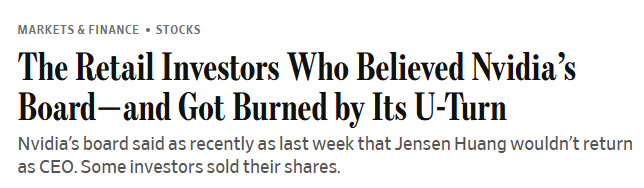
Obviously, the board fumbled this process from the outset. They could have completed their investigation before forcing his hand to resign. Plus, on last week’s earnings call they explicitly said Jensen would not return as CEO. There are going to be some lawsuits here:
In many ways, it feels like the rich and powerful are immune to the consequences of their actions. It’s always been like this to some degree, but it feels like it’s more apparent now than ever before.
In her novel, The Glass Hotel, Emily St. John Mandel writes about a character who starts a relationship with an uber-rich Bernie Madoff-like hedge fund huckster.
After living a life of luxury, she comes to a realization about what it’s like to be fabulously wealthy:
You know what I’ve learned about money? I was trying to figure out why my life felt more or less the same in Singapore as it did in London, and that’s when I realized that money is its own country.
The stock market feels like it is its own country too.
The stock market is amoral. The stock market has no morals or ethics. It does not have political affiliations. The stock market has no feelings.
It only cares about profits and growth.
Sometimes things can happen with companies or the market that you don’t personally agree with.
You don’t have to like it but it’s important to understand this dynamic.
The stock market is more important than ever. I wrote an entire chapter in Risk & Reward about the history of stock market ownership in America because that trend is one of the most important forces of the economy in the past 50 years.
Now that two-thirds of households own stocks in some form, the incentives are much different than they were in the past when 10-20% of households owned stocks.
The stock market is more powerful than ever. It’s a driver of economic activity. It’s how people save and invest for retirement.
Everyone wants it to go up. You don’t have to like it, you don’t have to agree with it but in some ways the stock market is now too big to fail.
Are we adding new and unintended risks to the equation by focusing so much attention on the stock market?
Absolutely.
I just don’t know when or how those risks will rear their ugly head.
When we do have a financial crisis that impacts the stock market in a big way, the pain is going to be felt more broadly than it was in the past.
Further Reading:
Risk is a Four Letter Word