Here’s a chart of U.S. consumer sentiment that goes back to the early-1950s:
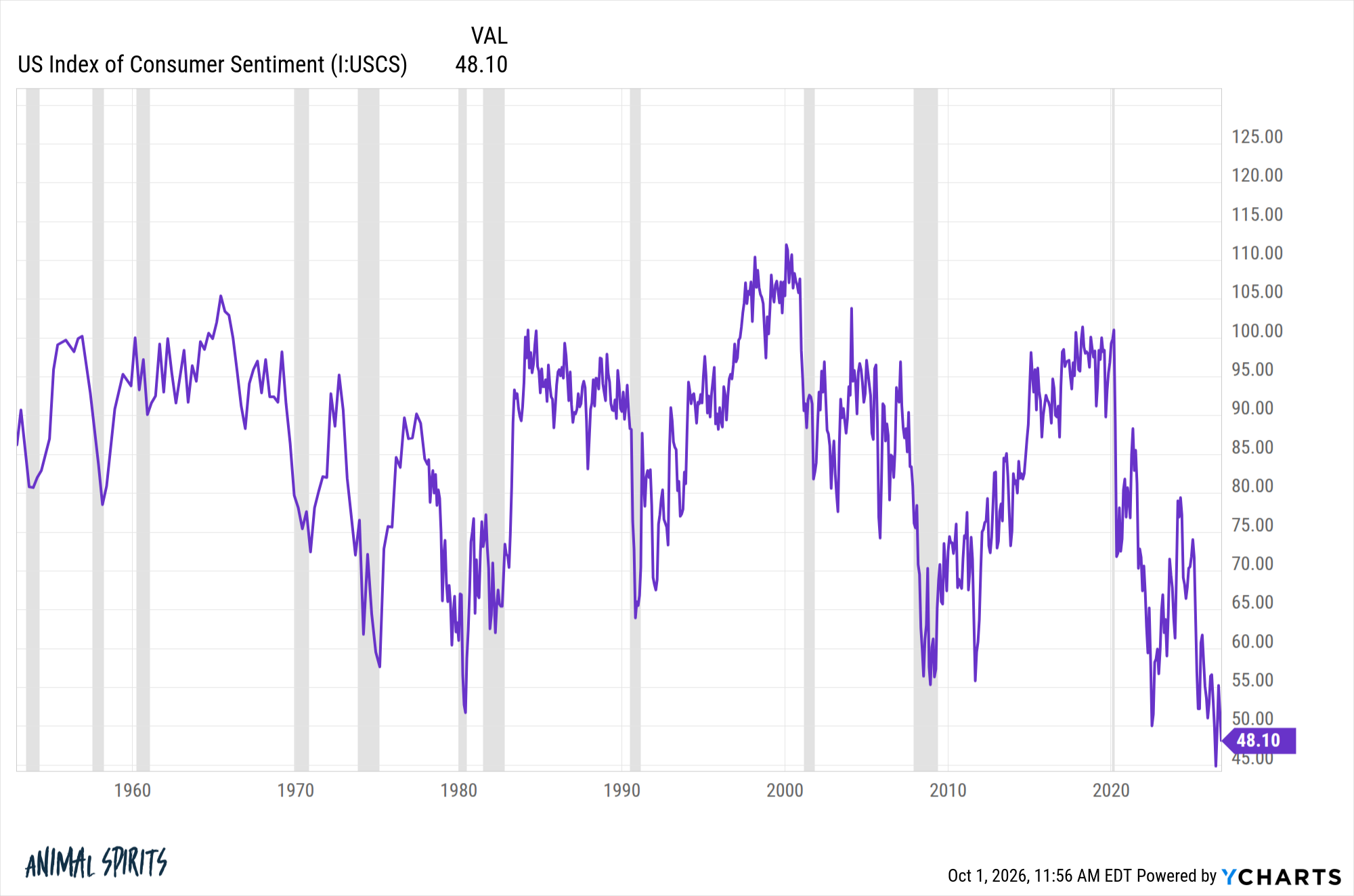
Consumer sentiment is currently lower than it was during:
- 9% inflation in 2022
- The Covid pandemic
- The 2008 financial crisis and bursting of the housing bubble
- 15% inflation and 18% mortgage rates in the early-1980s (that ended with not one but two recessions in 3 years)
- Stagflation and the energy/inflation shocks of the 1970s
- The Vietnam war
- The Cold War
- 11 recessions in total
- 11 bear markets including 3 that cut the market in half
How is this possible with the stock market at all-time highs, the unemployment rate at 4%, household net worth higher than it’s ever been and an economy that hasn’t had a real recession in nearly 20 years?
There are a lot of reasons to consider.
Price levels. Households don’t care that the trailing 12 month inflation rate was 3.4%. They do care that consumer prices are up 30% since the start of 2020. Yes, wages are up too but the cost of the big ticket items like automobiles and housing give you sticker shock that can be jarring.
People hate high inflation.
Plus this move up in prices happened so fast that no one was able to slowly acclimate to higher levels. Lower prices are still fresh in everyone’s memory.
Housing costs. On the one hand, we have a 65% homeownership rate in this country so most people have been insulated from rising home prices and mortgage rates. It’s a much smaller subset of mostly young people who have been shutout of the housing market.
But the fact that housing prices are so much higher makes it difficult for people to move. Many people feel trapped in their current homes. No one like 7.5% mortgage rates, especially if you already have a 3% mortgage.
So young people are angry about housing costs but so too are homeowners who feel trapped and can’t move as freely as they would like.
This is why housing activity is at financial crisis levels right now.
Wealth inequality. The top 0.1% now controls 15% of household net worth in America. It was 8.6% in 1989. It feels like no matter the environment, the uber rich just keep getting richer. For people who are struggling, it’s not fun to see that.
Politics. Everything is now turned into a political issue where it feels like you’re forced to take sides. It’s all so exhausting to constantly look at every issue through a lens of your team vs. my team.
Add in the fact that politicians have not a single shred of shame left and political grifting is off the charts and that’s a fair reason for some negativity.
Social media. Social media rewards sensationalism, doom and pessimism. If it bleeds it leads has always worked for the news and that’s even more amplified on social media.
War. The war has caused a huge spike in energy prices. Gas prices are pushing $5 nationally. No one likes high gas prices and it feels like we will never learn our lesson about starting expensive wars in the Middle East.
The pandemic. Sentiment fell off a cliff during the pandemic and hasn’t come close to hitting those pre-pandemic levels since.
Those are all legitimate reasons many people are sour on the economy right now, right?
But come on.
If you think this is worse than the Great Financial Crisis or the 1970s you need a swift kick to the pants. That’s a ridiculous stance to take.
I’m sure there are some young people who do feel this way because they need more life experience but there are others who obviously know better.
Now I’ll share with you my favorite reason for all-time lows in consumer sentiment — it’s a survey and they changed the methodology of the survey.
The University of Michigan used to conduct phone interviews to gather data on how people are feeling about the economy. But who answers their phone anymore from someone they don’t know?
So in 2024 they changed it to an online survey. Surely, this allows them to have a bigger sample size of people answering questions.
But guess what people do online that they don’t do nearly as much when talking to a person? They lie! They’re more sensational! They say things they don’t actual do or believe!
Who actually answers these things anymore?
Yes, people are pissed off about inflation, wars, housing, wealth inequality, the new Taylor Swift songs and much more.
It’s also true that it’s becoming harder and harder to gauge sentiment in an online world where people have one persona in real life and another one on the internet.
Take these numbers with a giant grain of salt.
Michael and I talked about the economy, consumer sentiment and much more on this week’s Animal Spirits video:
Subscribe to The Compound so you never miss an episode.
Further Reading:
Ignoring the Noise is Impossible
Now here’s what I’ve been reading lately:
- The fall of the creative class (Apricitas Economics)
- Is the bond market at a tipping point? (Discipline Funds)
- Some lessons on asset pricing (Pedro Santa Clara)
- Who is really rich in America? (Of Dollars & Data)
- Great parents make great kids (A Teachable Moment)
- The death of the American host (Derek Thompson)
Books: