Why Are Valuations Falling in a Bull Market?
Posted September 15, 2026 by Ben Carlson
Some notable market moves we’ve experienced this year:
Mortgage rates have gone from 6% to 7%.
The 10 year Treasury yield has gone from 4% to 5%.
The inflation rate was 2.4% earlier in the year. Now it’s 3.4%.
Oil prices have shot up from less than $60/barrel in January to more than $100/barrel today.
That has caused the average nationwide gas prices to rise from $2.90 to well over $4 a gallon.
If you were to look at these numbers in a vacuum it would be a logical leap to say this has to be bad for both the stock market and the economy.
But the economy keeps chugging along. And the stock market is up double digits yet again this year.
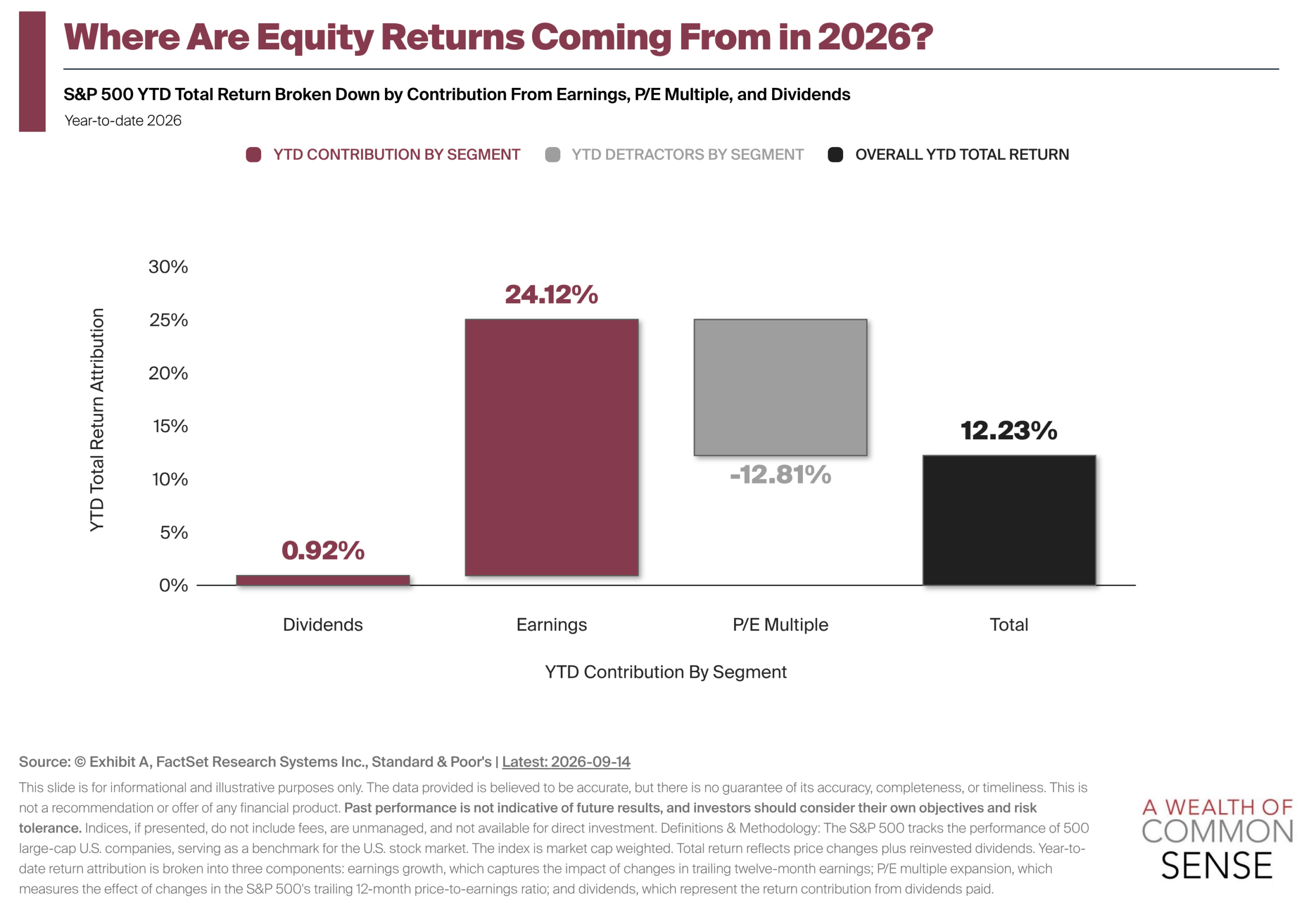
The most interesting aspect of the returns in 2026 is the fact that it’s all fundamentally driven:
Earnings are growing even faster than stock prices which means valuations are actually falling.
So why is this the case?
Here are some questions to consider:
Do investors assume this year’s earnings growth won’t hold up because it’s mainly being driven by hyperscaler spending on the AI buildout?
Are investors worried about higher inflation?
Or is this all because bond yields are up so much this year thus depressing valuations?
It’s likely some combination of the three.
Whatever the reason, it’s fascinating to see such strength in earnings and stock market returns in what feels like a challenging macro environment.
For the time being, it feels like AI is the only thing that matters.
That will last until is stops.
I have no idea when that will happen.
Further Reading:It’s a Concentrated World
This content, which contains security-related opinions and/or information, is provided for informational purposes only and should not be relied upon in any manner as professional advice, or an endorsement of any practices, products or services. There can be no guarantees or assurances that the views expressed here will be applicable for any particular facts or circumstances, and should not be relied upon in any manner. You should consult your own advisers as to legal, business, tax, and other related matters concerning any investment.
The commentary in this “post” (including any related blog, podcasts, videos, and social media) reflects the personal opinions, viewpoints, and analyses of the Ritholtz Wealth Management employees providing such comments, and should not be regarded the views of Ritholtz Wealth Management LLC. or its respective affiliates or as a description of advisory services provided by Ritholtz Wealth Management or performance returns of any Ritholtz Wealth Management Investments client.
References to any securities or digital assets, or performance data, are for illustrative purposes only and do not constitute an investment recommendation or offer to provide investment advisory services. Charts and graphs provided within are for informational purposes solely and should not be relied upon when making any investment decision. Past performance is not indicative of future results. The content speaks only as of the date indicated. Any projections, estimates, forecasts, targets, prospects, and/or opinions expressed in these materials are subject to change without notice and may differ or be contrary to opinions expressed by others.
The Compound Media, Inc., an affiliate of Ritholtz Wealth Management, receives payment from various entities for advertisements in affiliated podcasts, blogs and emails. Inclusion of such advertisements does not constitute or imply endorsement, sponsorship or recommendation thereof, or any affiliation therewith, by the Content Creator or by Ritholtz Wealth Management or any of its employees. Investments in securities involve the risk of loss. For additional advertisement disclaimers see here: https://www.ritholtzwealth.com/advertising-disclaimers
Please see disclosures here.