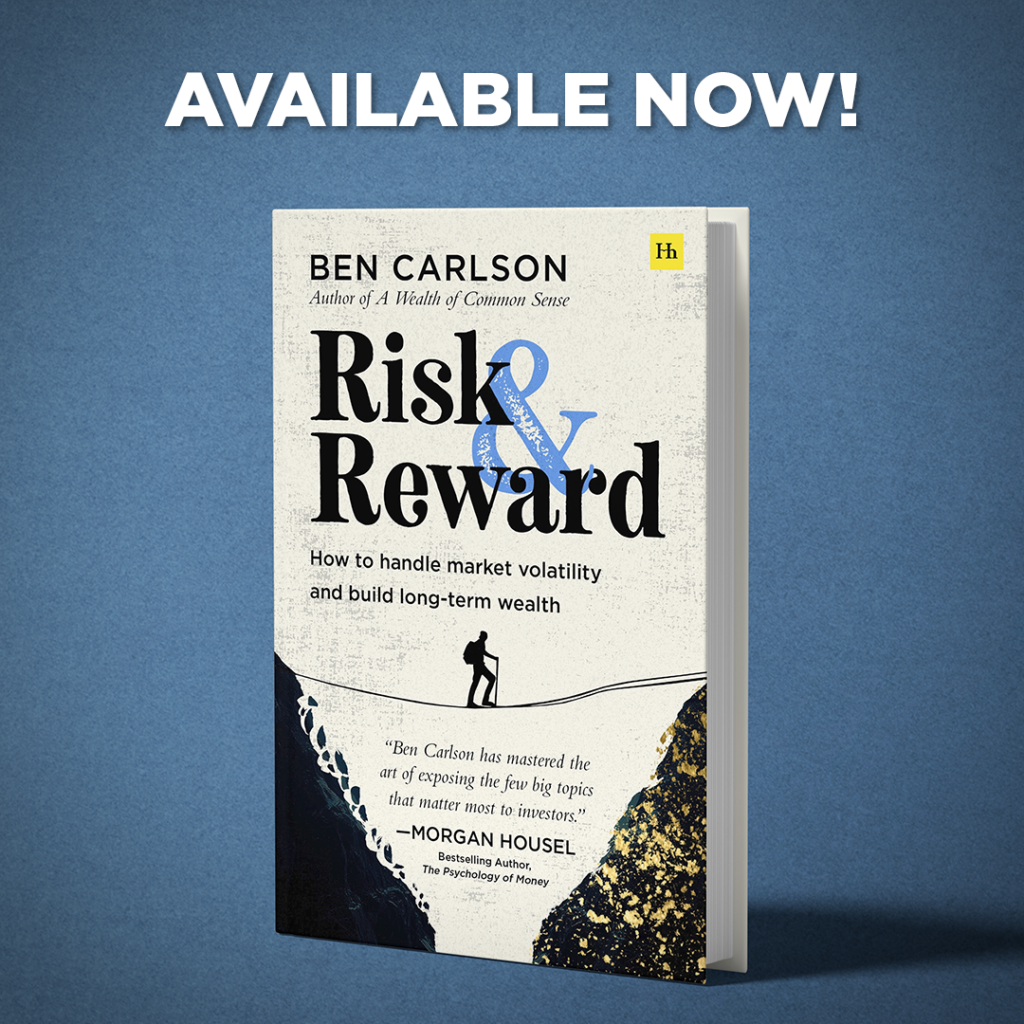
These are some of the craziest economic stats I came across in my research for Risk & Reward:
In modern economic times, prices didn’t start rising on a sustained basis until the 1940s. From 1800 to 1940, prices rose at an average inflation rate of just 0.2% per year, meaning the cost of living was just 28% higher in 1940 than it was at the onset of the 19th century. There were nearly 70 separate periods of deflation, where prices fell.
The worst bout of deflation followed the Panic of 1873, also called the Long Depression, which saw prices fall 40% over the next two plus decades.
I didn’t know much about the Panic of 1873 or the Long Depression outside of these wild numbers.
Why did this happen?
Luckily, there is an excellent new book on the topic by Liaquat Ahamed called 1873.
I’m a sucker for financial history that looks at the booms and busts. This one had it all.
A real estate bubble, a stock market mania, bond market speculation, lax credit standards, bad loans, an innovation boom, smart but dumb rich people and some good old fashioned human nature that led to a spectacular crash and a financial crisis for the ages.
What makes this environment interesting is the fact that it didn’t have to turn into a financial crisis. This could have been a stock and bond market crash followed by a run-of-the-mill recession:
And yet what is also notable, and what makes 1873 so distinctive, is that the immediate economic impact of all the financial turbulence proved to be relatively modest. Though it was being buffeted by one shock after another, the global economy seemed to possess a natural resilience that allowed it to rebound. Of the four major economic powers, only the United States experienced a significant downturn, with a peak-to-trough decline of barely 6 percent in industrial production. While the other great powers–Germany, Britain, and France–experienced a few years of stagnation, none faced any significant decline in industrial production or a deep recession.
At the outset this was a run-of-the-mill recession. But then policymakers intervened and made things much, much worse:
As a result, economic historians now reject the once-common characterization of the aftermath of 1873 as a great depression. In fact, the Crisis of 1873 might have easily gone down in history as just one in the long series of minor setbacks that peppered the nineteenth century, leaving little lasting damage, had the governments of the major economic powers not simultaneously blundered, amid all the financial tumult, into a precipitous and totally unnecessary reordering of the global currency system. This proved to be a self-inflicted wound that generated a giant squeeze in the volume of global liquidity, and it had enormous unintended economic, social, and political consequences that would unfold for decades.
Over the following six years, prices across the world dropped by 20 to 25 percent. In the United States, still in the process of readjusting after the Civil War, the deflation cut even deeper–the prices of wholesale goods plummeted by 35 percent. Though prices would stabilize briefly in the late 1870s and early 1880s, the fall would resume thereafter and continue until the mid-1890s, by which time overall prices had fallen by one-third and wholesale prices by more than one-half.
I know what you’re thinking. Falling prices! What’s not to like?
Well, the bankers — who helped usher in the boom that led to the downturn — cleaned up. Deflation is great for creditors. It was terrible for people who took on debt which were mainly farmers at the time.
Once prices started falling, business profits shrank considerably. That all but dried up investment in new business formation and innovation since there was no incentive to invest. Faith in the economic system crumbled. Pessimism reined. The unemployment rate shot up.
The period from 1880 to 1896 is still considered the longest bear market in history.
It’s easy to see the parallels of the late-19th century with today’s boom.
Most financial historians have already compared the railway bubble with the AI buildout. You also have huge expansion in credit. Speculative behavior. A booming stock market. Loads of rich people. All the usual markers of a good old fashioned boom.
I don’t know if it will lead to a bust but it usually does.
However, I think the bigger risk here could look a lot like what happened following the panic of 1873. A policy error feels like an even bigger risk than a potential economic slowdown and bear market if and when the AI spending boom slows.
Think about the aftermath of the dot-com bubble bursting. The recession lasted just 8 months. GDP fell less than 1%. The unemployment rate went from 4% to 6%, hardly a financial crisis.
Sure, the stock market crashed but that was from excessive speculation in the late-1990s.
Yet the Fed lowered rates as low as they’d been in more than 40 years and lending standards were so relaxed that a housing bubble formed. Policy mistakes from a minor recession led to one of the biggest housing bubbles in history, which helped set the stage for the Great Financial Crisis just a few short years later.
What could that policy mistake look like today?
It could be monetary policy. Or fiscal policy. Or AI policy. Or trade policy. It’s hard to say.
Sometimes policy mistakes happen during the boom times. Sometimes it happens during the ensuing bust.
The financial markets are so intertwined with the economy these days and government policy responses become bigger with every market hiccup.
I don’t know who will be to blame but I am concerned that a policy error could make the next downturn — whenever it happens — even worse.
Michael and I talked about 1873, policy risks and more on this week’s Animal Spirits video, live from Future Proof in Huntington Beach:
Subscribe to The Compound so you never miss an episode.
Further Reading:
How Will This Cycle End?
Now here’s what I’ve been reading lately:
- Ambiguity, hubris and AI (Verdad)
- The ABCs of getting rich (The Everywhere Millionaire)
- Bonds are attractive (White Coat Investor)
- What was the best portfolio of the past 50 years? (Of Dollars and Data)
- Fast time, slow time (History Helps)
- The Jonathan I found (Humble Dollar)
Books: