A lot of people are worried about the impact of artificial intelligence
For good reason.
Here’s something Bill Gates said this week:
“In private, people who understand how good this stuff is, and how much better it’s getting, they’re very worried,” he said. But few tech executives, Mr. Gates said, are willing to publicly admit that. “They’re now saying to each other: ‘Hey, man, don’t say that. It’s bad for us — the next trillion dollars we’re trying to raise.'”
Like everyone else, Gates is most concerned about young people:
I’m especially worried about young people, who will enter a workforce with fewer entry-level openings. They understand the challenge because they are the most active users of AI and see both the capabilities and the rate of improvement. It’s no wonder that so many of them feel negatively about AI.
Fears like this are the reason the public generally has a negative opinion on the technology. It’s not surprise most people dislike AI at the moment.
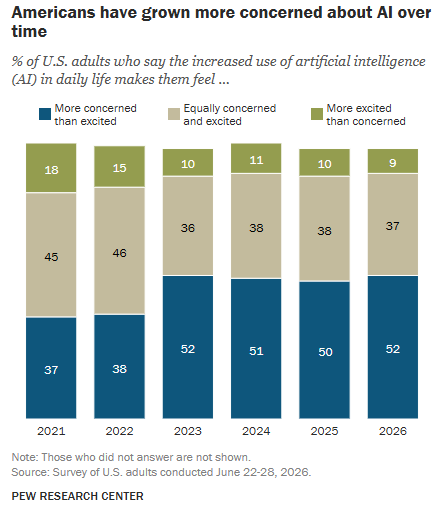
According to Pew Research 52% of Americans are more concerned than excited about the increased use of AI in daily life:
The jobs piece is the one that most people are worried about:
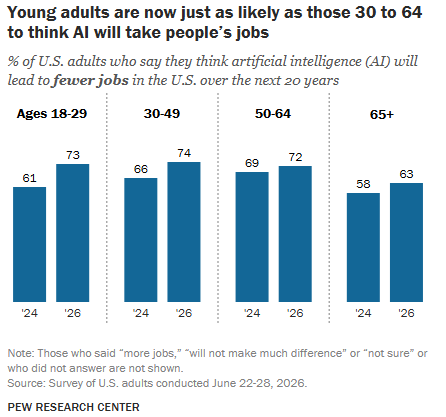
The good news is that AI hasn’t led to a bunch of lost jobs just yet. But most people assume it’s only a matter of time before the robots lead to layoffs.
I speak to a handful of college finance classes every year. I’m on the road once a month or so giving talks. All the questions I get from young people revolve around how they should handle the threat of AI.
My general advice is that you should double down on people skills — communication, sales, creativity, etc. The people who continue to read and write on their own and don’t default to short cuts will be able to stand out from the herd.
But giving this kind of advice to young people often feels hollow. I have no idea how this is all going to play out. No one does!
Should you change professions? Change majors? Stay on the same track? It depends?
The best advice is probably still betting on the stuff that won’t change. The evergreen career advice.
Jerry Seinfeld was on Sebastian Maniscalco’s new podcast We Got Company. They were chatting about how they developed their comedy acts early on.
Maniscalco asked Seinfeld if he had any mentors when he was just starting out. Jerry said, “Jay Leno taught me everything.”
And it wasn’t Leno giving him tips. Seinfeld observed Leno to figure out how to get better:
And when I say taught me I watched how he did it. I watched his dedication and his work ethic. And that the harder he worked, the better he got and the better everything got. Everything gets better when you do your job well. That seems like the most basic lesson of life, right? Everything gets better when you do your job well.
What am I going to do today that I am going to do my job better? Everything that comes out of that is good.
Sure, AI will automate many of the tasks we all currently do now. And the computers don’t need to sleep. But I don’t think hard work is going out of style.
Seinfeld once told Tim Ferriss, “I grasped the essential principle of survival in comedy really young. That principle is: you learn to be a writer. It’s really the profession of writing, that’s what standup comedy is.”
Interestingly enough, Seinfeld’s daughter is now a writer. He explained to Sebastian how he taught his daughter about the writing process:
It’s pretty simple. You don’t have to write but you can’t do anything else. That’s a writing session.
No phone, no music.
If you don’t give it [your brain] anything to do, and you put a problem in front of it, and there’s nothing else to do in that room, it’ll just work on it.
The brain wants to work. It’s like a border collie.
Writing. Reading. Talking. Selling. Building trust. Working hard.
AI is only going to make these things more important because most people won’t do them anymore if there’s an easy button.
Jerry and Sebastian’s entire interview is worth a listen:
Further Reading:
Seinfeld on When Money Became Everything