A reader asks:
I’m a follower of all things RWM so couldn’t help but feel a theme of Ben’s book (namely how difficult it is to beat the market over short periods) seems to contradict the Porterhouse active management strategy the firm just put out. How would you articulate the value of an investment adviser making active decisions for some portion of a client’s portfolio if you simultaneously also believe it’s very difficult to outperform the market? Or is RWM/Franklin Templeton just that good?
Fair question.
I’m going to share some quotes from my book and talk about how they relate to this question about our momentum factor strategy.
But first, let’s talk about momentum as a strategy.
If I’m being perfectly honest, momentum didn’t make sense to me at first. It feels like performance chasing.
Indexing made sense right away. The lightbulb went off after reading my first Bogle book.
Value investing clicked right away. Who wouldn’t want to buy a dollar for fifty cents?
Momentum makes your brain hurt as a rational person. Why would you want to buy more of a stock that’s up 100% in the past 3 months?
My understanding required more research from the likes of Cliff Asness, Meb Faber and Wes Gray before it made sense.
None other than Eugene Fama himself — the father of efficient markets — once wrote:
There are patterns in average stock returns that are considered anomalies because they are not explained by the Capital Asset Pricing Model. The premier market anomaly is momentum. Stocks with low returns over the past year tend to have low returns for the next few months, and stocks with high past returns tend to have high future returns.
Momentum is more behavioral than fundamental.
There’s a laundry list of mistakes and behavioral biases that investors exhibit that cause momentum to exist.
Research shows that investors hold onto losing stocks too long in hopes they will come back to their original price while selling their winners too early. Investors also anchor to recent results, so initially markets underreact to news, events or data releases. On the flip side, once things become apparent, investors herd and overreact, causing an overshoot in either direction. Fear, greed, overconfidence, and confirmation bias can lead investors to pile into winning areas of the market after they’ve risen, or pile out after they’ve fallen.
Basically, momentum tries to benefit from irrational market participants.
The most important thing to understand about implementing a momentum-based strategy is that it must be rules-based to work. You need predetermined rules to buy and sell securities.
Here’s what I wrote in my book about making good decisions ahead of time:
Automating good decisions ahead of time helps take your lesser self out of the equation. A rules-based framework based on pre-established guidelines helps you avoid mistakes in the heat of the moment.
This is especially true of momentum names.
Here’s something else I wrote in the book:
The most important work you can do as an investor is proper preparation. And when it is time to act, it will be because your plan tells you to, not because of some scary headlines or talking head on financial television forcing your hand.
Making it look easy requires plenty of hard work.
We did a ton of work up front on this strategy to take discretion out of the equation once implemented.
The first thing we did when deciding how to turn Josh’s list of best stocks at CNBC into an actual portfolio was to go to the research team at O’Shaughnessy Asset Management to help us codify the rules. You need to automate both buy and sell guidelines because it’s impossible to make sense of fast-moving stocks in the short-run.
Here’s something else I wrote the benefits of having a release valve in your plan:
I know this is blasphemous to certain investment thinkers, but this can be a worthwhile endeavor if your 5-10% “fun” portfolio allows you to stick to a longer-term, set-it-and-forget-it investment plan with the other 90-95% of your capital. Even people on a diet need the occasional cheat day. You just have to size it right so you don’t overdo it.
We have a lot of clients come to us with individual stock portfolios. Many of them have done quite well over the years. But they never know when to sell. It’s a constant state of worry.
What happens if I sell too soon and it keeps going up?
What if I hold on too long and don’t diversify in time?
This is a strategy to give investors an outlet.
I used to have a brokerage account that made up 10% of my portfolio for trading individual stocks and such. The problem is that 10% of my portfolio took up 90% of my mental bandwidth because I was constantly checking the performance.
Josh, Michael and I were the first money into the Porterhouse strategy. We always do that to make sure everything works on the operational front. I put roughly 10% of my portfolio into this strategy. This is the aggressive portion of my investment plan.
And the best part about this being a concentrated factor strategy is that I have more faith to both lean into the pain when it doesn’t work and hold the stocks that are working. That was always the hard part when picking individual stocks on my own.
The momentum factor will experience pain too. It can be a volatile strategy. Just look at the iShares Momentum ETF this year alone:
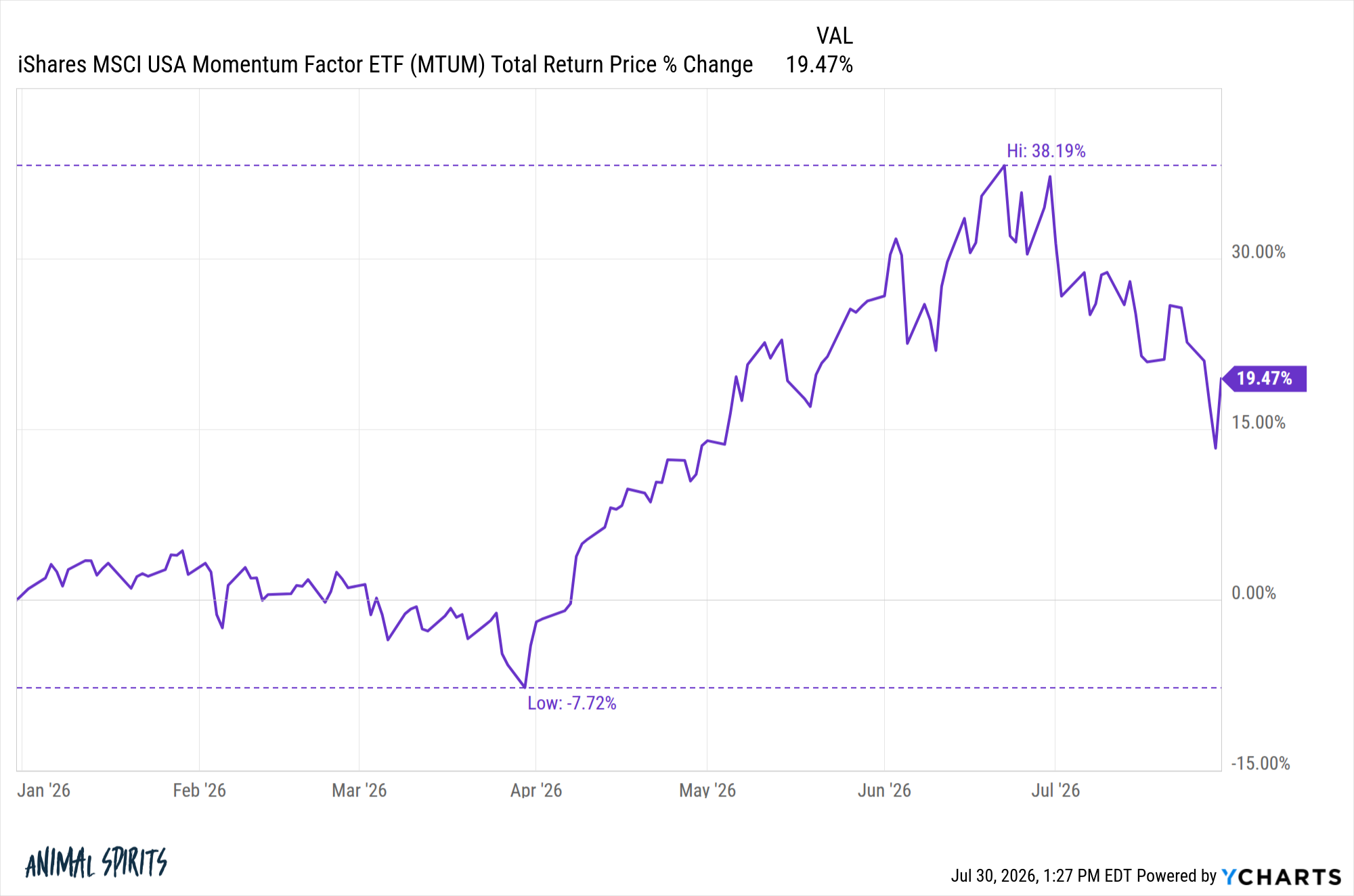
At one point the strategy was down almost 7% on the year. A few short months later, the year-to-date gain was almost 40%. That was followed by a very quick near-20% drawdown. Now momentum is up 20% or so in 2026.
Momentum can be volatile because human emotions are volatile. No pain, no gain.
Here’s one more passage from Risk and Reward:
Investor Josh Wolfe once said, “Failure comes from a failure to imagine failure.” One of the best ways to manage these risks is to avoid having a single point of financial failure be your downfall. You do this in practice through diversification.
I also like momentum for the diversification benefits. Momentum often acts like a complement to more fundamentally based strategies like value or high-quality stocks.
Momentum is also something of a chameleon in terms of the types of stocks it can own over time. Look at this backtest of the changes in sectors over time for Porterhouse:
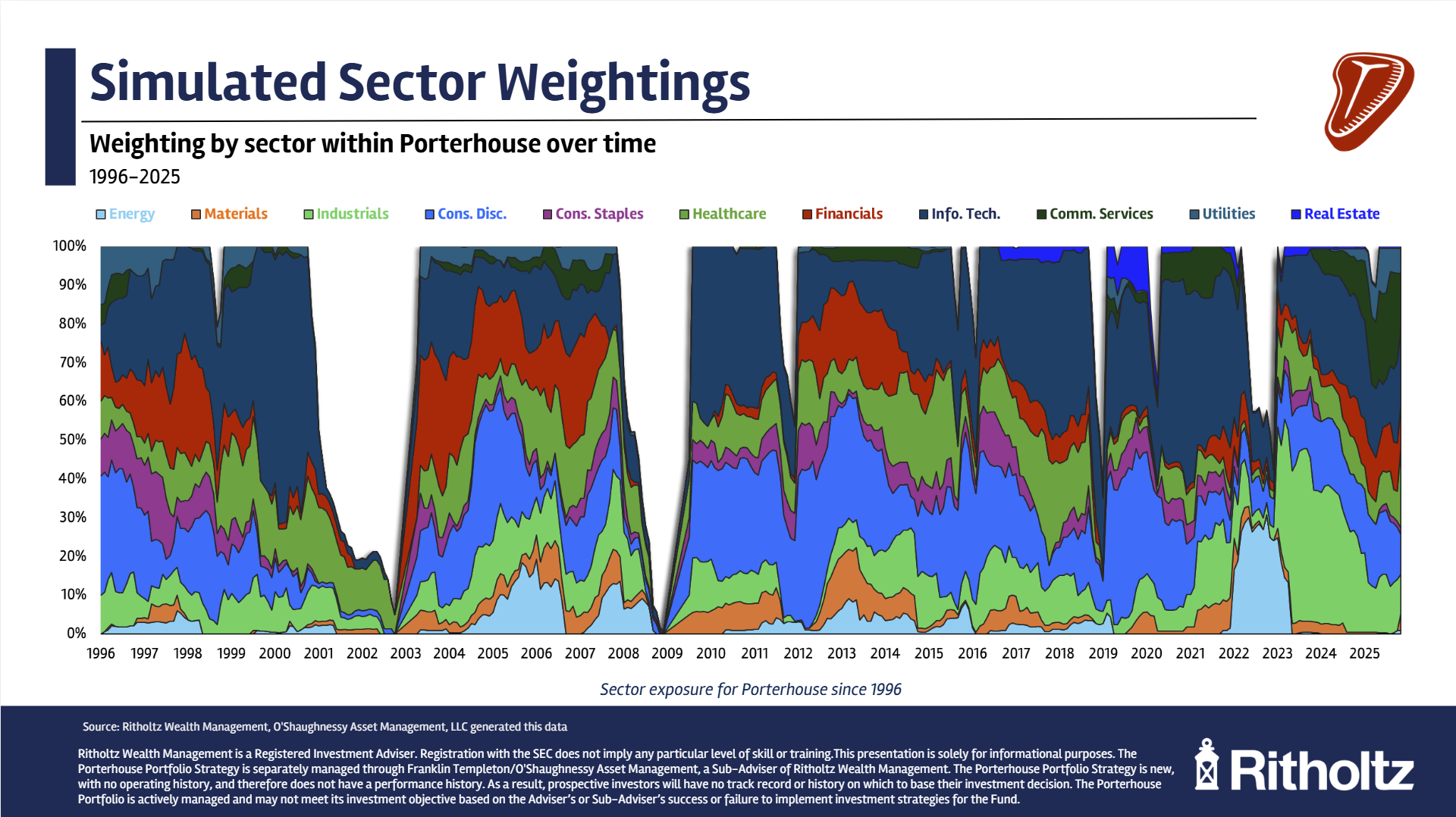
As market leadership changes, so do the underlying holdings. This doesn’t always work but momentum can change its stripes depending on the environment.
Is this strategy guaranteed to work?
No strategy is.
But I like the fact that it’s rules-based, it’s grounded in market psychology and it can offer diversification benefits.
This type of strategy is certainly not for everyone. We’re not putting all of our clients into Porterhouse. Some of them don’t want or need it.
I’ll end with one final excerpt from my book:
You have to figure out the right speed for your investments. The true perfect portfolio is the one you can stick with come hell or high water. And perfect is the enemy of good. The good strategy you can stick with is decidedly better than the perfect strategy you can’t stick with.
Adding more diversified streams of investment returns helps me stick with my plan because I want to be prepared for a wide range of market environments.
Josh Brown joined us on Ask the Compound this week to cover this question:
We also answered questions about Shake Shack, when to lighten up on stocks, dealing with a large inheritance and how to teach people about making wise investment decisions.
If you want to learn more about Porterhouse, click here.
Further Reading:
Why we launched the Porterhouse strategy