A reader asks:
Came across the Capgemini 2026 Wealth Report (as of 2025) and was really surprised by the number of millionaires (25,300,000) mentioned with $1 million in investable assets. And I remembered reading one of your blog posts (House Rich Millionaires) from late last year in which 1 in 5 Americans were millionaires. Capgemini is essentially saying there’s 8.73 million people in the US with $1 million in investable assets. Does $1 million in investable assets still make you rich in the US? How much do you think you need to be rich?
I’m a sucker for these millionaire studies.
Let’s go through a bunch of them to see what the numbers say.
This is from the report in question:
- The population of global millionaires surged 7.9% to 25.3 million in 2025.
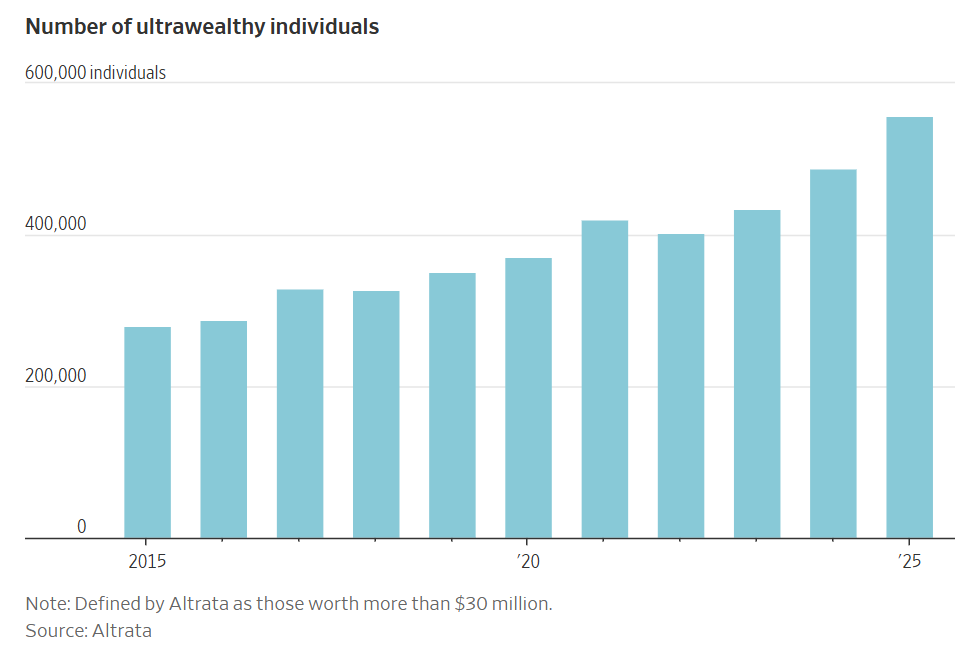
- Ultra high net worth = $30 million or more. This group makes up 1% of the millionaire population but 35% of millionaire wealth (there’s even inequality among rich people!).
- The U.S. added 730,000 new millionaires in 2025, bringing the total U.S. millionaire population to 8.73 million, according to the report.
To clarify — these numbers only include liquid net worth, meaning no home equity. There is $35 trillion in home equity in America right now so it makes a difference.
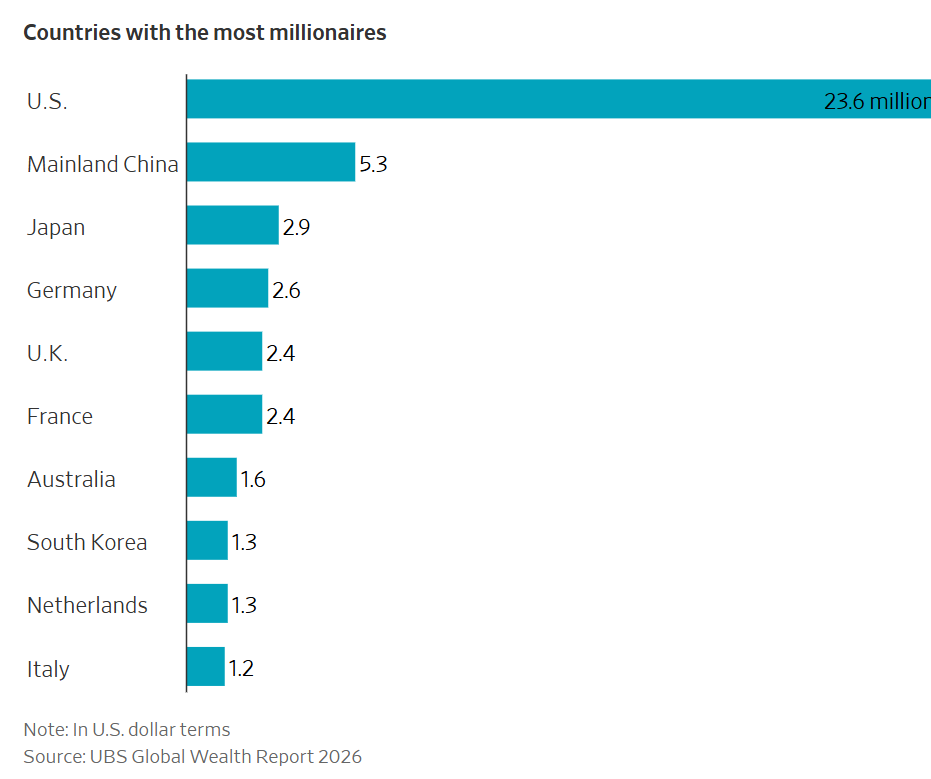
Housing wealth makes the number of millionaires in the United States jump from around 9 million to 24 million.
Using data from UBS, The Wall Street Journal shows nearly 24 million millionaire households right now in America, by far the most of any country:
Some more stats from this millionaire report:
- Over 440,000 people–or more than 1,200 a day–became millionaires in the U.S. in 2025.
- The fastest-growing segment globally, rising at a 7.3% clip over the past five years, were those with $50 million to $100 million in wealth.
The Journal also shows the ranks of the ultrawealthy ($30 million or more) have grown considerably in recent years:
That’s a lot of really rich people.
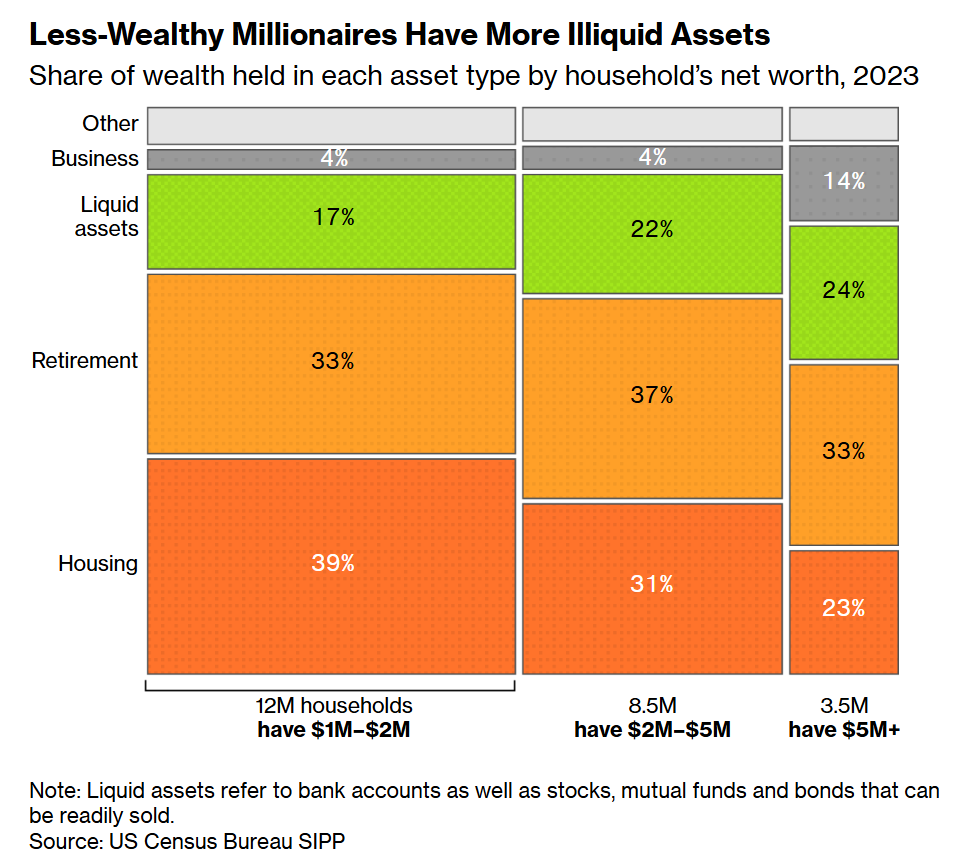
My House Rich Millionaires piece used data from a Bloomberg report.
That data also showed 24 million millionaire households in America which is around 1 in 5 households. One-third of this group has become a millionaire in the past 8 years.
However you slice and dice it, there are a lot of millionaires in America these days:
So is $1 million enough money to make you rich?
Having $1 million in liquid net worth would put you in the top 1% globally. It puts you in the 88th percentile of American households.
A million dollars is still a lot of money. Whether or not it makes you rich depends.
Where do you live? A million dollars goes further in Topeka or Des Moines than Manhattan or San Francisco.
How old are you? A million dollars in your 40s means a lot more than than a million dollars in your 60s.
What’s your burn rate? In The Algebra of Happiness, Scott Galloway writes:
The definition of “rich” is having passive income greater than your burn. My dad and his wife receive about $50,000 a year from dividends, pension, and Social Security, and spend $40,000 a year. They are rich. I have a number of friends who earn between $1 million and $3 million, with several children in Manhattan private schools, an ex-wife, a home in the Hamptons, and a lifestyle fitting of a master of the universe. They spend most, if not all, of it. They are poor.
It depends how much your lifestyle costs.
How many rich people are around you. It’s easy to be rich but not feel rich when you’re constantly around other wealthy people.
What does a rich life look like for you? This one is obviously subjective but by far the most important when it comes to the definition of wealth.
There are people with boatloads of money who aren’t actually rich.
There are people who wouldn’t be considered wealthy in net worth terms but have a rich life in other ways.
Round numbers don’t always tell the whole story.
I covered this question in detail on an all new episode of Ask the Compound:
Bill Sweet hopped on the show this week to help us celebrate the 4th of July and answer questions from our Compound audience about saving priorities when you have a kid, the finances of running a small business, how real estate fits in your asset allocation and when to sell stocks to buy a house or condo.
Further Reading:
House Rich Millionaires