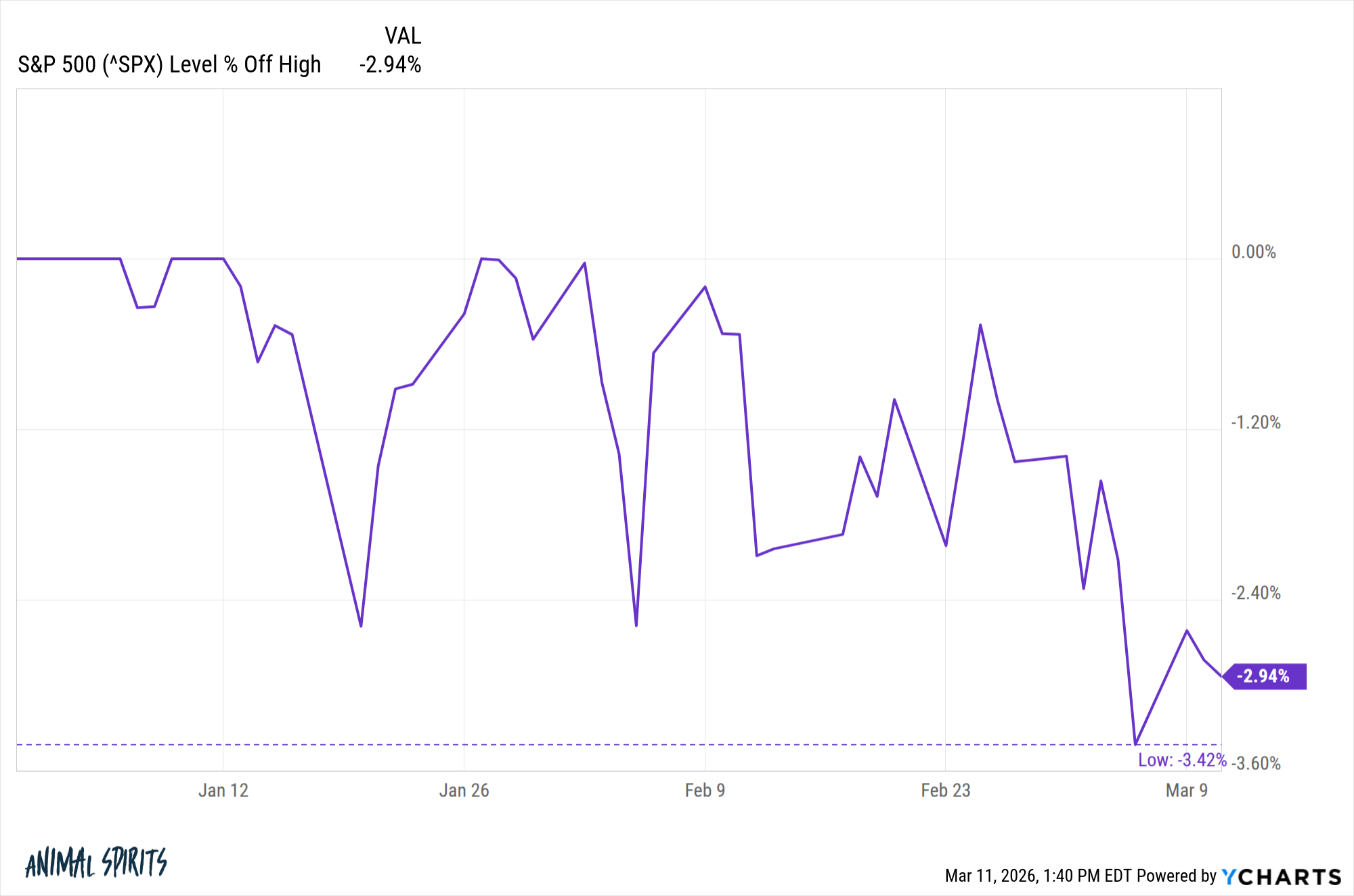
These are the worst peak-to-trough drawdowns every year in the 2020s for the S&P 500:
2020: -33.9%
2021: -5.2%
2022: -25.4%
2023: -10.3%
2024: -8.5%
2025: -18.9%
For 2026 it’s just -3.4%.
That’s surprising, right?
The year is still young but we have the Iran war going on, spiking oil prices, higher prices at the pump, geopolitical uncertainty, the software sell-off and more.
Yet the market has been resilient. The S&P 500 is currently down around 1% on the year.
What gives? Why won’t the stock market fall more in the face of all the scary headlines?
The stock market is often counterintuitive. It’s forward-looking. The short-term doesn’t always make sense. Sometimes it’s a teflon market.
It’s possible investors are trying to avoid overreacting if this conflict is resolved in short order.
Investors have also become accustomed to ignoring geopolitical headlines that don’t have a long-lasting impact on corporate profits or the market as a whole.
For years, this idea has been beaten into the investor psyche. This could be supremely rational behavior. Fool me once…and so on.
Of course, it’s also possible this could lead to a Minsky moment where investors become too complacent and that leads to an even greater overreaction down the line.
Trying to base your investment views on how you think other investors could over- or under-react to the news of the day is akin to the game of wits in The Princess Bride:
Inconceivable!
Thinking through why markets will rise or fall in the short run can be an intellectually stimulating exercise but it’s not something that’s helpful to your investment process on a consistent basis.
The stock market will fall eventually. The reason won’t matter as much as you think. That correction will end at some point. Life will go on.
This is just what happens in the stock market.
Barry Ritholtz joined me on Ask the Compound this week to discuss the teflon stock market, investor overreactions, the TACO trade, Fed rate cuts and more:
Blair duQuesnay also came on the show to answer questions about when to quit your job and how to deal with the tax ramifications of concentrated stock positions.
A Wealth of Common Sense is a blog that focuses on wealth management, investments, financial markets and investor psychology. I manage portfolios for institutions and individuals at Ritholtz Wealth Management LLC. More about me here. For disclosure information please see here.
Get Some Common Sense
Categories
Get a Full Investor Curriculum: Join The Book List
Every month you'll receive 3-4 book suggestions--chosen by hand from more than 1,000 books. You'll also receive an extensive curriculum (books, articles, papers, videos) in PDF form right away.