A reader asks:
Do you think we’ll finally see housing prices fall in 2026? Redfin says there are way more sellers than buyers and people with 3% mortgages can only hold on for so long. I know prices don’t fall very often but it seems like a softening labor market mixed with sky-high prices could finally make it happen. What say you Ben?
If you had told me back in early-2022 that mortgage rates would go from sub-3% all the way up to 8% and stay above 6% for 3+ years I would have assumed housing prices would have fallen by now.
Nope.
Prices just keep going up.
According to Robert Shiller’s housing data, prices were up 6% in 2023, 4% in 2024 and nearly 2% (so far) in 2025.
However, I think you could make the case that buyers are finally fighting back a little and saying enough is enough.
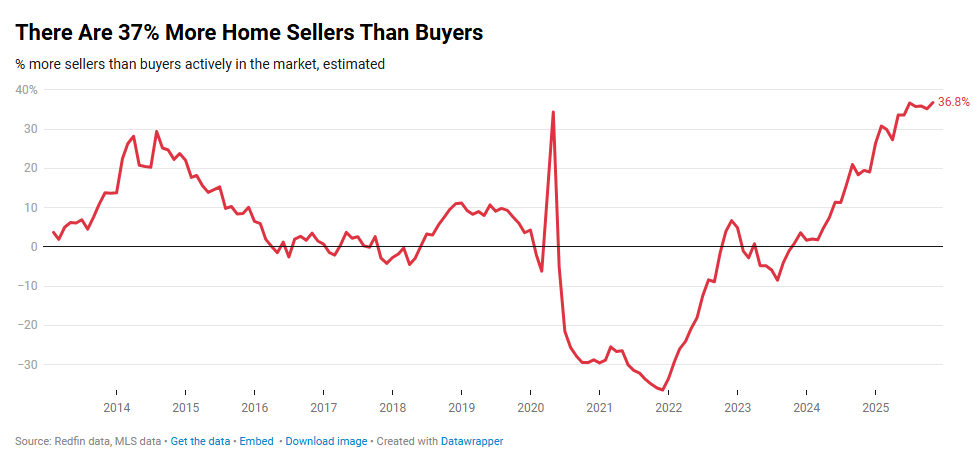
Redfin data estimates sellers outnumber buyers by a substantial margin:

The Wall Street Journal says homebuilders are struggling to offload new homes despite the fact that they’re offering much lower mortgage rates:
America’s biggest builders are struggling to sell homes even when they offer buyers a 4% mortgage. Their experience suggests rate cuts alone won’t be enough to boost weak sales in the wider housing market.
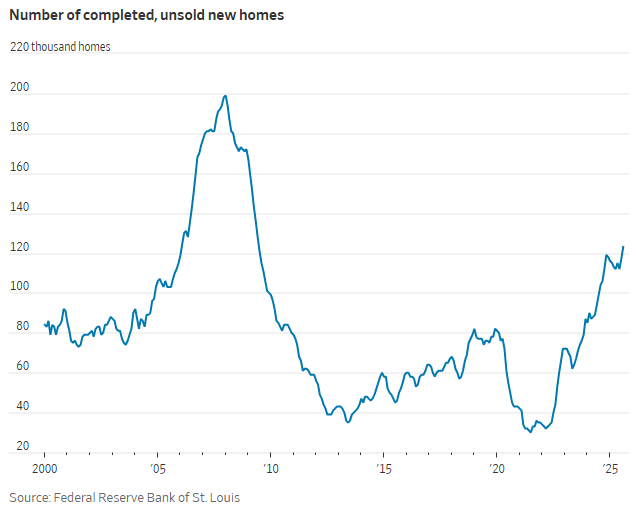
The number of completed but unsold new homes has reached levels last seen in the summer of 2009, data from the Federal Reserve Bank of St. Louis shows. At the end of last year, builders were confident that sales would recover in 2025 and built tens of thousands of units to have enough supply for the spring-buying season. But demand didn’t pick up, and more homes sat unsold.
The number of new, unsold homes is climbing fast:
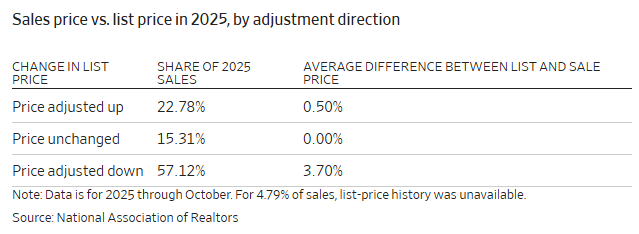
And the houses that are selling are now seeing markdowns. NAR data shows that nearly 60% of houses sold in 2025 came with at least one price cut.
So why aren’t housing prices falling more?
One reason is nationwide housing prices simply don’t fall that often:
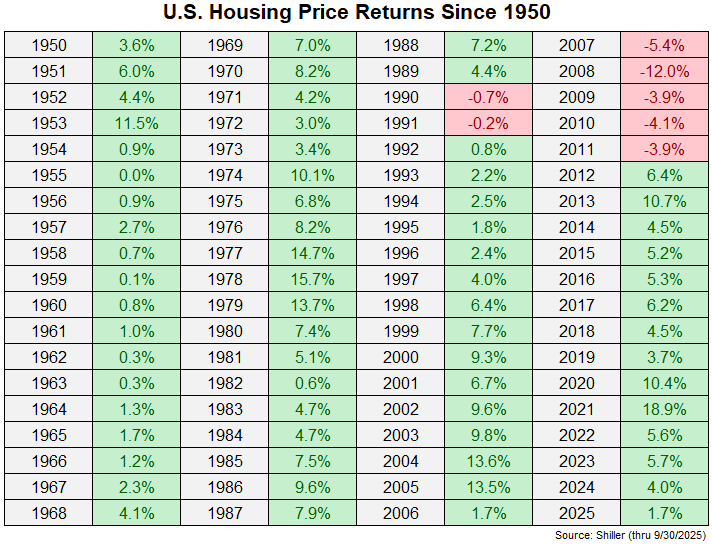
Prices have fallen on a nominal basis just 7 times out of the past 76 years. And those 7 down years were clustered into two distinct financial crises — the savings and loan crisis of the early-1990s and the Great Financial Crisis.
And while prices crashed more than 25% in the 2008 debacle, the 1990 downturn was a drawdown of a little more than 2%.
There were 11 recessions in this 76 year time frame since 1950 so even when there’s a recession it’s highly unlikely that home prices will fall.
Housing prices don’t fall on a sustained basis that much. If you’re holding out hope for a crash, you might be waiting a very long time.
HOWEVER, this is nationwide prices.
Everyone knows housing is local. In certain parts of the country, housing prices are already falling.
Lance Lambert shows that there are parts of the country where median home prices are dropping, substantially in some cases:
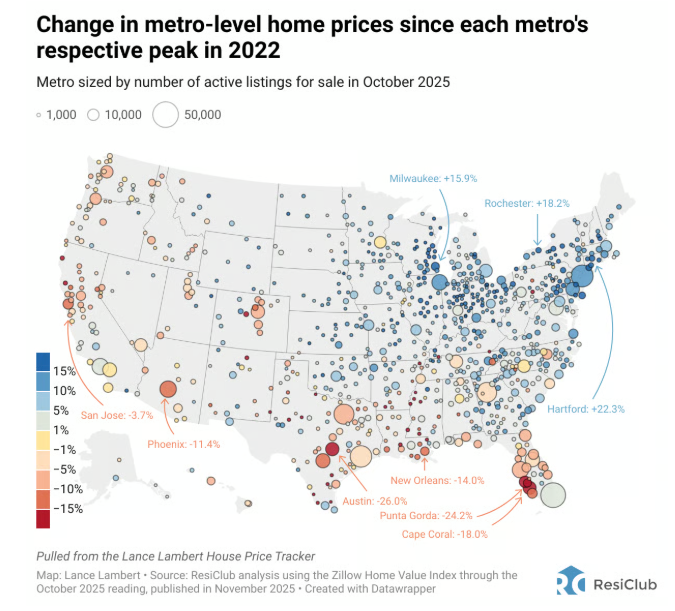
Housing markets in the south are seeing some decent-sized housing price corrections. Places like Austin (-26%), Cape Coral (-18%) and New Orleans (-14%) are sitting on double-digit downturns.
It’s also true that the regions with the biggest price declines experienced the biggest price booms earlier in the decade. From 2020 through the summer of 2022, housing prices rose by around 70% in both Austin and Cape Coral. But it’s good news some of the excesses are being worked off in these areas.
Some sanity has re-entered the market in certain places.
This decade has been unpredictable in many ways so I’m not sure it even makes sense to make this kind of forecast over a one year period.
My base case would be housing prices will probably stagnate to allow incomes to play catch-up but a minor downturn in prices wouldn’t surprise me if mortgage rates stay above 6%.
Falling mortgage rates could unlock demand from buyers sitting on the sidelines. But what if those borrowing rates are falling because the economy is slowing or going into a recession?
Even if there is some sort of correction in the near-term it’s hard to make the case for an all-out crash.
You still have a demographic tailwind when it comes to housing demand where the biggest age bracket in the U.S. is in their prime homebuying years:
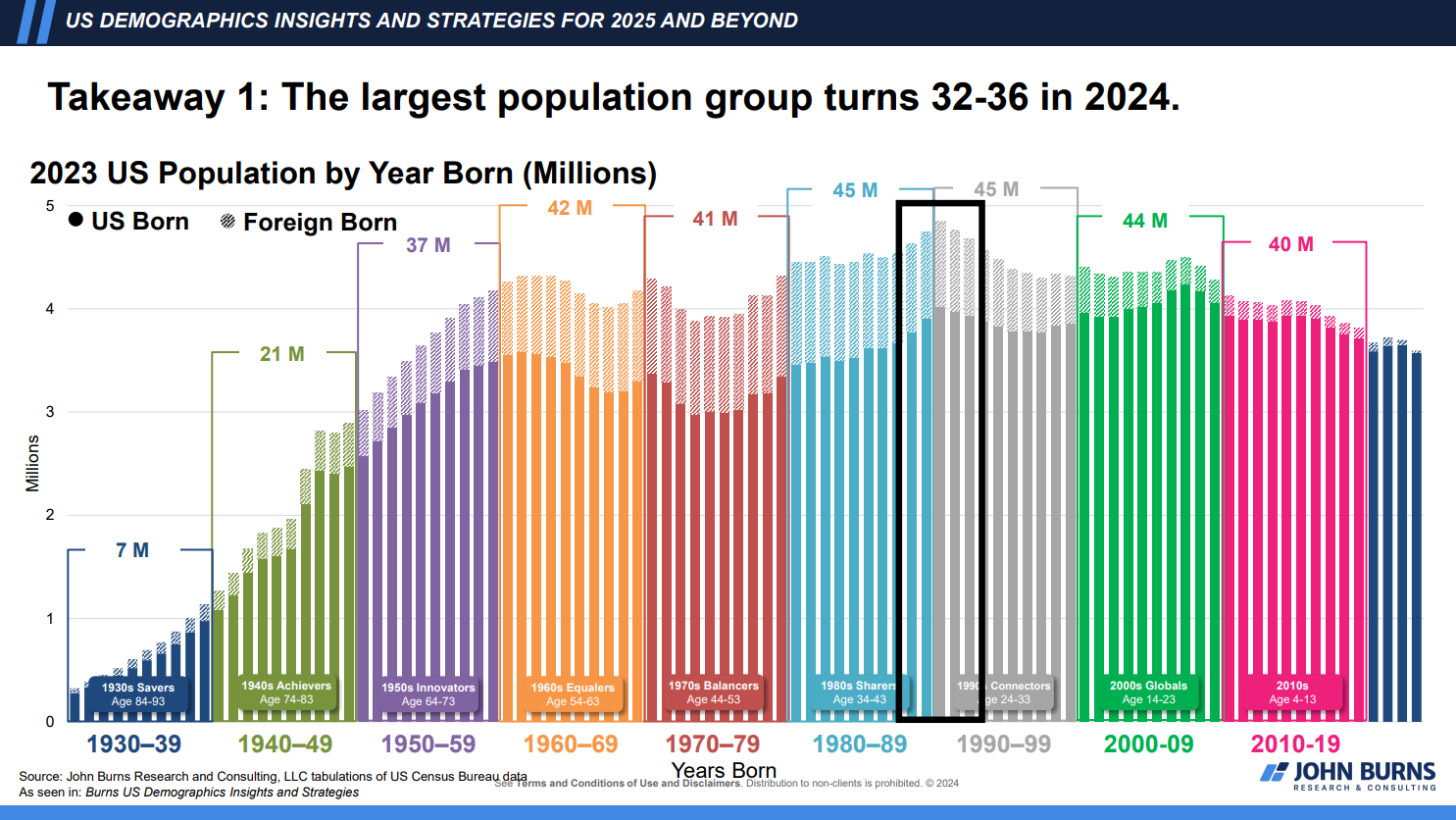
It wouldn’t shock me to see prices fall because they rose so fast but I would be surprised if housing prices crashed.
I went in-depth on this question on the latest edition of Ask the Compound:
Bill Sweet joined me for our 200th episode (!) to answer questions about the beauty of Roth IRAs for early retirement, how Gen Z saves, how to handle the risks of retirement planning and how servicemembers should manage their money.
Further Reading:
4 Questions About the Housing Market