Paul Tudor Jones was on CNBC this week predicting a melt-up in stocks:
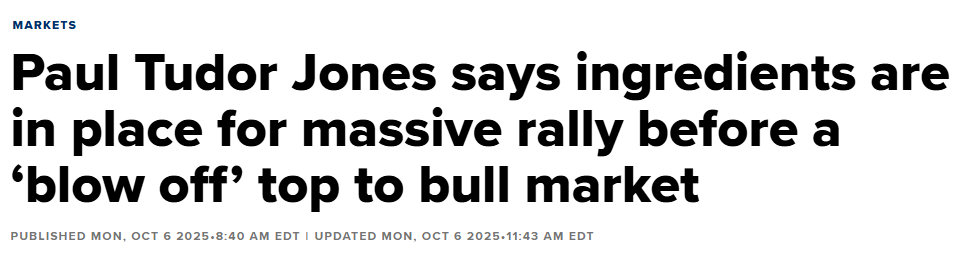 Here’s what he said:
“My guess is that I think all the ingredients are in place for some kind of a blow off,” Jones said Monday on CNBC’s “Squawk Box.” “History rhymes a lot, so I would think some version of it is going to happen again. If anything, now is so much more potentially explosive than 1999.”
Call it a bubble or a mania or a boom or something else but it feels like we’re entering a new phase in this cycle.
I know plenty of people will say I’ve seen this movie before and I know how it ends but I have more questions than answers about how this whole AI boom will play out.
How do you make forecasts in a bubble? Here’s how to never be wrong in a bull market:
I see a melt-up before an eventual crash.
Translation: stocks go up and they go down.
The pundits will make predictions that allow them to be right either way. Melt-up I win, crash you lose. Don’t fall for it.
What’s the worst-case AI outcome? Allow me to present two potential outcomes from the AI spending boom:
Scenario #1. The tech giants spend hundreds of billions of dollars more than necessary and it takes longer for the AI ROI to come through. This leads to a nasty bear market.
Scenario #2. The AI investments pay off. The ROI occurs in short order. AI immediately makes businesses more efficient which allows them to layoff millions of white collar workers.
Which scenario is preferable? Which one is worse?
There are obviously other outcomes here but AI has the potential to make things uncomfortable for a lot of people one way or another.
This technology can make us all far more efficient but the transition period of getting from here to there is going to be messy.
It’s odd to think that an AI bubble that doesn’t pop could end up being even more painful for certain people.
Could an AI bust lead to a recession? Joey Politano has a great chart that shows how large AI-related investments are to the U.S. economy:

This isn’t just a stock market story anymore. The AI spending binge is having a real impact on economic growth.
Let’s say the AI bubble does pop. The Mag 7 companies spend a few hundred billion dollars more than is necessary and they have to pull back.
Is that the start of the next recession?
The last 15 years has shown the U.S. economy is dynamic. Every time a risk pops up something steps in to keep the train running.
When the pandemic hit it was government and consumer spending. When inflation hit it was the AI boom.
Can anything step in if the AI spending slows drastically?
My only guess would be the housing market if mortgage rates fall enough but that might be too hopeful.
It sure feels like the stock market and economy are overly reliant on the AI trade right now.
Can anyone predict the end of this thing? I wrote a post in 2015 (!) called Is This the Top? because so many people were questioning how much the bull market had left in the tank at that point.
Are we in the 8th or 9th inning right now?
The future is always unknowable but the outcomes often feel more binary during boom times.
There are no handbooks for how to pick the top during a boom. There’s no foolproof signal that tells you when to exit stage left.
For instance, the average forward price-to-earnings ratio for the S&P 500 since 1990 is 16.5x. Here’s a look at the forward PE at the peak before every bear market in that time:
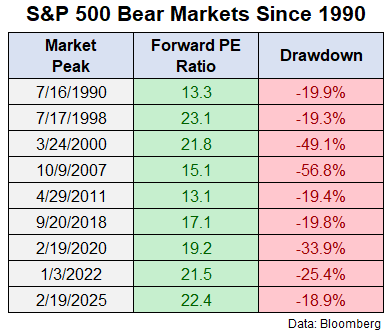
Sometimes it’s well above average but we’ve also experienced bear markets from below average valuations. And it’s not like the stock market hits a line in the sand and goes down immediately.
Look at how many times it looked like valuations had peaked during the dot-com bubble in the late-1990s:
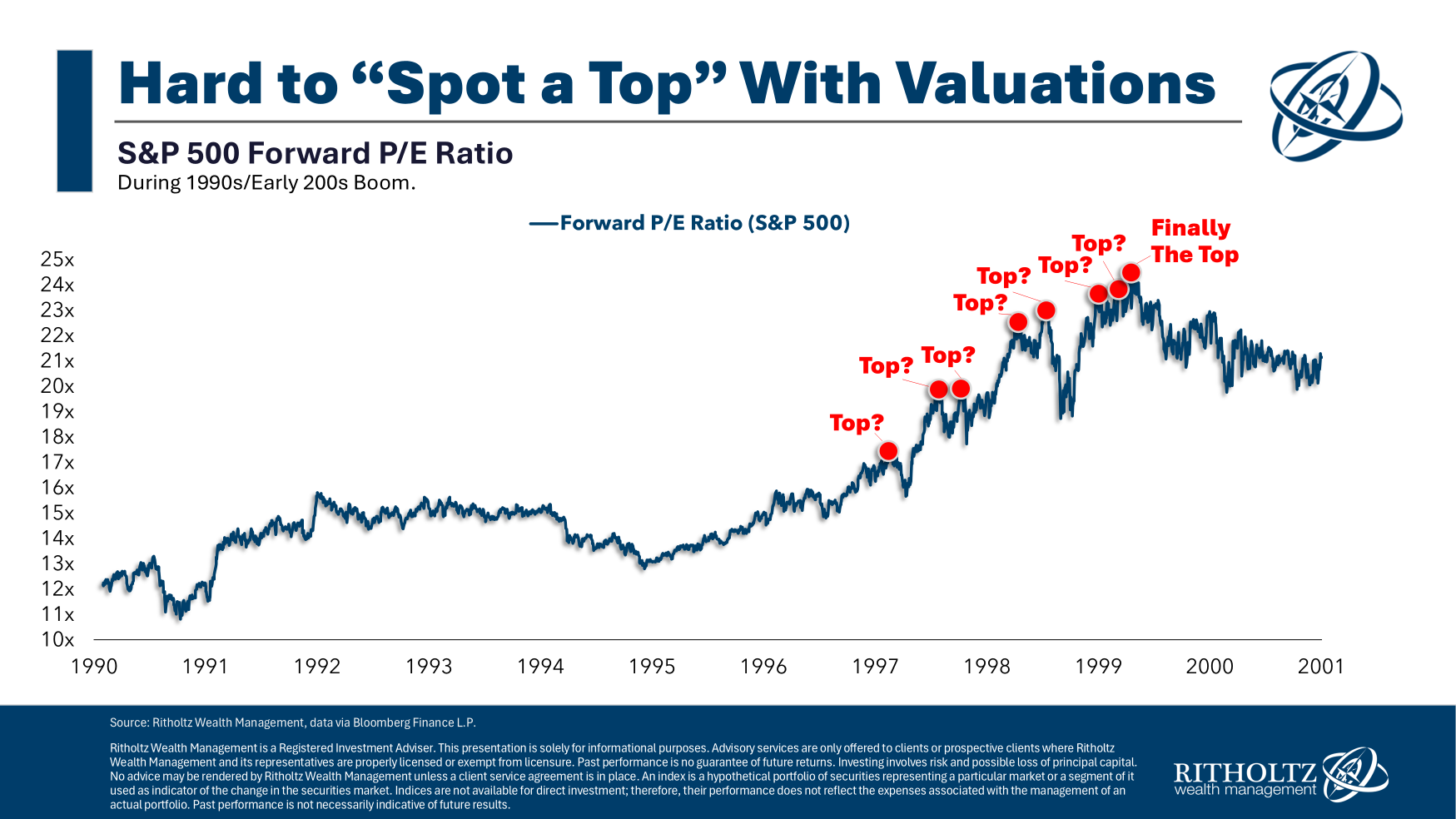
Calling the top is next to impossible because emotions matter more than numbers in the short-run. People are driven by narratives in an innovation boom not data.
The truth is no one is going to predict when the current cycle comes to an end. And if someone does it will be pure luck that they will be chasing for the rest of their career.
Every cycle comes to an end eventually but you’re far better off preparing for a wide range of results rather than predicting when the market will turn.
Investing would be a whole lot easier if you knew when the tops and bottoms would occur in advance. In lieu of a crystal ball, I diversify and invest for the long-run.
Michael and I discussed the AI boom from a million different angles and much more on this week’s Animal Spirits video:
Subscribe to The Compound so you never miss an episode.
Further Reading:
How Do You Invest in a Bubble?
Now here’s what I’ve been reading lately:
- Creating wealth for other people (Of Dollars and Data)
- The cash on the sidelines fallacy (Spilled Coffee)
- How to measure your wealth wisely (A Teachable Moment)
- Real estate vs. traditional portfolios (Flow Financial)
- Four years of walking the world (Chris Arnade Walks the World)
- There are few rest-of-your-life decisions (The Imperfectionist)
Books: