The Wall Street Journal says the middle class is getting pessimistic about the economy:
The middle class–generally considered to include households making roughly $53,000 to $161,000 a year–is playing an outsize role in that waning optimism. After months of tracking high-income earners’ increasing confidence about the economy, households making between $50,000 and $100,000 made an abrupt about-face in June. They now more closely resemble low-income earners’ gloomier views, according to surveys done by Morning Consult, a data-intelligence firm.
Here’s a chart that breaks down sentiment by income levels:
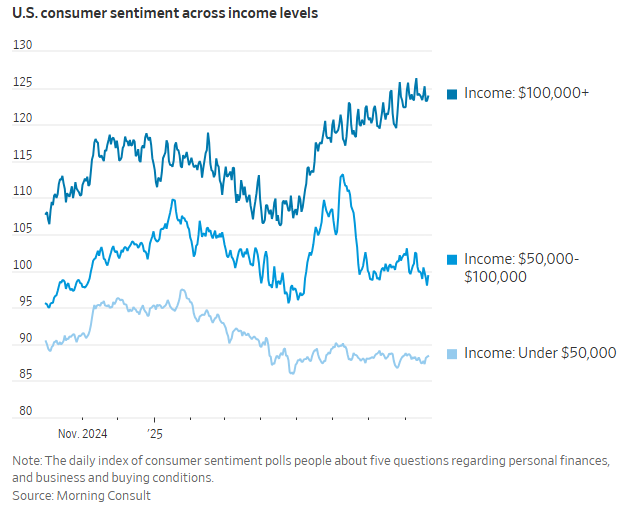
You can quibble with their definition of middle class but the thing that stands out to me is how volatile these numbers are. Sentiment crashes then shoots higher then crashes again.
I’m not sure we can trust these surveys anymore.
Here’s another one from the WSJ that asks people if they have a good chance of improving their standard of living:
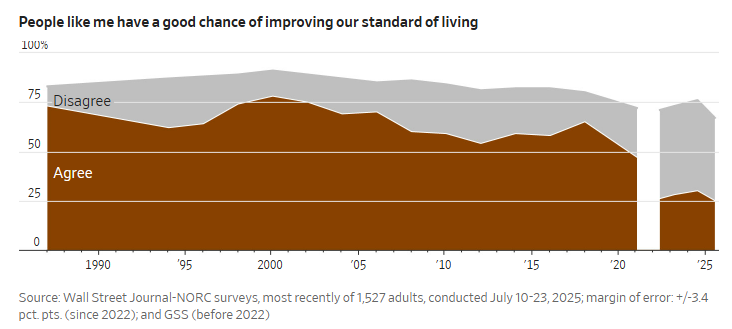
The article says people are losing faith in the idea that they can get ahead through hard work.
Maybe things are harder today than they were in the past. In some ways, they probably are. In other ways, things are far easier.
But look at the trend in this survey over time. It was already going downhill…and then Covid hit and it crashed. I contend some combination of social media and our collective experience during the pandemic has broken the vibes for good. We can’t trust these sentiment indicators anymore. They’re far too noisy.
Two Stanford researchers have a model that looks at how the economy is performing versus the perception of the economy through sentiment readings. The two used to track closely. Not anymore:
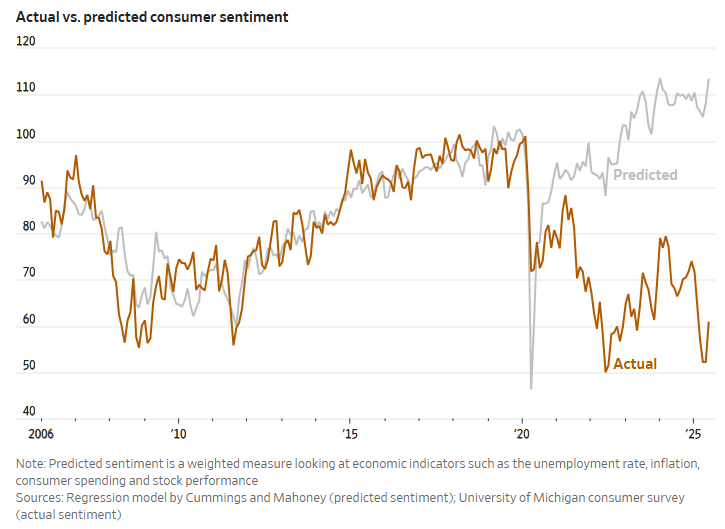
This is from the story:
“The gap is staggering,” Mahoney said of the separation of sentiment from the solid economic metrics. One factor fueling the gap recently, he said, has been the stock market boom–“which has historically translated into stronger sentiment. But not on this occasion.”
You have to watch what people do not what they say. People say a lot of stuff on the internet that doesn’t match reality.
Roger Lowenstein wrote an op-ed in the Journal about American exceptionalism. He says last year one out of every 24 household registered a new business application. You don’t start a new buisness if you’re worried about the future or hard work.
Look at this chart:
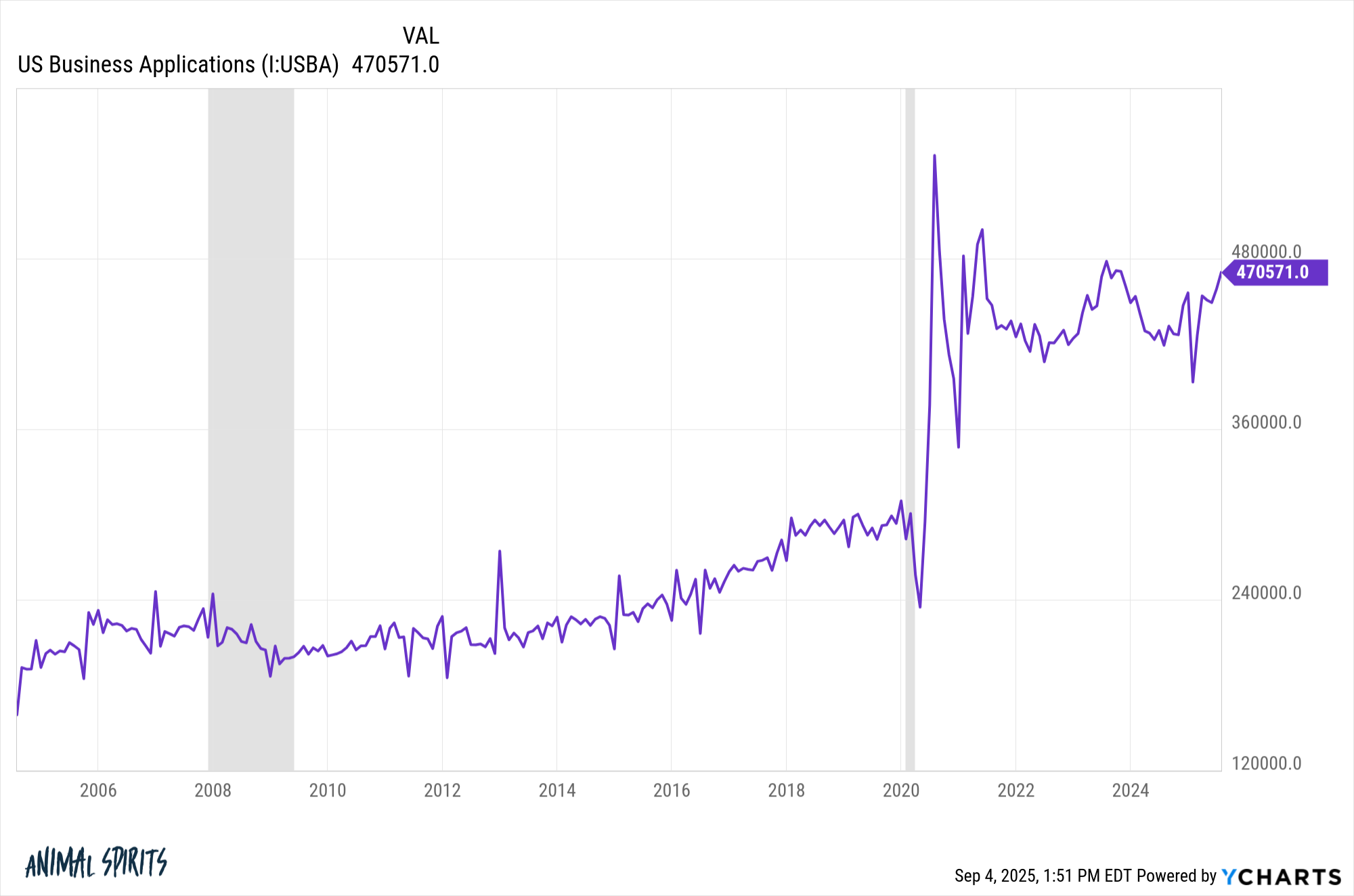
New business applications have exploded since the pandemic while sentiment has dropped to the floor.
Which one should we trust more — people’s feelings or their actions?
Gallup shows the number of households who own stocks continues to rise:
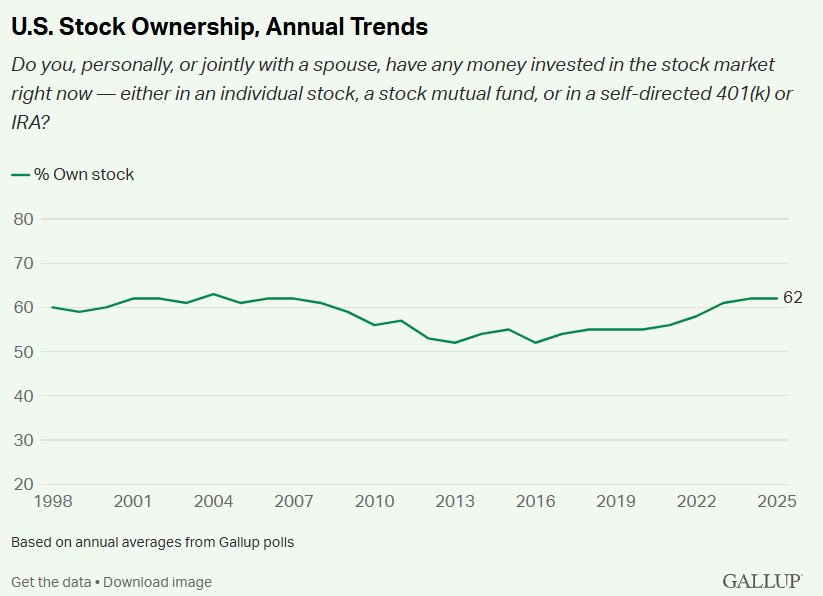
The increase in the 2020s has been substantial, going from 55% in 2019 to 62% now. Would more people be investing in the stock market if they thought things were going downhill from here?
People say they are pessimistic about the future. Their actions don’t match their words.
Don’t trust the vibes. They’re broken.
Maybe for good.
Michael and I talked about seniment readings, American exceptionalism and much more on this week’s Animal Spirits video:
Subscribe to The Compound so you never miss an episode.
Further reading:
The News is Making You Miserable
Now here’s what I’ve been reading lately:
- Market concentration isn’t new (Chart Kid Matt)
- Should your investing change when you get wealthier? (Oblivious Investor)
- Life isn’t a spreadsheet (Spilled Coffee)
- Run your own race (OptimistiCallie)
- Choose your f*cks wisely (Contessa Capital)
- Is there more to life than this? (More to That)
- The enduring legend of Philip Seymour Hoffman (The Ringer)
Books: